The Great Intellectual Divide
The conflict between Arius and the orthodox party, spearheaded by Athanasius of Alexandria, stands as one of the most significant intellectual and theological battles in Western history. It was not merely a dispute over words, but a fundamental disagreement on the nature of reality and the relationship between the Creator and the Created.
To determine if Arius was “wrong,” we must look through three distinct lenses: logical consistency, theological tradition, and linguistic nuance.
Logical Consistency: The Arian Strength
From a purely syllogistic perspective, Arius held the high ground. His argument was built on a linear, common-sense understanding of paternity:
- If a Father begets a Son, the begetter must precede the begotten.
- Therefore, there was a time when the Son was not.
- If the Son has a beginning, he cannot be co-eternal with the Father.
This logic protected the absolute oneness of God (monotheism) from appearing to be split into multiple parts. For many in the 4th century, this was the most rational way to interpret the scriptures.
Theological Tradition: The Orthodox Counter-Argument
The orthodox party did not necessarily argue that Arius’s logic was “bad”; they argued it was insufficient. Their concern was not formal logic, but Soteriology (the study of salvation).
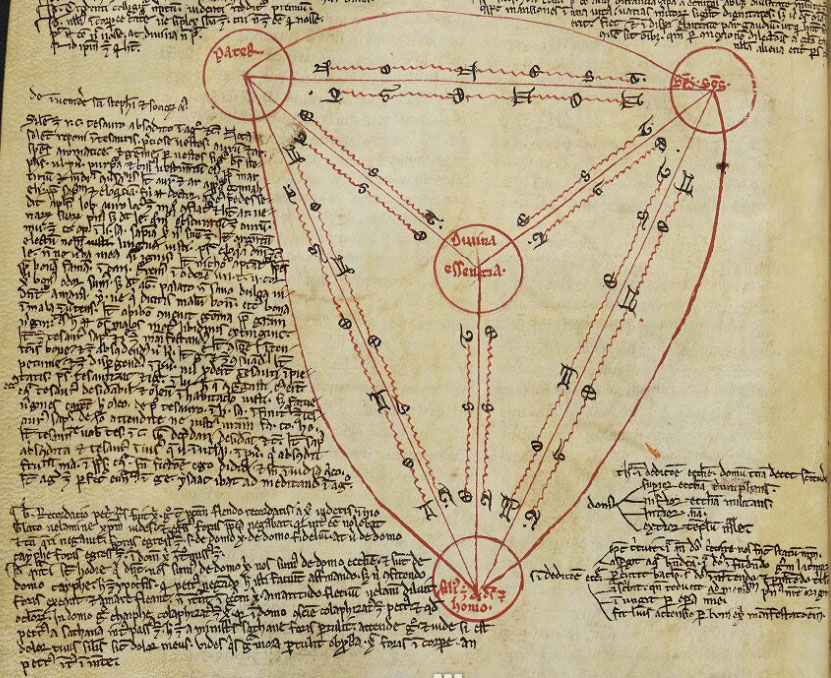
If Jesus were a created being—even the most perfect one—he could not bridge the gap between a holy God and humanity. The Council of Nicaea (325 CE) eventually adopted the term homoousios (of the same substance) to describe the relationship.
Image of the Shield of the Trinity diagram
Linguistic Nuance: The Battle of Terms
The entire debate often hinged on the Greek word monogenes. While Arius translated this as “only begotten” (implying a point of origin), the orthodox party argued it meant “unique” or “one-of-a-kind.” This linguistic ambiguity allowed both sides to use the same scriptures to reach opposite conclusions.
Conclusion
Was Arius wrong?
- By Logic: No. His reasoning was consistent with human observation.
- By Theology: Yes, according to the institutional Church. His view was seen as undermining the divine power required for human salvation.
Ultimately, the defeat of Arianism marked the shift from a strictly “rational” monotheism to a “mystical” Trinitarianism that continues to define Christianity today.