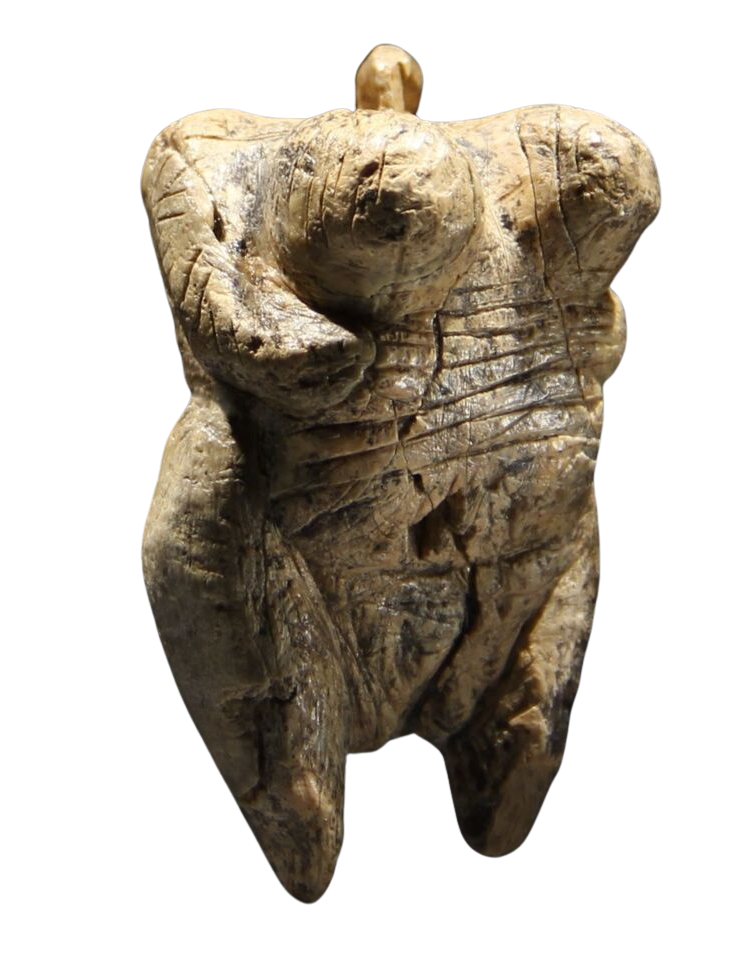
The story of human art and self-expression is far older than civilization. Deep within the European Upper Paleolithic lies the origin of figurative depiction — a threshold marked by a single, extraordinary object: the Venus of Hohle Fels. Standing as the oldest undisputed representation of a human being ever discovered, this miniature statuette carved from woolly mammoth ivory offers an unparalleled window onto the cognitive, symbolic, and cultural world of early Homo sapiens.
Discovery
In September 2008, a team led by archaeologist Nicholas J. Conard made a monumental find during excavations in Hohle Fels cave, near Schelklingen in the Swabian Jura region of Baden-Württemberg, Germany. Buried deep within Aurignacian sediment layers, the figurine had long since fractured under the pressure of the earth. Archaeologists recovered six distinct fragments that fit together with remarkable precision, forming a nearly complete object approximately six centimeters tall. Dated to between 35,000 and 40,000 years ago, the discovery pushed back the known timeline for figurative art and established that early humans were crafting complex representations of themselves far earlier than had previously been supposed.
Form and Symbolic Intent
The Venus of Hohle Fels is a study in deliberate emphasis over anatomical realism. The statuette entirely lacks facial features. Where a head might be expected, the sculptor instead carved a perforated loop — a ring worn smooth, which strongly implies the figurine was suspended from a cord of leather or plant fiber and carried on the body over an extended period. It was not an object set aside for contemplation; it was integrated into daily life as a pendant or amulet.
The body itself is defined by pronounced exaggeration: large, heavily protruded breasts dominating the upper torso; wide, voluminous hips set against a comparatively narrow waist; and a deeply incised pubic region. These are not the proportions of observed anatomy but of concentrated symbolic intent. Archaeologists broadly interpret such exaggerations as expressions of femaleness, fertility, and reproductive continuity — values of acute significance in the volatile environment of the Ice Age, where the survival of any group depended entirely on successful reproduction. The Venus was, in all likelihood, a powerful icon of those life-giving forces: perhaps a talisman worn in pregnancy, a token of protection in childbirth, or a marker of shared spiritual belief within a community.
Preservation and Legacy
The original Venus of Hohle Fels is held permanently at the Prehistoric Museum of Blaubeuren (Urgeschichtliches Museum) in Baden-Württemberg — the same institution whose collection encompasses many of the defining objects of Swabian Jura Paleolithic art. It stands as a crown jewel of prehistoric archaeology.
What the Venus of Hohle Fels ultimately demonstrates is not merely the antiquity of art, but the early emergence of the very faculties that define human culture: abstract thought, symbolic communication, and shared systems of meaning. Some 40,000 years before writing, before agriculture, before the first cities, a craftsman sat with a piece of mammoth ivory and made something that was not food, not shelter, not a tool for hunting — but an idea, given form.