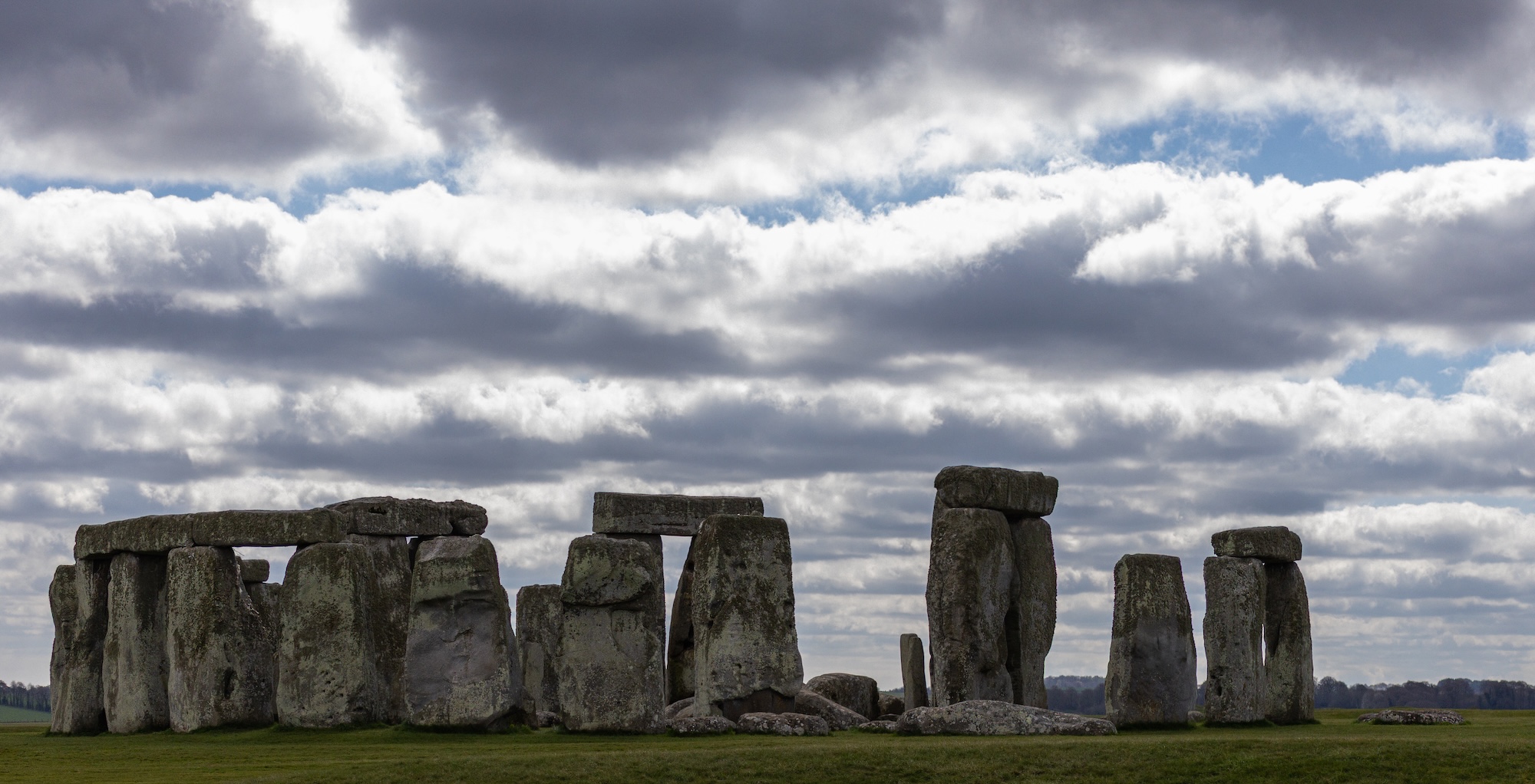
Among the enduring mysteries of prehistoric architecture, Stonehenge stands as a monumental testament to ancient human ingenuity. While the massive, locally sourced sarsen stones dominate the popular imagination, it is the smaller, non-local monoliths known as bluestones that present one of the most compelling archaeological puzzles in Europe.
Forty-three of these pillars — averaging between two and five tons each — form the monument’s inner horseshoe and circle. “Bluestone” is not a geological term but a collective designation for several rock types, most notably spotted dolerite (distinguished by white flecks embedded in dark igneous rock), rhyolite, and volcanic tuff. The name comes from the vivid blue-grey hue these stones reveal when wet or freshly fractured.
A Journey of 140 Miles
Unlike the local sarsens, the bluestones were transported an astonishing 140 to 180 miles to Salisbury Plain from the Preseli Hills in west Wales. Recent collaborative research by British archaeologists and geologists has pinpointed their precise origins at two outcrops: Carn Goedog and Craig Rhos-y-felin. Excavations at both sites reveal that Neolithic people were quarrying these stones as early as 3400 BC, with the most intensive activity clustered around 3000 BC.
The geology of these Welsh outcrops proved enormously useful. The rock naturally splits into vertical pillars, allowing workers to exploit ready-made fissures rather than carve stone from solid rock. Neolithic labourers drove wooden wedges, ropes, mallets, and levers into these joints to ease the pillars free, then lowered them onto artificial stone and earth platforms — loading bays with a roughly one-metre drop — designed to transfer each multi-ton block onto wooden sledges.
Overland, Not by Sea
For generations, two competing theories attempted to explain how the bluestones reached Wiltshire: human transport or glacial transport. Recent discoveries have effectively settled that debate in favour of human agency, ruling out the glaciers and, intriguingly, also casting doubt on the long-popular hypothesis that the stones travelled primarily by sea via Milford Haven and the Bristol Channel. Because Carn Goedog and Craig Rhos-y-felin sit on the northern slopes of the Preseli Hills, researchers now argue that a direct overland route to Salisbury Plain is far more probable.
The sheer effort this implies is staggering — dozens of multi-ton pillars moved across more than 140 miles of varied terrain. That expenditure of physical and social capital speaks to something beyond practicality. It suggests that the early farming communities of Wiltshire maintained deep, vital connections to their ancestral homelands in Wales, and reinforced those ties by physically carrying pieces of their landscape with them.
A Monument in Motion
The bluestones also reveal that Stonehenge was not a single-phase construction but a dynamic, evolving sanctuary. Evidence suggests the stones may have been arranged in an earlier, now-dismantled circle within Wales itself — the site of Waun Mawn is the most likely candidate. When they were eventually relocated to Salisbury Plain around 3000 BC, they were set as rough, unworked pillars within the pits known as the Aubrey Holes. The great sarsen stones that define Stonehenge’s iconic silhouette were not integrated until roughly five centuries later.
Virtually every other Neolithic monument in Europe used materials sourced from within a ten-mile radius. The Welsh bluestones are the glaring exception — and that exception redefines what we thought possible for prehistoric societies. These were people who possessed sophisticated logistics, hard-won engineering skills, and a shared cultural vision capable of bridging vast geographical divides. The bluestones are not merely ancient rocks; they are the physical record of a relationship between two places and the people who refused to let distance sever it.
Sources
University of Southampton — Quarrying of Stonehenge ‘bluestones’ dated to 3000 BC — Dr Joshua Pollard, Professor of Archaeology. Research funded by the British Academy, NERC, the National Geographic Society, the Society of Antiquaries, the Royal Archaeological Institute, and the Cambrian Archaeological Association.
Williams-Thorpe, O., Green, C. P., & Scourse, J. D. — “The Stonehenge Bluestones: Discussion” — Proceedings of the British Academy, 92, 315–318. Read the paper