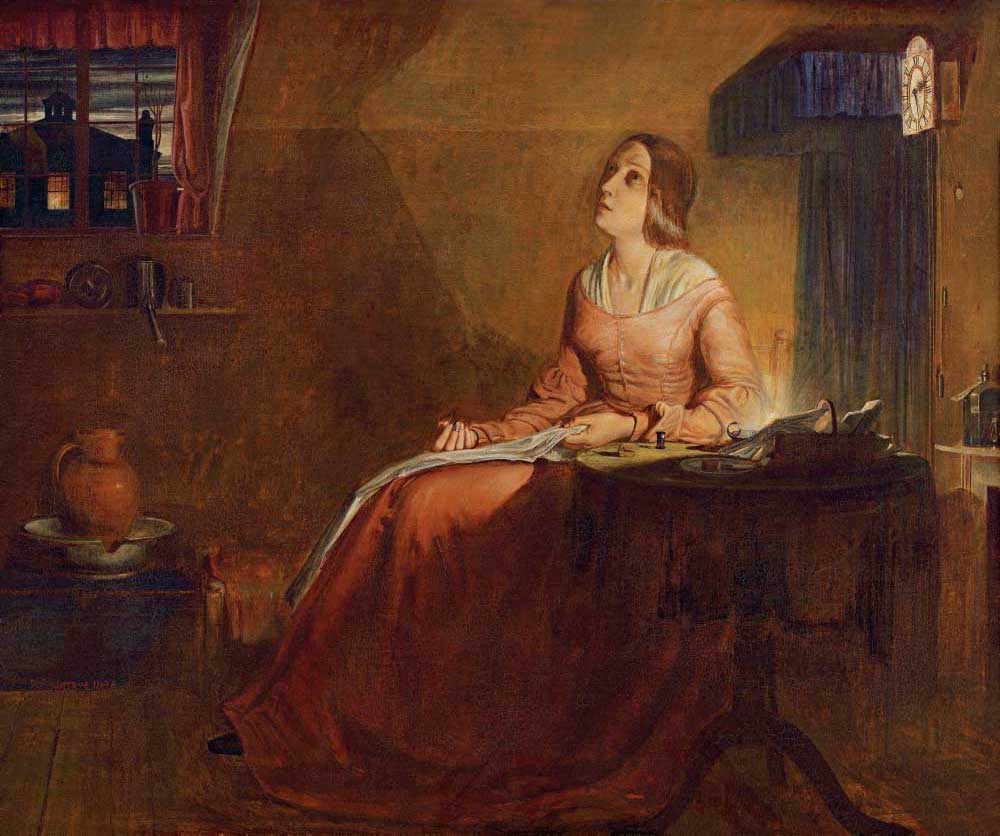
At the end of Part Five, Marx promised to examine the form in which the whole machinery of exploitation finally meets the worker — the wage — and warned that it is a form built to hide what it carries. Part Six keeps that promise. Its first and deepest chapter argues that the wage is the great everyday mystification of capitalism, the thing that makes exploitation not merely tolerable but invisible, and invisible precisely to the people living inside it. The three chapters that follow come down from that height to the concrete: wages paid by time, wages paid by the piece, and the puzzle of why the same hour of work fetches such different sums in different countries. The chapter on piece-wages, written a century and a half ago about Victorian sweatshops, reads now as though it were describing the smartphone in your pocket.
The Most Natural Lie
Marx begins by catching ordinary language in a contradiction. Everyone speaks of “the value of labour,” of wages as “the price of labour” — so many shillings for so many hours of work. But press on the phrase, he says, and it falls apart. Value is the social labour congealed in a thing; to ask the value of labour is to ask how much labour is contained in labour, an absurd tautology. Labour is the very stuff by which value is measured, and so it can no more have a value of its own than a yardstick can have a length measured in yardsticks. The value of labour, Marx writes, is an expression as imaginary as the value of the earth — and yet, like other such phrases, it arises inevitably from the everyday surface of economic life.
What is actually bought and sold, as the whole book has insisted, is not labour but labour-power, the capacity to work. The worker is paid the value of that capacity — the cost of keeping him alive and able — and his day’s labour reproduces that value in only part of the day, working the rest for nothing. But the wage does not appear that way. It appears as payment for the whole day. If three shillings cover six hours of necessary labour, and the worker labours twelve, those three shillings present themselves as the price of all twelve hours. And so the decisive sentence of the chapter:
The wage form thus extinguishes every trace of the division of the working-day into necessary labour and surplus-labour, into paid and unpaid labour. All labour appears as paid labour.
The unpaid hours do not vanish; they are simply painted the same colour as the paid ones. To bring out how peculiar this is, Marx sets the wage beside the older forms of exploitation it replaced. Under serfdom, the division was nakedly visible: the peasant worked three days on his own strip and three on the lord’s, the unpaid labour marked off in plain space and time. Under slavery the appearance ran the other way — since the slave himself was owned, even the hours in which he produced his own keep looked like labour for the master, so that all his labour appeared unpaid. Wage-labour inverts the slave’s case exactly. Here even the surplus, unpaid labour appears as paid. Where the slave’s property-relation hid the part he worked for himself, the worker’s money-relation hides the part he works for nothing.
Two things must be said carefully about this, because they are easy to get wrong. First, the mystification is not a trick anyone perpetrates. No employer hides the unpaid hours; the wage genuinely is the agreed price, honestly handed over. The concealment is structural, woven into the form itself — the worker is paid after he works, as for any service rendered; the exchange looks exactly like buying cotton or shoes; and the strange fact that this particular commodity, labour, is also the universal source of value lies entirely beyond the reach of common sense. Second, this surface form, Marx says, is the foundation of everything the system believes about itself — the basis of all its juridical notions, all its illusions as to liberty, all the apologetics of the economists. The free and equal contract of the marketplace, the whole moral self-image of the Eden of rights from the labour-power chapter, rests on a form that shows the direct opposite of the relation beneath it. And he notes, with quiet satisfaction, that classical economics tangled itself in “inextricable confusion” precisely here, by failing to see that what it called the value of labour resolved, under analysis, into the value of labour-power — the very slip that left Ricardo unable to explain profit.
Wages by the Hour
Chapter Twenty brings the abstraction down to the pay packet, beginning with the most familiar form: wages paid by time, by the hour, day, or week. The price of an hour’s labour, Marx shows, is simply the daily value of labour-power spread over the number of hours in the day — and the moment you write it that way, a lever appears. The daily wage and the price of the hour can be pulled apart, and capital learns to play one against the other.
Lengthen the working day, and the daily wage may even rise a little while the price of each hour quietly falls, so that the worker is paid more in total for being exploited at a worse rate. Or set the hourly price low and hire workers by the hour without guaranteeing them hours: now the worker cannot earn a living without straining for as many hours as he can get, yet the hours are not promised, so that overwork and unemployment coexist in the same trade and even the same person — long hours when work is there, idleness and want when it is not. The time-wage, in Marx’s hands, is not a neutral meter running beside the work; it is an instrument finely shaped for extracting the most labour for the least money, and its abuses turn out to be variations on a single theme — the gap the wage-form opens between the price of an hour and the length of the day.
Paid by the Piece
Chapter Twenty-One is the one that startles a modern reader. Piece-wages — payment per finished article rather than per hour — are, Marx argues, merely a converted form of time-wages, the same value of labour-power measured by output instead of by the clock. But it is the form most perfectly suited to capital, and the reasons he gives read like a field guide to twenty-first-century work.
It polices itself. Since only acceptable pieces are paid for, the wage-form itself enforces quality and intensity, and the capitalist can dispense with much of the apparatus of supervision; the worker becomes his own overseer. It turns the worker into his own driver. Paid by the piece, he has every incentive to work faster and longer, to intensify and prolong his own labour, competing against his neighbour and against himself — exploitation internalized as ambition. It breeds middlemen. Piece-rates make it easy to interpose subcontractors who take a cut for handing out the work, the system the Victorians called sweating. It atomizes. Each worker paid for his own output, the wage individualizes them, setting them in competition and corroding the solidarity that collective bargaining requires. And it ratchets downward. As the faster pace set by the keenest workers becomes the general standard, the rate per piece is cut, so that the worker must run ever faster merely to hold his earnings still; piece-wages, Marx concludes, tend over time to depress the average wage and stretch the working day. He calls the piece-wage the form of wage most in harmony with the capitalist mode of production — and anyone who has read about warehouse pickers paid per item, drivers paid per ride, or the per-task micro-payments of the platform economy will recognize the harmony at once. The algorithm that sets and silently lowers the rate, the worker who drives himself, the dissolved workplace and the interposed app: the machinery is new, the form is exactly the one Marx described.
The Same Wage, Different Countries
The last chapter, short and more technical, asks why money-wages differ so widely between nations, and arrives at a result that is less obvious than it looks. Comparing wages across countries means holding a great deal steady — the price and range of necessaries, the cost of training, the extent to which women and children are drawn in, the productivity and intensity of the labour. Once that is done, Marx draws out the counter-intuitive point. The richer, more developed capitalist nations often pay higher money-wages and yet command labour more cheaply, because their workers are so much more productive that each unit of output carries less labour-cost despite the fatter pay. The more intense and productive national labour, he argues, counts as more on the world market — a modification, at the level of nations, of the law of value. Behind the period detail sits an observation that has aged extremely well: what determines competitiveness is not the money-wage but the labour-cost per unit of output, so that high-wage economies can undersell low-wage ones, and the naive comparison of headline wages explains nothing. It is the seed of a century of argument about the structure of the world economy.
The Objections
The deepest objection strikes at the foundation chapter. Marx declares “the value of labour” an irrational expression and the wage a form that conceals unpaid labour — but both claims stand or fall with the labour theory of value. To an economist who rejects that theory, “the price of labour” is a perfectly coherent, perfectly honest price for a service, set like any price by supply, demand, and productivity at the margin; there is no hidden reservoir of unpaid labour being painted over, and so nothing is concealed. The “mystification” exists only for someone who has already decided that surplus-value is there to be hidden. Worse, the whole appearance-versus-essence machinery can look like a device for immunizing the theory: whenever the visible facts fail to show exploitation, Marx can say the visible facts are a “form of appearance” masking the truth, a move that seems to put the claim beyond refutation.
A second objection targets the piece-wage chapter’s tone. The portrait of self-driving and self-exploitation is one-sided: piece-rates also reward effort and skill fairly, and the flexibility of task-based work is something many people actively choose. To describe the per-ride driver only as a victim of his own incentives is to ignore the autonomy and opportunity the arrangement genuinely offers.
A third objection meets the chapter on national wages with the standard theory of trade. Comparative advantage, exchange rates, and productivity differences already explain international wage gaps without any appeal to a “modification of the law of value on the world market,” a notion awkward in itself and disputed even among Marx’s followers. The sound part of the chapter is just ordinary productivity economics; the distinctively Marxist part is the dispensable part.
The Replies
On the foundation, the defenders make a concession that turns out to be the whole point. Marx never claims the wage is a lie; he insists it is a true appearance — the worker really is paid the agreed price, freely and in full. The claim is that this true surface systematically hides a deeper structure, and the test of that claim is whether the hidden structure does work the surface cannot. Here Marx can point to a concrete payoff: classical political economy, sticking to the surface category “value of labour,” tangled itself in contradictions it could not resolve, above all the riddle of how profit can arise from equal exchange — a riddle that dissolves the moment one distinguishes labour from labour-power. An essence that explains the surface’s own failures is not an unfalsifiable dodge; it is what every science does when it distinguishes how things look from how they work, as when it says the sun only appears to cross the sky. Whether the particular essence Marx posits is the right one depends, again, on the value theory — but the burden there is symmetric, since the rival account equally presupposes its own framework. The dispute is between two pictures of the economy, not a mistake inside one.
On piece-wages, the reply grants that flexibility is real and still insists the chapter has aged into prophecy. The autonomy of the task-paid worker is formal; the structural pressures Marx identified — the internalized compulsion to overwork, the erosion of the rate as the fast pace becomes standard, the proliferation of intermediaries, the atomization that makes collective resistance hard — are precisely the features that define platform labour today, and they were deduced from the wage-form alone, before any of it existed. That some workers prefer the arrangement does not refute an analysis of where the arrangement tends to push them; it is part of what the analysis predicts, since the form recruits the worker’s own ambition to its purposes.
On national wages, the Marxist mostly agrees with the critic about which part is sound and disputes which part is dispensable. The chapter’s central empirical claim — that higher money-wages can coexist with lower unit labour costs, so that the well-paid worker of a rich country can be the cheaper worker for capital — is correct, important, and was far from obvious to the writers Marx was correcting, who compared headline wages and drew false conclusions. The grander framing, the modification of the law of value across the world market, is genuinely contested, including within Marxism; but the observation it was meant to capture has become a commonplace of how competitiveness is actually measured, and on that ground the chapter scored a hit.
Toward Accumulation
With Part Six the “production” half of Capital is complete, and complete in a particular way: it ends not with another mechanism but with the disguise that hangs over all of them. The wage is the form in which exploitation walks about in daylight unrecognized, in which the unpaid hours are folded seamlessly into the paid, and in which the whole relation presents itself, to worker and economist alike, as a free exchange of equivalents. Everything the earlier parts uncovered in the hidden abode is, by the wage, returned to the surface wearing the opposite of its true face.
What remains is the grand movement that the rest of the book has been preparing — what becomes of the surplus once it is made. Part Seven, the climax of Volume One, follows surplus-value as it is thrown back into production to breed more capital: the reproduction of the whole relation, the laws of accumulation, the swelling and contraction of the industrial reserve army, and the bleakest and most fiercely disputed thesis Marx ever advanced, that the accumulation of wealth at one pole is the accumulation of misery, toil, and degradation at the other. Whether one reads the wage-form as a genuine veil over real exploitation or simply as the honest price of a service that the theorist perversely insists on calling a disguise, Part Six leaves us where it found us: with the seamstress beneath her single candle, paid in full for every shirt by the wage’s own honest arithmetic, owing nothing and owed nothing — while Hood’s refrain, that it is not linen she is wearing out but human creatures’ lives, says aloud the one thing the wage is built to keep from being said.