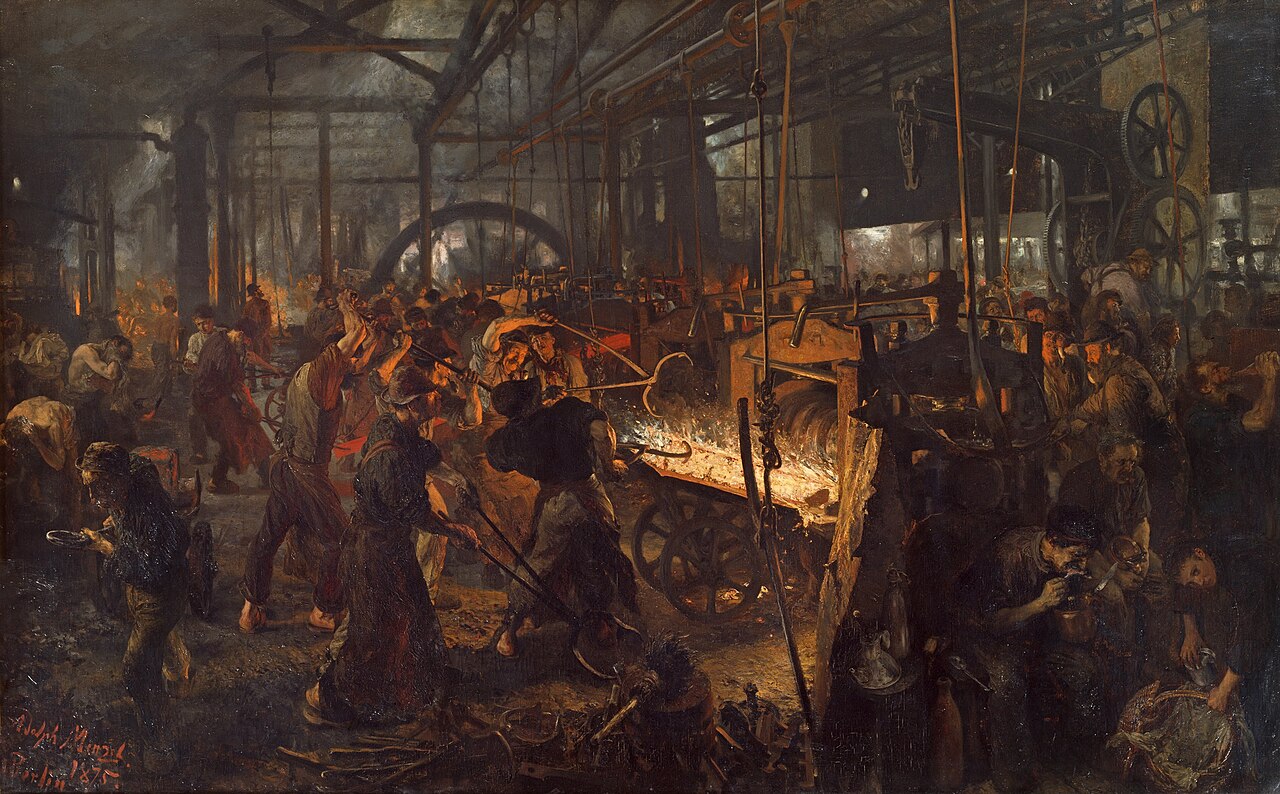
At the end of Part Two, Marx led us through the door marked “No admittance except on business” and promised that inside we would find the secret of profit. Part Three is the keeping of that promise. Across five chapters — the longest and, in places, the most harrowing stretch of the book — he shows how surplus-value is actually produced on the factory floor, how it can be measured, and how the hunger for it turns the length of the working day into a battlefield. The word that governs the whole part is absolute: here surplus is squeezed out by the crudest method available, simply making the working day longer. The subtler method — raising productivity so that less of the day suffices to cover the worker’s wage — waits for Part Four. First Marx anatomizes the workshop itself.
The Labour Process, Stripped Bare
Before he examines what capitalism does to work, Marx asks what work is, in any age. Stripped of every social trapping, the labour process is the activity by which human beings reshape nature to meet their needs — the everlasting exchange of matter between humanity and the natural world. It has just three simple elements: the purposeful activity of the worker, the object on which he works, and the instruments he works with. The blacksmith, his iron, his hammer.
What sets human labour apart, in Marx’s most quoted image, is that it is planned. A bee builds cells that would shame an architect, and a spider weaves like a master weaver, but they work by instinct alone. What distinguishes the worst architect from the best of bees, Marx writes, is that the architect “raises his structure in imagination before he erects it in reality.” The worker holds the result in his mind before his hands produce it; labour is purpose made flesh. This much is true of a Roman farmer, a tribal hunter, a medieval weaver — labour in this general sense is, in Marx’s phrase, the everlasting nature-imposed condition of human existence, belonging to no particular economic system.
Then capitalism enters, and changes not the substance of the process but its ownership. Two things are now different. The worker labours under the control and supervision of the capitalist, who has bought his labour-power and means to use it efficiently. And the product no longer belongs to the one who made it: it belongs to the capitalist, exactly as the wine belongs to the owner of the cellar in which it ferments, not to the grapes. The worker has sold the use of his capacity, and what that capacity produces is no longer his. With these two quiet adjustments the eternal labour process becomes the capitalist labour process — and the stage is set for the trick.
The Secret Made Plain
Marx now walks through the production of surplus-value with a deliberately humble example: a capitalist sets a worker to spin cotton into yarn. Everything is bought at its honest value — the cotton, the wear on the spindle, and a day’s labour-power. Suppose the worker’s labour-power is worth three shillings a day, the value of the food, shelter, and fuel needed to keep him going, and suppose that sum represents six hours of social labour. Suppose, too, that in six hours of spinning the worker adds exactly three shillings of new value to the cotton.
If the capitalist stops the process there, after six hours, something deflating happens. He has spent fifteen shillings on materials, spindle-wear, and wages, and he ends with yarn worth exactly fifteen shillings. No profit. He has merely changed the form of his money. Marx lets him splutter through every excuse in the economists’ handbook — that he abstained, that he rendered a service, that he supervised the work — and demolishes each: the value of the product is just the sum of the values poured into it, and no honest addition of values yields a surplus.
The capitalist’s mistake was to stop. For here is the hinge of the entire book. The value of a day’s labour-power — what it costs to keep the worker alive for a day — and the value that labour-power can create in a day of work are two completely different magnitudes. It may take only six hours of labour to produce the worker’s daily necessities; but there is nothing to stop the worker from labouring twelve. The capitalist has bought the day’s labour-power at its full, fair value, and the use of it for the whole day is now his by right. So he simply keeps the worker spinning. In the first six hours the worker reproduces the value of his own wage; in the second six he produces a value that belongs, free of charge, to the capitalist. That unpaid second half is surplus-value. “The trick,” Marx writes, “has at last succeeded; money has been converted into capital” — and not one law of exchange has been broken anywhere. Everything was bought and sold at its value. The surplus came not from cheating in the market but from the gap, discovered in the workshop, between what labour-power costs and what labour does.
Dead Labour and Living
This result forces a distinction that answers the question left hanging since Chapter Five: why labour, and not machinery or materials, should be the source of new value. Marx divides the capitalist’s outlay into two parts according to how each behaves in production.
The first part is spent on means of production — raw cotton, the spindle, the building, the coal. These are themselves products of past labour: dead labour, congealed and stored. In production they give up the value they already contain — the spindle passes a little of itself into the yarn as it wears — but they cannot give up more than they have. They transfer their value; they do not create new value. Marx calls this part constant capital, because its value reappears in the product unchanged.
The second part is spent on labour-power. And living labour does something the dead materials cannot: in the very act of using up the means of production, it adds fresh value beyond their worth. It both preserves the old value, by working the cotton into yarn rather than letting it rot, and creates new value on top. This part of capital alone expands, and Marx calls it variable capital. The whole surplus comes from here. The point is not that machines are useless — they are enormously useful, and raise output prodigiously — but that usefulness is a matter of use-value, while value, in Marx’s strict sense, is congealed labour, and only living labour is busy congealing. A machine can multiply the worker’s product a hundredfold and still add, of itself, not a farthing of new value. That asymmetry is the foundation everything later rests on.
The Measure of Exploitation
With capital divided into its constant part, its variable part, and the surplus it yields, Marx can now measure things. The working day splits cleanly in two. During the necessary labour, the worker reproduces the value of his own wage — he works, in effect, for himself. During the surplus labour, he works for the capitalist, for nothing. The ratio between them, surplus labour to necessary labour, Marx calls the rate of surplus-value, and he insists it is the exact expression for the degree of exploitation of labour-power. If the worker spends six hours covering his wage and six producing surplus, the rate is a round one hundred per cent: he works half the day for himself and half for his employer.
This is worth setting beside the figure the capitalist actually cares about, the rate of profit, which measures the surplus against his total outlay — against the whole capital, constant and variable together, not the wage bill alone. Because the means of production usually dwarf the wages, the rate of profit is always far smaller and gentler-looking than the rate of exploitation. A factory may exploit labour at a hundred per cent while reporting a profit rate of ten. The mismatch is not innocent: it is, Marx suggests, part of how the system veils from itself the extent to which it lives on unpaid labour, spreading the surplus thinly across the whole capital so that its true source disappears from view.
He drives the point home with a memorable piece of demolition. The economist Nassau Senior had argued, against the campaign to shorten the working day, that the entire net profit of a factory was produced in its very last hour — so that lopping even a single hour off the day would annihilate profit and ruin the trade. Marx takes Senior’s own arithmetic apart, exposes the blunder, and exhibits the episode as a small classic of economics pressed into service as apology: theory bent to the precise shape the manufacturers needed. The “last hour” was not science but advocacy in a frock coat.
The Working Day
If surplus grows as the working day lengthens, then the length of the day is where the interests of capitalist and worker meet head-on, and Chapter Ten — the longest and most unforgettable in the book — is given over to that collision. Here the cool categories of the earlier chapters turn hot.
Capital, Marx argues, has an inbuilt drive to extend the working day toward its absolute limit, because every extra hour is surplus labour gained for nothing. He gives the drive its famous image:
Capital is dead labour, that, vampire-like, only lives by sucking living labour, and lives the more, the more labour it sucks.
The worker, of course, means to preserve himself; he insists that a day’s labour-power not be drained in a way that wrecks him for tomorrow. So two claims of right confront each other — the buyer’s right to use to the full what he has lawfully bought, and the seller’s right to limit the using so as to keep his own life and health. Both rest equally on the law of exchange, and there is no higher principle to adjudicate between them. “Between equal rights,” Marx writes, “force decides.” The length of the working day is settled not by economics but by power — by a long, grinding struggle between the class of capitalists and the class of workers.
And then Marx does something no purely theoretical chapter could. He pours in the evidence: hundreds of pages distilled from the reports of the government’s own factory inspectors and medical officers, the Blue Books, documenting what the drive for surplus labour did to real bodies. Children worked through the night in relays so the machines need never stop. A twenty-year-old milliner, Mary Anne Walkley, died after labouring some twenty-six hours almost without a break, in a crowded workroom, to finish dresses for a ball — what Marx labels “death from simple overwork.” He turns the bourgeoisie’s own official record into an indictment. And he gives capital its motto in the face of the wreckage: “Après moi le déluge!” — after me, the flood — for capital, left to itself, is reckless of the worker’s health and length of life, attending to them only under compulsion from society.
That compulsion is the chapter’s other half. The normal working day — the ten-hour limit, the restrictions on child labour, the Factory Acts — was not granted by enlightened owners but wrung from a reluctant state by decades of working-class pressure, strikes, and agitation. The shortening of the day is, for Marx, the first great victory of labour as a class: proof that the limits capital will not set for itself can be imposed on it from outside. The categories of value, here, are paid out in flesh, and the workshop turns out to be not a place of harmony but a front line.
Rate and Mass
One short chapter closes the part by turning from the rate of exploitation to its total yield. The mass of surplus-value an individual capital produces depends on two things multiplied together: the rate at which each worker is exploited, and the number of workers set to work — that is, the size of the variable capital. A higher rate, or more hands, each enlarges the haul.
Two consequences matter for what follows. First, to become a capitalist at all — to live on surplus rather than work — one must command a certain minimum of capital, enough to employ labour on a scale that frees the owner from labouring himself; below that threshold the would-be capitalist is merely a better-off worker. Second, and more pregnant, since surplus springs only from living labour, there are limits to how far a capital can replace workers with machines without strangling its own source of surplus. A capitalist who automates may undersell his rivals for a time, but an economy that expels living labour expels the very thing that makes its surplus. Marx only marks the tension here; it will grow, in the later volumes, into the famous tendency of the rate of profit to fall, and it is already pushing capital toward the alternative strategy that Part Four examines — not lengthening the day, but cheapening the worker.
The Objections
The most formidable objection to the whole apparatus of Part Three is technical, and it has occupied economists for over a century. Marx builds his analysis on the assumption that commodities sell at their values, in proportion to the labour in them. But capital flows toward the highest returns, and competition tends to equalize the rate of profit across industries — even though industries differ enormously in how much they spend on machines versus wages, on constant versus variable capital. If profit rates equalize while the labour-content per pound of capital does not, then prices must systematically diverge from values. Reconciling the two — the so-called transformation problem — has proved thorny. Eugen von Böhm-Bawerk charged Marx with an outright contradiction between the value theory of Volume One and the price theory of Volume Three; later critics, drawing on Piero Sraffa, argued that one can compute prices and profits directly from the physical data of production, with the detour through labour-values adding nothing.
A second objection presses on the claim that machines create no new value. To many this seems plainly refuted by automation. The most mechanized firms are the most productive and often the most profitable; an economy of robots would pour out goods. If only living labour makes value, then a fully automated factory would produce no surplus at all — which sounds less like an insight than a reductio of the premise.
A third objection is historical. The horrors of Chapter Ten were real, but they receded. Across the rich world the working day shrank, child labour was abolished, and wages and life expectancy climbed — and this happened through reform, unionization, and economic growth within capitalism, not through its overthrow. The trajectory looks like a vindication of the reformers Marx often scorned, and an embarrassment to the air of gathering catastrophe that hangs over the chapter.
The Replies
On the transformation problem, the defenders concede it is a real and intricate difficulty and deny that it is fatal. A line of twentieth-century work — the “New Interpretation” associated with Gérard Duménil and Duncan Foley, and the Temporal Single System Interpretation of Andrew Kliman and others — argues that the alleged contradiction is an artifact of assumptions Marx never made, in particular the assumption that inputs and outputs must be valued at the same instant. Read with values determined over time rather than all at once, they contend, the system is consistent, and the key aggregate claims survive: total profit still equals total surplus-value, and the source of profit is still unpaid labour. This remains a genuinely unsettled, technically demanding dispute, with able people on each side and no consensus in sight — which is itself worth saying plainly.
On automation, the Marxist answer is that the objection mistakes the theory’s own conclusion for a refutation of it. Of course machines raise productivity without limit; that is a statement about use-value, about the flood of goods. The claim about value is different and deliberate: machinery transfers the labour stored in it and no more, so as capital mechanizes, it does undercut the living labour that is its only fountain of surplus. A fully automated economy producing no value is not an absurd consequence Marx overlooked but very nearly the contradiction he was pointing at — capital forever striving to expel the worker on whom its profits depend. Far from dating the theory, this is the part of it that speaks most directly to an age of robots and artificial intelligence, and it has been taken up with fresh urgency on exactly those grounds.
On the historical objection, the reply turns the trajectory around. The working day did not shrink because capital relented; it shrank because the working class compelled it to, through precisely the strikes, agitation, and legislation Chapter Ten records. The improvement is evidence for Marx’s model of conflict, not against it — the limits capital would not set for itself were imposed from outside, just as he said they would have to be. And the underlying drive did not vanish; it migrated. Where the countervailing power of unions and law is weak — in global supply chains, in informal and gig labour, in the always-on reach of the smartphone into the worker’s evening — the pressure to extend and intensify labour reasserts itself with familiar force. The vampire was beaten back in Lancashire; it was not killed.
Toward Relative Surplus-Value
Part Three has laid the secret bare. Surplus-value is unpaid labour, produced in the workshop, measured by the rate at which the day is split between work for oneself and work for the capitalist, and pursued with a hunger that, left alone, will consume the worker. But the method examined here — absolute surplus-value, won by lengthening the day — runs into a wall. The day has only twenty-four hours, the body needs some of them, and the organized resistance of the working class, crowned by the Factory Acts, fixes a ceiling that capital cannot simply override. Having met that limit, capital turns to the other road.
If the day cannot be made longer, the necessary part of it can be made shorter. Raise the productivity of labour — through cooperation, through the division of labour, through machinery — so that the worker reproduces the value of his wage in four hours instead of six, and the surplus portion of an unchanged day swells without anyone working a minute more. This is relative surplus-value, and the pursuit of it drives the technical transformation of production that Part Four anatomizes, from the workshop to the factory system. Whether one takes Part Three as the definitive unmasking of exploitation or as a powerful argument resting on a value theory still fiercely contested, it is the place where Marx’s cool analysis turns to fire — where, as in Menzel’s furnace, the abstractions of value glow suddenly, dangerously, human.