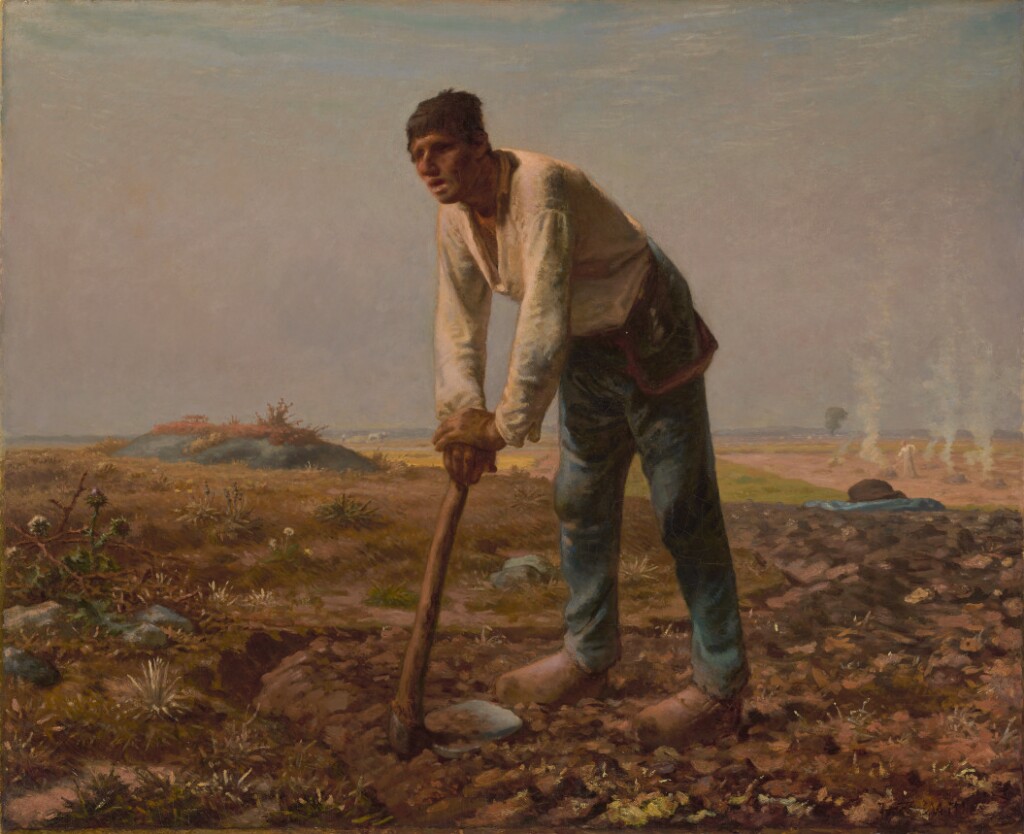
Part Five is the quietest stretch of the book. Having shown how surplus-value is wrung from the working day by lengthening it, and how it is wrung instead by raising productivity, Marx pauses to do the bookkeeping: to knit the two methods together, to work out the algebra of how surplus and wages move as the conditions of labour change, and to settle the correct way of expressing how hard labour is exploited. For long passages it reads less like a polemic than like a textbook. But two sharp ideas lie hidden in the arithmetic. One is a redefinition of the word “productive” that turns a compliment into a sentence. The other is the charge that the ordinary, respectable way of measuring profit is built to conceal the very thing it measures. Behind both, throughout, stands the figure the formulae never show: the labourer whose day they are silently dividing.
What Counts as Productive
Marx opens Chapter Sixteen by overturning an everyday word. In ordinary speech, and in much of classical economics, “productive labour” meant labour that makes something useful — the farmer, the weaver, the builder. Under capitalism, Marx argues, the word quietly comes to mean something else entirely. Here a labourer is productive only if he produces surplus-value for capital — only, that is, if his work feeds the self-expansion of someone else’s money. Usefulness has nothing to do with it.
The example he chooses is deliberately jarring. A schoolmaster, he says, is a productive labourer not when he educates children but when, in addition to belabouring their heads, he labours to enrich the man who owns the school. That the owner has invested in a teaching factory rather than a sausage factory changes nothing. The same lesson, taught by a self-employed tutor for a fee, produces no surplus-value and is, in this technical sense, unproductive. What makes labour “productive” is therefore not any relation between the worker and a useful product, but a social relation between the worker and capital. And so the flattering word turns cold:
To be a productive labourer is, therefore, not a piece of luck, but a misfortune.
Marx adds a second twist that widens the category even as it empties it of warmth. In modern production no one makes the whole product; work is shared among a combined or collective worker, a team of hands and heads. To count as productive you need not touch the thing made at all — it is enough to be an organ of that collective labourer, performing some subordinate function within it. The bookkeeper, the engineer, the supervisor are productive too, if the combined effort yields surplus. The honorific has become a description of one’s usefulness to capital, and nothing more.
Two Methods, One Surplus
Marx then draws together the two ways of enlarging surplus that Parts Three and Four examined. Lengthening the working day beyond the hours needed to replace the worker’s wage yields absolute surplus-value; it is, he says, the general groundwork of the whole system. Shortening the necessary hours by raising productivity — so the wage is reproduced faster and more of the day is left over — yields relative surplus-value, and this requires the constant technical revolutionizing of production that builds the specifically capitalist mode of production proper. He marks here a distinction that will matter in later volumes: the merely formal subjection of labour to capital, where the old craft is simply taken over by an employer, gives way over time to its real subjection, where the labour process itself is remade from within by machinery and method.
Seen one way, he concedes, the line between the two methods blurs — every gain in relative surplus-value still rests on prolonging the day beyond necessary labour, and every prolongation presupposes enough productivity to leave a surplus at all. But when the practical question arises of how to raise the rate of surplus-value, the distinction is real and unavoidable: either stretch the day, or shrink the necessary part of it. There is no third door.
This leads Marx to a deeper point about where surplus comes from in the first place, aimed at anyone tempted to think it springs from nature. Surplus labour does have a natural precondition: labour must be productive enough that the worker can cover his own subsistence in less than his whole waking time, leaving something over. Where labour is so feeble that the whole day is swallowed by survival, there can be no surplus, and so no leisured class of any kind. But — and this is the hinge — favourable nature gives only the possibility of surplus, never its reality. He offers the case of a man in the eastern islands where sago grows wild in the forest, who can cut a week’s bread in a few hours. Nature has handed him abundant leisure. Nothing in that bounty explains why, under capitalism, he would come to labour six days to keep the product of one. Only compulsion explains that. The bounty of nature sets the worker free to produce a surplus; it never makes him hand it over. Indeed, Marx notes with some relish, nature that is too generous retards development, keeping man, as an old writer put it, “in hand, like a child in leading-strings”; it is not the lush tropics but the demanding temperate zone, with its varied soil and turning seasons, that is the mother-country of capital. And the final irony, the fetishism note that recurs through the book: under capitalism even this natural productiveness of labour comes to appear as a productive power of the capital that hires it.
The Algebra of the Working Day
Chapter Seventeen is the most purely technical in the book, and its dryness conceals a genuinely important result. Marx isolates three things that can vary — the length of the working day, the intensity of labour (how hard the worker is driven within each hour), and the productivity of labour (how much each hour yields) — and works through, case by case, how surplus-value and the value of labour-power move as each changes while the others hold still.
The cases need not be tabulated here, but one conclusion deserves to be lifted out of the arithmetic, because it overturns a lazy reading of Marx that both his followers and his critics have indulged. Suppose productivity rises while the day and its intensity stay fixed. The goods the worker consumes become cheaper to produce, so the value of his labour-power falls, so the necessary part of his day shrinks and the surplus part grows: the rate of exploitation climbs. And yet — here is the point — the worker’s actual basket of goods can grow larger at the very same time. Because productivity has risen, fewer hours of labour are embodied in more bread, more cloth, more comfort. The worker can be consuming more while the labour-time it costs to keep him consumes less of his day. Rising real wages and a rising rate of exploitation are therefore not opposites at all; they can, and historically do, climb together. Intensifying labour works much like lengthening the day in disguise, packing more expended life into the same clock-hours; lengthening the day adds surplus outright. But the productivity case is the one that matters most, because it dissolves the supposed contradiction between a working class that grows better off and a system that exploits it more. The two are perfectly compatible, and Marx’s algebra is what shows it.
How to Measure Exploitation
Chapter Eighteen, short and pointed, asks how the rate of exploitation ought to be written down — and turns the question of which fraction to use into a small act of unmasking. Marx’s own measure is surplus-value divided by variable capital, which is the same as surplus labour divided by necessary labour: the unpaid part of the worker’s day set against the paid part. That ratio, he insists, is the exact expression of the degree of exploitation, because it compares what the worker gives for nothing directly against what he is paid for.
The classical and “vulgar” economists, he shows, habitually used other fractions, and the choice was not innocent. Set the surplus against the whole working day rather than against the necessary part, and a day half of which is unpaid yields a rate of fifty per cent rather than a hundred. Set it against the entire value of the product, or against the total capital advanced — the means of production heaped in with the wages — and the figure shrivels further still. This last is the familiar rate of profit, and because the constant capital usually dwarfs the wage bill, it makes an exploitation of a hundred per cent present itself as a modest return of a few per cent. The surplus is real and unchanged; only the denominator has swollen, spreading the unpaid labour thinly across the whole outlay until its source vanishes from the page. The choice of what to divide by, Marx argues, is exactly how political economy contrives to describe exploitation in a notation that hides it — the same confusion he had caught John Stuart Mill committing a chapter earlier, mistaking the gentle rate of profit for the steep rate of surplus-value. On the level plain, as Marx says of Mill’s economics, simple mounds look like hills.
The Objections
The first objection is that Marx has loaded his dice in the vocabulary. To redefine “productive labour” so that it means “surplus-yielding for capital,” and then to call this a misfortune, is to smuggle the indictment into the dictionary. Ordinary usage and classical economics had perfectly good, morally neutral reasons to honour wealth-creating work with the word; bending it into a term of accusation is rhetoric dressed as analysis.
The second objection cuts deeper, against the measure itself. Marx says the rate of profit “conceals” the true rate of exploitation, which is surplus over variable capital. But that claim presupposes the very thing in dispute — that variable capital alone is the source of the surplus, so that dividing by it rather than by total capital is the “real” measure. To an economist who rejects the labour theory of value, there is no hidden truth being concealed: the rate of profit is simply the correct and decision-relevant magnitude, the thing investors actually respond to and by which capital is actually allocated. There is no truer rate lurking beneath it. The charge of concealment quietly assumes the conclusion it is meant to support.
The third objection turns Chapter Seventeen’s own result against Marx. If wages and exploitation can both rise together, then the theory looks nearly impossible to refute from the wage side: workers worse off prove exploitation, workers better off prove it too. And if the workers really are growing better off in absolute terms — eating more, living longer, working fewer hours — then the moral charge in the word “exploitation” loses much of its bite. A rising tide that genuinely lifts the worker’s boat is hard to condemn merely because the owner’s yacht rose faster.
The Replies
On the loaded vocabulary, the defenders answer that Marx is exposing a meaning already buried in classical economics rather than inventing a new one. As he points out, the economists themselves had always tied “productive labour” to surplus-yielding labour; the Physiocrats counted only agriculture productive precisely because they thought only it left a surplus. Marx is making explicit what the category secretly always was — a measure of usefulness to capital, not to human need — and then letting the irony show. And the redefinition earns its keep analytically: only the surplus-relation explains the otherwise baffling result that a clown or a schoolteacher can be a “productive” worker while a self-employed artisan making fine furniture is not. The word tracks capital, and Marx simply says so out loud.
On the measure, the reply concedes the premise and reframes the charge. Of course the rate of profit is the magnitude capitalists act upon — that is exactly Marx’s point. The category through which the system represents itself to itself is one that necessarily disguises the rate of exploitation, not through anyone’s error but by its very structure, and this is the seed of the long analysis of profit that occupies the third volume. Does calling surplus-over-variable-capital the “true” rate depend on the labour theory of value? It does, and the Marxist does not pretend otherwise. But the burden is symmetric: the rival measure, which treats every factor as earning its marginal product, equally presupposes its own theory of value and distribution. The disagreement is between two frameworks, each consistent within itself, not a mistake to be corrected inside a shared one — and saying so plainly is more honest than either side’s claim to neutral arithmetic.
On the moral force, the reply rests on a distinction the chapter itself supplies. Exploitation, in Marx’s technical sense, is a structural and quantitative fact about unpaid labour; immiseration is a separate claim about absolute living standards. Chapter Seventeen’s whole achievement is to show that the two come apart, so that rising wages neither refute exploitation nor were ever required to establish it. Whether structural exploitation is morally damning even amid real and rising prosperity is a genuine question, and not one the algebra can answer. The Marxist case that it remains damning leans not on absolute want but on the arguments already laid down about the worker’s propertyless and unfree position, and on the history of dispossession the book has reserved for its end. One may find that case persuasive or not; what Part Five establishes is only that the comfort of the worker cannot, by itself, settle it.
Toward Wages
Part Five has balanced the workshop’s books. The two methods of extracting surplus are shown to be one process seen from two sides; the rate of exploitation is given its proper expression and distinguished from the figure that flatters the owner; and the surplus is traced to its origin in social labour rather than in the bounty of nature. The machinery of the theory is now complete and calibrated.
What Marx turns to next is the form in which all of this finally reaches the worker — the wage. Part Six will show how the value of labour-power, bought by the hour or the week, presents itself to worker and employer alike as the price of labour, a form in which the entire working day appears to be paid for, the unpaid surplus hours dissolving invisibly into the paid ones. The wage is the great everyday mystification, the ordinary appearance in which exploitation simply disappears from view; and beyond it lies the long climax of the book, the drama of accumulation, where the surplus once made is thrown back to breed more capital. Whether one reads Part Five as the rigorous, indispensable core of a science of exploitation or as an elegant accounting that rests, like everything around it, on a premise its critics never grant, it leaves untouched the figure its formulae cannot hold: the man straightened for a moment over his hoe, the whole of whose day has just been divided, by a line he cannot see, into the part that is his and the part that is not.