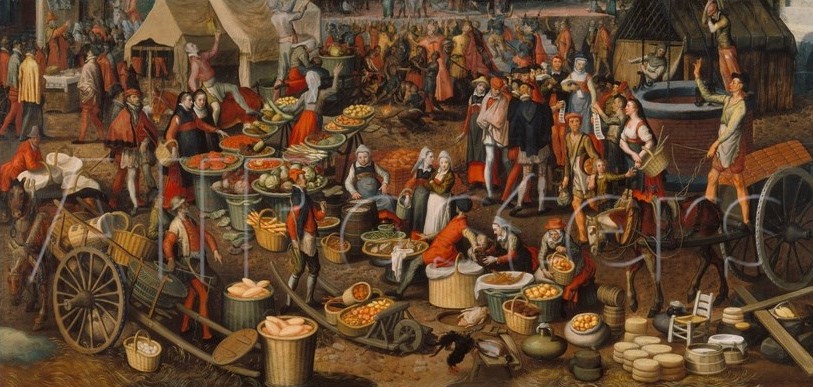
Chapter One examined the commodity at rest — a single object turned over in the hand and dissected. Chapter Two sets the commodities in motion and, for the first time, introduces the people who carry them. It is one of the shortest chapters in the book, and it is often treated as a bridge, a stretch of restatement between the analysis of the commodity and the coming account of money. But two things make it worth slowing down for. It is where Marx derives the legal person — the owner, the contract, the rights-bearing individual — from the bare fact of exchange. And it is where he tells the story of how money is actually born: not as a logical necessity worked out on paper, but as something a whole society stumbles into without meaning to.
Commodities Need Owners
A commodity, Marx notes with some amusement, cannot take itself to market. It has no legs and no will. To be exchanged it requires a human being whose will resides in it — an owner. Commodities are mere things, and as such they cannot resist; if one will not go to its new holder willingly, the old one can simply carry it off. The drama of the marketplace is performed not by the goods but by their guardians.
The moment two owners face each other to trade, something beyond economics appears. Each must recognize the other as the rightful owner of his goods, free to dispose of them; neither may simply seize what the other holds. They relate as persons with wills, and the form their relationship takes is the contract — an agreement between two free and equal proprietors. Marx’s claim here is bold and easy to miss. This legal relation, with its free and equal persons and its respected property, is not the foundation of exchange but its reflection. The economic act comes first; the law is its echo. The abstract legal subject — the individual who owns, contracts, and bears rights, identical before the law whatever his actual situation — is the commodity owner seen from the side of the courthouse.
The Contradiction of Exchange
Why must exchange happen at all? Because every commodity sits in the wrong hands. To its owner it is useless: the weaver cannot wear all his own linen, and in any case he made it to sell, not to use. A commodity is a non-use-value for the person who owns it and a use-value only for someone else. So all commodities must change hands.
But the change of hands is harder than it looks, because two requirements press against each other. A commodity can only be sold — realized as value, turned into money — if it is useful to a buyer. Yet it only reaches the buyer who finds it useful by being sold. Use-value and value are knotted together: the thing must prove useful to others in order to be worth anything, and must be worth something to its owner in order to move at all. Every act of exchange has to work this knot loose.
There is a further twist. Each owner comes to market wanting the same thing — to be rid of his own particular good and to hold instead the good that everyone will accept. Everyone, in effect, wants his own commodity to be the one that counts as universal, and that is impossible, since they cannot all be the exception at once. The contradiction can only be solved socially, behind the backs of the participants, by a single commodity being pushed out of the ordinary ranks and made to serve as the thing in which all the others express their worth. That excluded commodity is money. It is not invented by agreement; it precipitates out of the exchange process as its necessary product, the way salt crystallizes from evaporating water.
The Birth of Money
Marx then turns from logic to history, and here the chapter does something the first never tried: it tells a story in time. Exchange, he argues, does not begin inside a community, where goods are shared or allotted by custom and kinship. It begins at the edges, where one community meets another and trades its surplus. Only afterward does the habit of exchange seep back inward, slowly turning a community’s own products into commodities and corroding the older bonds that once held it together.
As trading repeats, the ratios in which things swap harden into custom, and the custom into something like a rule. The wider exchange spreads, the more urgently it needs a single commodity to serve as the common measure — and that role gravitates, over time, toward the precious metals. Gold and silver win not by decree but by their physical fitness for the job: they are uniform, they divide cleanly and recombine without loss, they resist decay, and a great deal of worth packs into a small weight. Their natural properties suit them to a social function. Hence Marx’s compact formula:
Although gold and silver are not by Nature money, money is by Nature gold and silver.
Money, in other words, is not money because of anything in gold itself; gold becomes money because society needs a universal equivalent and gold happens to wear the role well. With that, the chapter closes a circle begun in the first. The mystery of money is nothing other than the mystery of the commodity, now grown so large and bright that it dazzles the eye. The same disguise that makes a coat seem to possess value all on its own makes gold seem to be money by nature. The money fetish is the commodity fetish, magnified.
The Objections
The most serious modern challenge to this chapter comes not from economics but from history and anthropology, and it lands on a story Marx shares with the very classical economists he set out to demolish. Both Marx and Adam Smith assume a rough progression in which barter comes first and money arrives to relieve its awkwardness. The anthropologist David Graeber, surveying the actual evidence, argued that no society of pure barter that later invented money has ever been found. What the record shows instead is credit, debt, and obligation — elaborate webs of who owes what, frequently with no medium of exchange at all. On this account the tidy barter-to-money narrative is a founding myth of economics, repeated for two centuries because it makes a satisfying story, not because anyone observed it. Karl Polanyi had pressed a related point earlier: for most of human history economies were embedded in relations of kinship, ritual, and redistribution, and the self-standing market is a recent and largely engineered arrangement rather than the natural seed from which everything else grew.
This cuts against Chapter Two’s picture of money welling up spontaneously from expanding trade. If exchange was never the primordial economic act, then the birth of money needs a different telling — one in which states, temples, debts, and taxes do as much work as barter between neighboring tribes.
A second, older objection simply repeats the marginalist complaint from the previous chapter. Marx dramatizes money as the resolution of a contradiction buried deep in the commodity. To an economist in the tradition of Carl Menger there is no contradiction to resolve: money is just the most saleable good, spreading because it is handy, and casting the process as a dialectical necessity adds suspense to something quite ordinary.
There is also a doubt about the chapter’s boldest move — the derivation of law and the legal person from exchange. To say that property rights and the free, equal individual are merely a reflection of the commodity relation is to hang a great deal on a single thread. A liberal would reply that rights and persons rest on moral and political foundations of their own, and do not wait upon the marketplace to bring them into being.
The Replies
The defense begins by narrowing what Marx is actually committed to. He is not Smith. His claim is not that human economic life began with two strangers swapping a deer for a beaver, but that exchange and the commodity form took hold first at the boundaries between communities and only later colonized their interiors. More than that, his entire argument insists that generalized commodity production — the world in which nearly everything is made to be sold — is historically specific, a feature of capitalism rather than of human nature. On that crucial point Marx stands closer to Graeber and Polanyi than to the economists, since all three deny that the market is the natural ground state of society. The barter assumption is the part of the chapter that ages worst; the historical specificity is the part that has aged best.
The chapter’s most powerful descendant grows from the very move the liberal objects to. In the 1920s the Soviet jurist Evgeny Pashukanis took Marx’s offhand derivation of the legal person seriously and built from it a whole commodity-form theory of law. His argument was that the basic categories of modern law — the equal rights-bearing individual, the contract, the abstract subject who is the same before the law whatever his real circumstances — mirror, point for point, the categories of commodity exchange, in which unlike things are treated as equal values and unlike people as interchangeable owners. Law, on this view, is not a neutral framework that happens to host markets; it is the market’s own logic written in the language of rights. The theory proved influential enough to be dangerous: Pashukanis was denounced and disappeared in the purges of 1937, because a doctrine implying that law itself would wither away along with the commodity was unwelcome in a state busily constructing a permanent legal apparatus.
Beneath these particular defenses lies the chapter’s real purpose, which its detractors sometimes miss. Chapter One derived money on paper, as a matter of logic. Chapter Two shows that same derivation being carried out unawares by real people in real time — owners haggling at the edges of communities, settling customs, drifting toward gold, none of them intending to invent money and all of them producing it anyway. The logical and the historical are made to coincide. And the manner in which they coincide — a structure assembling itself behind the backs of the people who build it — is fetishism shown in motion rather than merely described.
Toward Money’s Functions
By the end of Chapter Two the commodity has gathered everything it needs to step onto the larger stage: a use-value and a value, a double-sided labor behind it, a form of appearance that ripens into money, owners to carry it, a contract to bind them, and a history that explains how gold came to rule the till. What money is has now been settled. What remains is to watch money work.
That is the business of Chapter Three, which follows money through its offices — as the measure of value, as the means of circulation, and finally as the strange self-moving thing that people hoard, lend, and chase for its own sake. Whether one reads Marx’s account of money’s birth as a penetrating reconstruction or as an elegant myth shadowing an older one, the machinery is now fully assembled. From here the argument stops describing how the pieces fit and starts showing what they do.