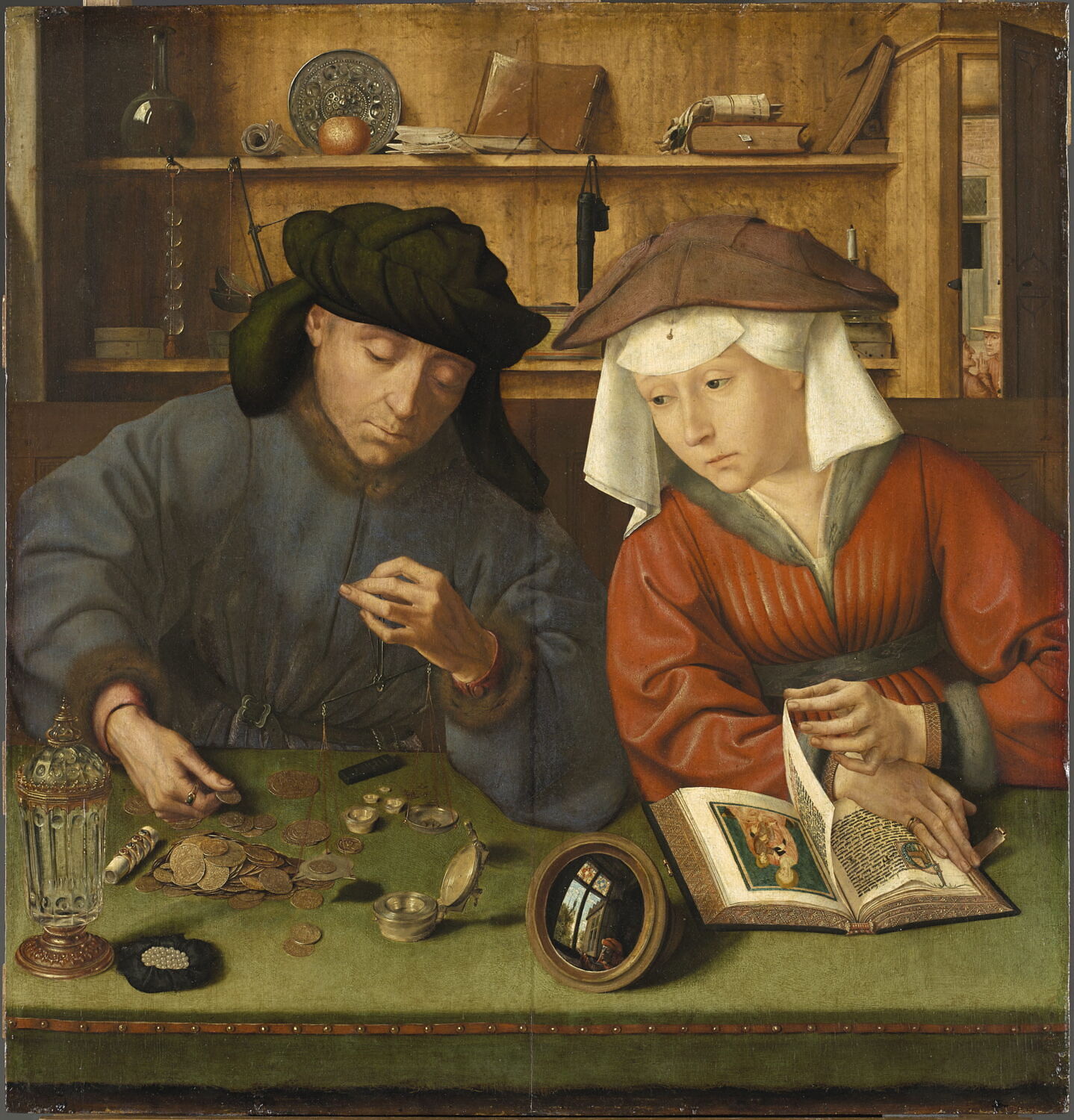
Chapter Four left us staring at a magic trick. Capital is money that comes back as more money — a hundred pounds laid out, a hundred and ten withdrawn — yet every law established about exchange insists that trade swaps equal values and creates nothing. Chapter Five is where Marx, rather than reaching for the obvious escape, deliberately bolts every exit but one. It is the most lawyerly chapter in the book: he plays prosecutor against each easy explanation of profit in turn, demolishing it, until the surplus seems not merely unexplained but impossible — and then, in the last paragraph, names the single narrow opening through which the whole of capitalism will be shown to pass.
The Riddle Restated
The demand Marx sets himself is severe, and he states it with deliberate harshness. The capitalist must buy his commodities at their value and sell them at their value, and still, at the end, withdraw more value than he put in. No cheating, no swindling, no thumb on the scale — fair exchange throughout, and yet a surplus. Most writers would soften this; Marx sharpens it, because he wants to prove that the profit of the whole capitalist class survives even when every trade is scrupulously honest. If surplus depended on dishonesty, capitalism would be a racket to be cleaned up, not a system to be understood.
He begins by noting how little the mere form of M–C–M actually changes. The capitalist buys from A and sells to B, but A and B see nothing unusual: to A he is simply a buyer, to B simply a seller. The famous inversion — buying before selling rather than selling before buying — exists only for the capitalist himself, strung across two ordinary transactions that, from everyone else’s side, are just sales and purchases like any other. So whatever produces the surplus cannot be hiding in the reordering of the steps. It must be sought in the plain machinery of buying and selling itself — and that is where Marx goes hunting.
Profit Cannot Be Born in the Marketplace
Take first the normal case, where commodities trade at their values, equivalents for equivalents. Here Marx draws a distinction the rest of the chapter turns on. In terms of use-value, both parties may well gain: the wine-grower who trades for corn ends up with something more useful to him than what he gave, and so does the farmer. Trade can leave both sides better supplied. But in terms of value — the quantity of social labor each holds — nothing has been added. Each party walked in with a certain value and walks out with the same value in a different shape. As one of the old economists Marx quotes put it, where equality exists there can be no gain.
This is the precise point where Marx parts company with a tempting argument, and it is worth pausing on, because it is exactly the objection modern economics will throw back at him. The French writer Condillac had claimed that exchange does create value: each party gives up something worth less to him for something worth more, so both come out ahead, and value appears out of the trade itself. Marx’s reply is that Condillac has quietly swapped the two senses of worth. Yes, each gets something more useful to him — that is a gain in use-value. But the linen and the corn embody the same labor before and after, whoever holds them; the exchange-value is untouched. To say commerce adds value because goods are worth more in the consumer’s hands than the producer’s is, Marx says, to be paid twice for the same thing. The buyer values the goods, true — but the seller equally values the money. Each prefers what he gets; neither has conjured new value into the world.
So equivalents yield no surplus. What about unequal exchange — selling above value, buying below? Marx works through the possibilities with almost mathematical patience. Suppose every seller could charge ten per cent over value. Each gains as a seller — and loses exactly as much the moment he turns around and buys, since he too must pay everyone’s surcharge. A universal price rise is no rise at all; it merely renames the same values in bigger numbers. Suppose instead a clever operator fleeces his partner, handing over forty pounds of wine for fifty pounds of corn. He has indeed gained ten pounds — but the ten pounds came straight out of the other man’s pocket. The total value in the system is unchanged; it has only been shoved from one purse to another, exactly as if he had stolen it. Cheating redistributes value; it does not create it. As Marx puts it, the capitalist class as a whole cannot over-reach itself — a nation of swindlers picking one another’s pockets is no richer at the end of the day.
This is why he sets aside, as antediluvian forms, the merchant who buys cheap and sells dear and the moneylender whose M–M′ seems to breed coins from coins. Their gains are real enough individually, but they are wrung from the producers they sit between — transfers, not creations. Here Marx reaches back to Aristotle, who had already, two thousand years before, condemned the breeding of money from money — interest, in Greek tokos, the same word as offspring — as the most unnatural of all ways of making a living, since money was made for exchange, not for spawning more of itself. The image of value laying golden eggs, from the previous chapter, was Aristotle’s nightmare given a system. Whatever the source of the surplus, it is not the usurer’s trick and not the merchant’s markup. Circulation, Marx concludes flatly, begets no value.
Nor Outside It Either
If the surplus cannot be born in the marketplace, perhaps it is made away from it, in private, before the goods ever change hands. But here Marx closes the other door. Consider a producer working alone, in contact with no one. He can certainly create value: by working leather into boots he adds his labor, and the boots are worth more than the leather was. But notice what has happened. He has made new value by new work; he has not made his existing value expand of its own accord. The leather did not, in becoming boots, secretly breed a surplus — a fresh quantity of labor was simply added to it. To create value by laboring is one thing; to make value swell into more value without fresh labor, which is what capital is supposed to do, is another. A man alone with his materials can do the first and never the second. Self-expanding value cannot be manufactured in solitude any more than it can be conjured in trade.
The One Commodity That Could Solve It
Marx has now bricked up both exits, and he states the resulting impossibility with relish:
It is therefore impossible for capital to be produced by circulation, and it is equally impossible for it to originate apart from circulation. It must have its origin both in circulation and yet not in circulation.
This is the knot the chapter has been tying. The surplus cannot come from exchange, and it cannot come from outside exchange, yet it plainly comes from somewhere, since capital exists and grows. Marx caps the paradox with a line borrowed from an old fable — Hic Rhodus, hic salta!, here is Rhodes, jump here — the bystander’s challenge to the boaster to make good his claim on the spot. He has set himself a problem that looks unsolvable: account for a profit that violates no rule of fair exchange.
And then, almost quietly, he shows the way through. The whole difficulty came from looking in the wrong place. The surplus cannot arise in the second act, the resale, because selling at value adds nothing. It must therefore arise in the first act, the purchase — not from the price paid, which is fair, but from the nature of what is bought. The capitalist must find, for sale at its honest value, a peculiar commodity whose use-value is itself the creation of value: a commodity that, once bought and put to work, produces more value than it cost. He would then have bought at value and sold at value, breaking no law of exchange, and still pocketed a surplus — drawn not from the trade but from the using of the thing traded for.
Such a commodity, Marx notes, can indeed be found on the market. He does not dwell on it yet; he only names the conditions it must meet and lets the reader feel the trap snap shut. The commodity is the human capacity to work — labor-power — and the whole of the next chapter is given over to the strange circumstances under which it comes to be bought and sold.
The Objections
The most powerful objection to this chapter is that its central impossibility is manufactured. Marx declares that the exchange of equivalents begets no value — but that is true only if value means embodied labor, which is precisely the doctrine in question. An economist in the line running from Condillac and Destutt de Tracy down through the marginalists would say those earlier writers were right and Marx wrong: exchange does create value, because value lives in the satisfaction a thing gives, not in the labor it cost. When two people trade, each hands over something he wants less for something he wants more; value, measured by want, has genuinely increased on both sides. From this vantage M–C–M′ needs no mystery and no descent into production. The merchant ends with more because trade itself is productive — moving goods to where they are wanted is a service like any other. Marx’s contradiction, on this reading, is an artifact he built himself, by defining value so that trade cannot add to it and then expressing astonishment that trade adds nothing.
A related complaint targets the severe constraint Marx imposes — buy at value, sell at value, and still profit. By forbidding every other route in advance, critics say, he has all but written the answer for himself; only a value-creating commodity could thread so narrow a needle, so labor-power arrives less by discovery than by elimination.
Others press on the uniqueness of that commodity. Even granting the puzzle, why should labor alone possess the magic property of producing more value than it costs? A machine, too, yields output worth more than the machine; land yields harvests worth more than the seed and toil put into them. Böhm-Bawerk and the economists after him saw no reason to crown labor the sole source of the surplus rather than spreading the credit among all the factors that cooperate in production. To single out labor is, once again, to assume the labor theory rather than to demonstrate it.
Finally, there is a historical objection from a sympathetic quarter. Marx waves merchant profit and unequal exchange aside as mere transfers, but world-systems and dependency theorists — Arghiri Emmanuel, Samir Amin — have argued that unequal exchange between rich and poor nations is no antediluvian relic but an ongoing engine of accumulation, and that colonial plunder built much of the very capital Marx wants to derive from production alone. Perhaps circulation, between unequal parties, does more of the work than the chapter allows.
The Replies
To the gains-from-trade objection, the Marxist answer is that it changes the subject. Of course both parties to an exchange feel better off — Marx says so himself, in just those words, when he grants that in use-value terms both sides gain. But the question the chapter is asking is not whether people are more satisfied after trading; it is where the extra money of the entire capitalist class comes from. And satisfaction does not accumulate in a bank account. If all anyone ever did was swap equivalents, however gladly, no one would hold a penny more at the end than at the start, and the aggregate sum of money could not grow. The subjective theory explains why exchanges happen and leaves untouched the thing to be explained — the systematic monetary surplus. Marx is not denying gains from trade; he is denying that they answer his question.
The charge that his constraint rigs the outcome, the defenders continue, mistakes rigor for sleight of hand. Marx could easily have explained profit by cheating, monopoly, or the merchant’s markup — and then capitalism would stand convicted of nothing worse than dishonesty, curable by better enforcement. By insisting that the surplus appear even when every exchange is fair, he makes the far stronger and more disturbing claim: that exploitation is built into the system’s normal, lawful operation, not into its abuses. Giving the opponent the best possible case — perfectly equal exchange — and showing the surplus arises anyway is the opposite of question-begging; it is the refusal of an easy win.
On the uniqueness of labor, the Marxist concedes that the chapter only points where the full argument must go, and that the heavy lifting belongs to the chapters on the labor process and on constant and variable capital still to come. The reply in brief is that a machine adds to the product only the value it loses — it passes on, as it wears out, the labor once spent making it, and not a particle more, while only living labor adds value that was not already there. Whether that distinction can be sustained is one of the genuine battlegrounds of economics, and it cannot be settled from Chapter Five. But it is not, the defenders insist, mere assertion: it follows from the account of value built up across the whole of Part One, and it is the next several chapters’ business to make it good.
As for unequal exchange between nations, the Marxist tends to accept the phenomenon while denying that it refutes the chapter. Marx’s claim concerns the origin of the aggregate surplus, which must be production, because trade among the world’s owners only moves existing value around. That value, once produced, can certainly be transferred — and unequal exchange is one of the great mechanisms by which it flows from poorer regions to richer ones. Creation and redistribution are different questions, and the world-systems theorists are mostly answering the second. On this reading their work extends Marx rather than overturning him: production makes the surplus, and an unequal world market decides in whose hands it ends up.
Toward the Hidden Abode
Chapter Five is the hinge of the whole first half of the book. By sealing every familiar explanation of profit — fair trade, sharp trade, the merchant, the usurer, the solitary craftsman — Marx forces the reader to the one place none of them looked, and he forbids himself the comfort of calling capitalism a mere swindle. The surplus is real, it breaks no rule of exchange, and it cannot be found anywhere in the bright, noisy world of buying and selling.
So Marx prepares to leave that world. The next chapter takes up the peculiar commodity on which everything now turns — labor-power, the human capacity to work — and the conditions under which a person comes to sell it: conditions, it will emerge, that require a very particular kind of freedom, the freedom to dispose of one’s own labor and the freedom from any other means of living by it. And at that chapter’s end Marx will lead buyer and seller out of the marketplace altogether, down into what he calls the hidden abode of production, whose threshold bears the sign “No admittance except on business,” and where the secret of the surplus, invisible from the street, at last comes into view. Whether what waits below is a rigorous proof of exploitation or an ingenious resolution to a puzzle that only the labor theory of value made puzzling, the descent is now unavoidable. Marx has left no other way down.