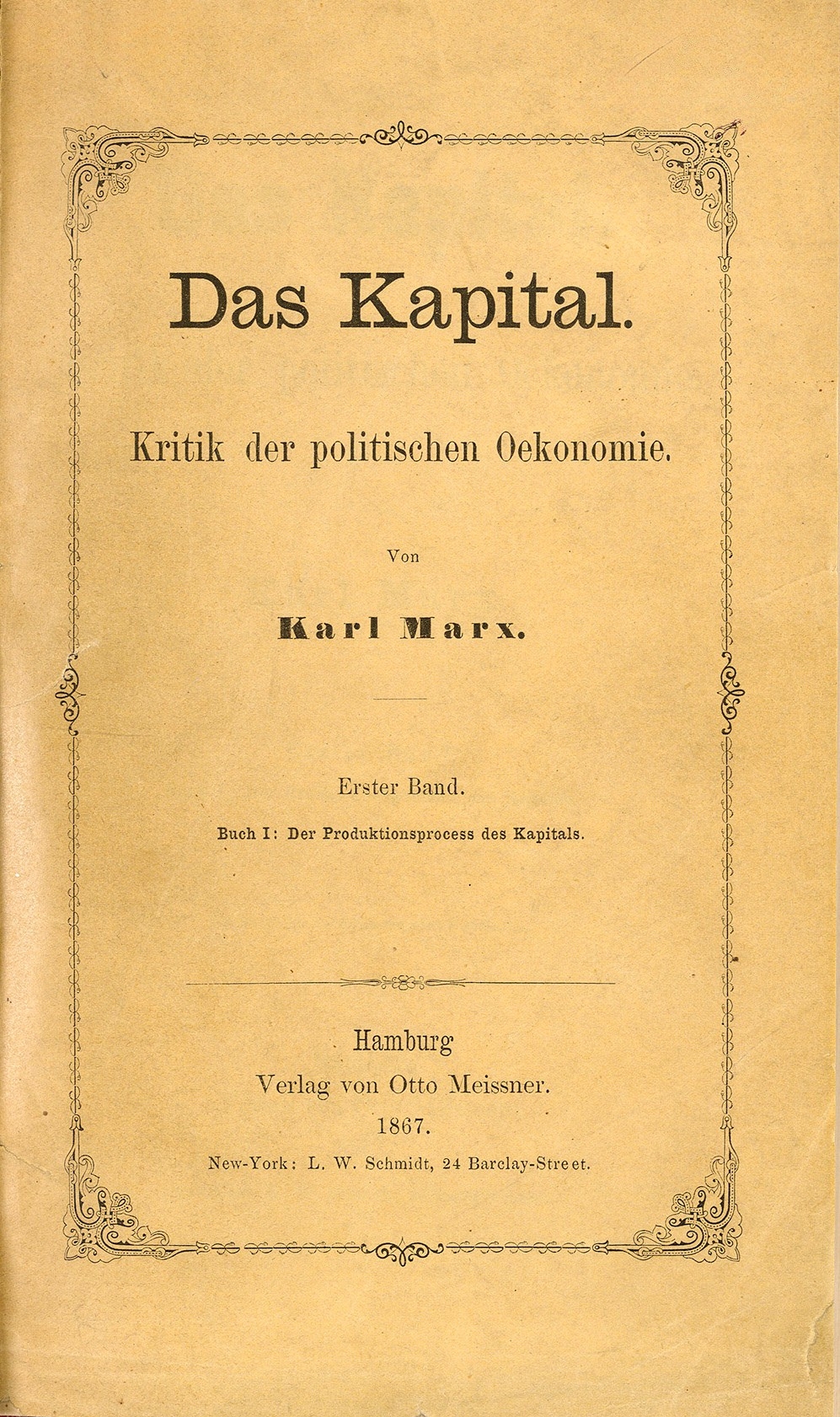
Few books are argued over as fiercely by people who have never opened them as Karl Marx’s Capital. It arrives wrapped in a century and a half of political baggage, treated as scripture by some and as a closed case by others. But the reason to read it now has little to do with whether one wants the revolution it was once thought to promise. Marx remains the most thorough critic the capitalist system ever produced, and he earned that standing in a disarmingly fair-minded way: he took the assumptions of the economists he opposed, granted them for the sake of argument, and followed them, step by patient step, to conclusions they did not expect.
That is what makes reading him clarifying rather than merely partisan. Marx is most useful not as a prophet — where he forecast specifics he was often wrong — but as a diagnostician. He insists on a question that modern economics tends to walk past: not how prices rise and fall, but where the worth of things comes from in the first place. Whatever answer one finally settles on, being made to face that question sharpens one’s view of the whole machine.
This is the first entry in a section-by-section reading of Capital. We begin where Marx does, with the two opening sections of Chapter One — the most contested pages in the history of economics, and for good reason. Nearly everything that follows in the book’s thousand pages is already folded into them.
The Commodity: Use-Value and Value
Marx opens not with banks or markets or money but with the smallest unit of capitalist wealth: the commodity, a thing produced to be sold. Look closely at any commodity, he says, and you find it has two sides.
The first is its use-value — its usefulness. A coat keeps you warm; a loaf of bread feeds you. Use-value is rooted in the physical properties of the thing and becomes real only when the thing is actually used or consumed. It is also timeless. A coat is useful whether you knitted it yourself or bought it, whether you live under capitalism, feudalism, or no economic system at all. Every human society has needed use-values.
The second side appears only when commodities are traded. A coat might exchange for twenty yards of linen. This ratio is its exchange-value, and it presents an immediate puzzle. A coat and a bolt of linen are physically nothing alike. How can two such different objects be set equal to each other in an exchange? When we say one is worth the other, we are treating them, for that moment, as the same in some respect. Which respect could that possibly be?
Marx’s answer is to strip the two commodities of everything that makes them physically what they are. Subtract the shape, the texture, the particular use — and one property survives the subtraction: both are products of human labor. The linen was woven; the coat was tailored. Set aside even the kind of labor involved, the weaving and the tailoring, and what remains is labor in general, the plain expenditure of human effort, of muscle and nerve and brain over time. Marx calls this abstract human labor, and the quantity of it congealed inside a commodity is its value.
Use-value and value are therefore very different kinds of fact. Use-value belongs to the physical world and the satisfaction of needs. Value is a social fact — a measure of how much of society’s collective effort a thing represents. A commodity has value only because human labor is locked up inside it.
This raises the obvious next question: how much value? Marx answers that value is measured by labor time. But that cannot mean simply the hours any particular worker happened to spend, or a slow and clumsy worker would produce more valuable goods than a fast and skilled one, which is absurd. So Marx adds his crucial qualifier: socially necessary labor time, the time required to make something under normal conditions, with the average skill and intensity prevailing in a society at a given moment.
From this follows a rule that will govern the rest of the book. The value of a commodity rises and falls with the amount of labor needed to produce it — but the amount of labor needed falls as productivity rises. Invent a power-loom that doubles a weaver’s output, and the socially necessary time to make a yard of linen is halved; the value of linen drops by half along with it. A weaver still working a manual loom at the old pace gains nothing from his extra hours, because the social standard has moved on without him.
Two clarifications complete the picture. A thing can have use-value without value: air, untouched soil, a wild berry are useful but contain no human labor, so in Marx’s sense they are worth nothing. And a thing can be useful, and a product of labor, and still not be a commodity. Bake bread and eat it yourself and you have made a use-value but not a commodity. A commodity is made to be exchanged — useful to someone other than its maker, and handed over through the market.
Where the Mainstream Steps Off the Train
Nearly every economist, then and now, accepts Marx’s first two moves: that commodities have a use-value and an exchange-value. The disagreement — and it is total — begins the moment he claims that abstract human labor is the hidden substance of all value. That single claim is the foundation of his system, and it is where the rest of economics parts company with him.
The first objection is that his central deduction contains a sleight of hand. Recall the move: strip away the physical properties of two commodities and “only labor is left.” The Austrian economist Eugen von Böhm-Bawerk replied that this is simply false. After you remove the physical traits, several things remain in common, not one. All commodities are scarce; all are wanted by someone; all are owned by someone. Why should labor, rather than scarcity or desirability, be crowned the single essential factor? Marx, on this reading, chose the answer he wanted and dressed it up as a deduction.
The second objection is larger, because it came with an entire rival theory. While Marx was writing, economics was being remade by what is now called the Marginal Revolution — the work of Carl Menger, William Stanley Jevons, and Léon Walras, arriving more or less at once. Their claim turned Marx upside down. Value, they argued, is not an objective deposit left inside an object by past labor. It is subjective, living in the mind of the person who wants the thing. Goods are not valuable because labor went into them; people put labor into things because they expect them to be wanted.
The favorite illustration is the mud pie. Spend five hours carefully shaping a pie out of mud and you have invested five hours of genuine human labor, yet the result is worth nothing, because no one wants it. Labor by itself, the marginalists insist, guarantees no value at all.
Marx anticipated something like this, which is exactly why he specified socially necessary labor — labor that actually meets a need under normal conditions. But critics argue that the qualifier quietly surrenders the game. How do we discover whether a given stretch of labor was socially necessary? Only by sending the product to market and seeing whether anyone buys it. If demand is what tells us which labor counted, then demand and usefulness are doing the real work of fixing value, and labor is merely along for the ride. Marx, the critics say, smuggles utility back in through the rear door while claiming to have shown it out the front.
A fourth objection points at everything the theory cannot explain. Marx’s framework is built for mass-produced goods that can be made again and again — coats, linen, the ordinary stuff of industry. It strains badly against things that cannot be reproduced. A painting by Leonardo, a surviving bottle of 1945 wine, a parcel of land in central Manhattan: the labor time behind these is either long fixed or beside the point, yet their prices can climb into the millions on scarcity and desire alone. The labor theory can only fit such cases by treating them as a growing list of exceptions.
The clash comes down to which direction one looks to explain a price. Marx looks backward: a smartphone is expensive because an immense web of human labor — mining, engineering, assembly — was spent to bring it into being. The marginalist looks forward: a smartphone is expensive because people want what it does, it is relatively scarce, and they will pay for it. The labor, on this view, was merely a bet the company placed on that future desire.
The Marxist Reply
Marxist economists do not concede these points; they argue that the critics have misread the kind of theory Marx was building. The subjective view, in their telling, is like studying the ripples on the surface of the sea and concluding there are no currents underneath.
Their central move is to separate value from price. Marx never claimed that labor time fixes the exact price of a thing on a given day. Prices are pushed around constantly by supply, demand, fashion, and monopoly. Value, in this defense, behaves like gravity, and price is a pendulum swinging around it. Supply and demand explain why the price of a coat wobbles up and down this week — but they do not explain why it wobbles around twenty dollars rather than one cent or a million. What sets the axis is the labor required to make it. Subjective utility can account for the swings; only labor accounts for the center they swing around.
To the objection about Leonardo and Manhattan, Marxists answer that it misses the project entirely. Capital is a critique of one specific thing: the capitalist mode of production, an engine that runs by endlessly reproducing goods through wage labor. Unique paintings and scarce land are monopolies, not the engine. Faulting the labor theory for failing to price the Mona Lisa, they say, is like faulting the laws of flight for failing to explain how a leaf drifts down from a tree.
There is also a deeper charge folded into the defense. The subjective theory, Marxists argue, is itself a symptom of what Marx called commodity fetishism — the habit of seeing economic life as a relationship between a person and a thing (“how much do I enjoy this phone?”) when it is really a relationship between people. Buy a phone and you have, in effect, entered into a relation with the miners, the assembly workers, the drivers who moved it. By anchoring value in labor, Marx forces those people back into view, against an economics that prefers to imagine goods simply appearing on shelves in answer to desire.
On the charge of circular reasoning, finally, Marxists insist that socially necessary labor time reflects an objective technological reality, not a verdict the market hands down after the fact. If the average factory weaves a shirt in ten minutes, then ten minutes is the standard, full stop. A craftsman who spends ten hours hand-weaving a single shirt has not created more value; he has simply worked inefficiently against a standard that already existed. The market does not conjure that standard out of demand — it enforces a level of technology and average skill that is a real feature of the society.
Beneath all of this lies a disagreement about what economics is even for. Mainstream economics asks how individuals make choices to maximize satisfaction under scarcity, and from that starting point value almost has to be subjective. Marx asks how a whole society organizes its collective labor to feed, house, and reproduce itself, and from that starting point value almost has to rest on labor. The two schools are not answering the same question badly; they are answering different questions.
Why the First Pages Carry the Whole Book
It is worth pausing on why economists fight so bitterly over a coat and a bolt of linen. The reason is structural. Chapter One is the foundation on which the entire thousand-page argument is stacked, and the rest follows from it almost mechanically.
Grant Marx his premise — that only living human labor creates new value, while machines and raw materials merely pass their existing value into the product — and a chain of conclusions clicks into place. If goods exchange at their true labor value, how does a capitalist earn a profit at all? Marx’s answer is that the capitalist buys one peculiar commodity: the worker’s capacity to labor. Suppose four hours of work produce enough value to cover a day’s wage, but the worker is kept on the job for eight. The extra four hours are unpaid. This is surplus value, and for Marx it is the hidden source of every profit.
From there the dominoes keep falling. To outrun their rivals, capitalists install faster machines and briefly profit by producing below the social average. But rivals soon buy the same machines, the social standard drops, and since machines — by the premise — add no new value while labor does, an economy crowded with machines and thin on workers finds its overall rate of profit tending to sink. To defend profits, firms squeeze wages and shed workers, and then discover they have impoverished the very people who were supposed to buy the flood of goods now pouring off the lines. The result is crisis.
This is why critics aim their fire at the opening pages rather than at the later chapters on factory misery or economic collapse. If value can be shown to be subjective — to have nothing essential to do with labor — then surplus value evaporates, exploitation becomes a figure of speech, and the prediction of capitalism’s breakdown loses its proof. Pull the bottom block and the tower comes down. Beginning with the humblest possible example, Marx was quietly laying charges at the base of the system.
The Two-Fold Character of Labor
If Section 1 dissected the commodity, Section 2 turns the same blade on the labor behind it — and here Marx believed he had made his single most original contribution, calling it “the pivot on which a clear comprehension of political economy turns.” His reasoning is elegantly symmetrical: if the commodity has two sides, then the labor that makes it must have two sides as well.
The first he calls concrete labor — the specific, skilled, physical work of making a particular thing. Tailoring, with its needles and thread, is concrete labor that produces a coat; weaving, with its loom, is concrete labor that produces linen. Concrete labor is defined by its purpose, its tools, and its result, and it produces use-values. Like use-value, it is timeless: in any society whatever, someone must perform concrete labor to grow food and build shelter.
The second he calls abstract labor. When commodities meet in the market, no one cares about the weaver’s particular artistry or the tailor’s particular craft. The market flattens every kind of work into a single thing: the sheer expenditure of human energy measured by the clock. Stripped of its skill and purpose, all labor becomes interchangeable, average human effort over time — and this is what produces value. Abstract labor is the social mechanism by which a society can treat an hour of a software engineer’s work and an hour of a barista’s as quantities of the same stuff.
The distinction lets Marx explain a real paradox of capitalism: a society can grow richer in material wealth and poorer in value at the same time. Suppose a new machine lets a tailor make two coats in the time that once made one. As concrete labor, the work has become more productive — there are now two useful coats where there was one, more physical wealth in the world. But as abstract labor, the time embodied in each coat has been halved, so the value of each coat falls by half. More things, each worth less. As Marx put it:
An increased quantity of material wealth may correspond to a simultaneous fall in the magnitude of its value. This antagonistic movement has its origin in the two-fold character of labour.
This split is also where Marx’s account of alienation begins. Capitalism, in his view, takes the creative, purposeful act of concrete labor and grinds it down into abstract labor — into metered, clocked, interchangeable units of effort, the worker reduced from a craftsman to a cog.
The Objections to the Double Labor
Section 2 has its own opponents, and revealingly, some of them accept Section 1 in full while rejecting this step in particular. The division traces a genuine fault line in the history of the field.
The classical economists came first. Adam Smith and David Ricardo had already argued, before Marx, that labor time determines value — the premise of Section 1. But they treated labor as a single uniform substance, plain “work,” and never split it in two. For Ricardo this was less a deliberate rejection than a blind spot, and it cost him: he could never quite explain how a capitalist could buy labor at its fair value and still come away with a profit without breaking the rules of fair exchange. Marx regarded Section 2 as the key that unlocked exactly this riddle.
In the twentieth century a more pointed challenge arrived from the Neo-Ricardians — economists such as Piero Sraffa and Ian Steedman — who built rigorous mathematical models of prices and profits using only physical inputs and raw labor hours. To them, abstract labor is excess metaphysics. If you can compute everything an economy needs from observable data, so many hours of a weaver’s time and so many pounds of cotton, then translating that into some invisible substance called abstract human labor is an unnecessary detour that adds nothing but mystery.
Two sharper objections target the concept head-on. The first concerns skilled labor. Marx holds that abstract labor is “simple average labor,” yet people plainly do not all perform simple labor; a surgeon’s hour yields far more value than an unskilled laborer’s. Marx handles this by saying skilled labor counts as multiplied simple labor — one hour of the surgeon equal to, say, six of the laborer. But how, Böhm-Bawerk asked, do we ever learn the multiplier? Only by looking at what the market pays for each. If market wages are what tell us how to convert skilled labor into simple labor, then Marx is using prices to define value — exactly backward from what his theory promised.
The second objection finds a contradiction in how Marx defines abstract labor at all. In places he describes it as a sheer physiological fact — the burning of calories, the firing of nerves, effort over time. Elsewhere he calls it a social form peculiar to capitalism. But these pull apart. If abstract labor is merely physiological, then it has existed in every society in history, feudal and tribal alike, since people have always expended energy. The critic Moishe Postone pressed this hard: if abstract labor is everywhere, Marx forfeits his claim that it is a specific disease of capitalism, the thing that alienates the modern worker in particular.
The Defense of the Double Labor
Marxists have spent more than a century guarding Section 2, because they take it to be what keeps economics anchored to human reality rather than drifting into bloodless arithmetic.
To the skilled-labor objection, they answer that the market does not assign the surgeon’s premium at random. The extra value of skilled work reflects the labor that went into producing the skill — the teachers’ hours, the years of study, the resources consumed in training. A surgeon’s hour is worth more because years of accumulated past labor are compressed inside it. The multiplier is not read off market prices; it is grounded in the real cost of making a skilled worker.
To the physiological objection, the defenders draw a careful line. Yes, the act of working is always physiological, in every age. What is unique to capitalism is that it forces that physiology into a single universal market — a machine that turns every kind of effort into a faceless, tradable unit of time. A medieval peasant handing three loaves to a lord knew precisely what concrete labor he was surrendering, and to whom. Only under capitalism does a worker’s energy become fully detached from any particular product or person and reappear as pure quantity, bought and sold by the hour. The physiology is old; its conversion into abstract, marketed labor is new.
The deepest disagreement, here as in Section 1, is about what kind of object the economy is. Reject Section 2 and the economy becomes a vast calculator of inputs, outputs, and efficiency, best described in equations. Accept it and the economy becomes a social battlefield, a place where human creativity is continually pressed flat into cold corporate measure. Which picture is true is not something the first chapter can settle. But it is the choice the chapter forces, and everything in the rest of Capital turns on how it is answered.