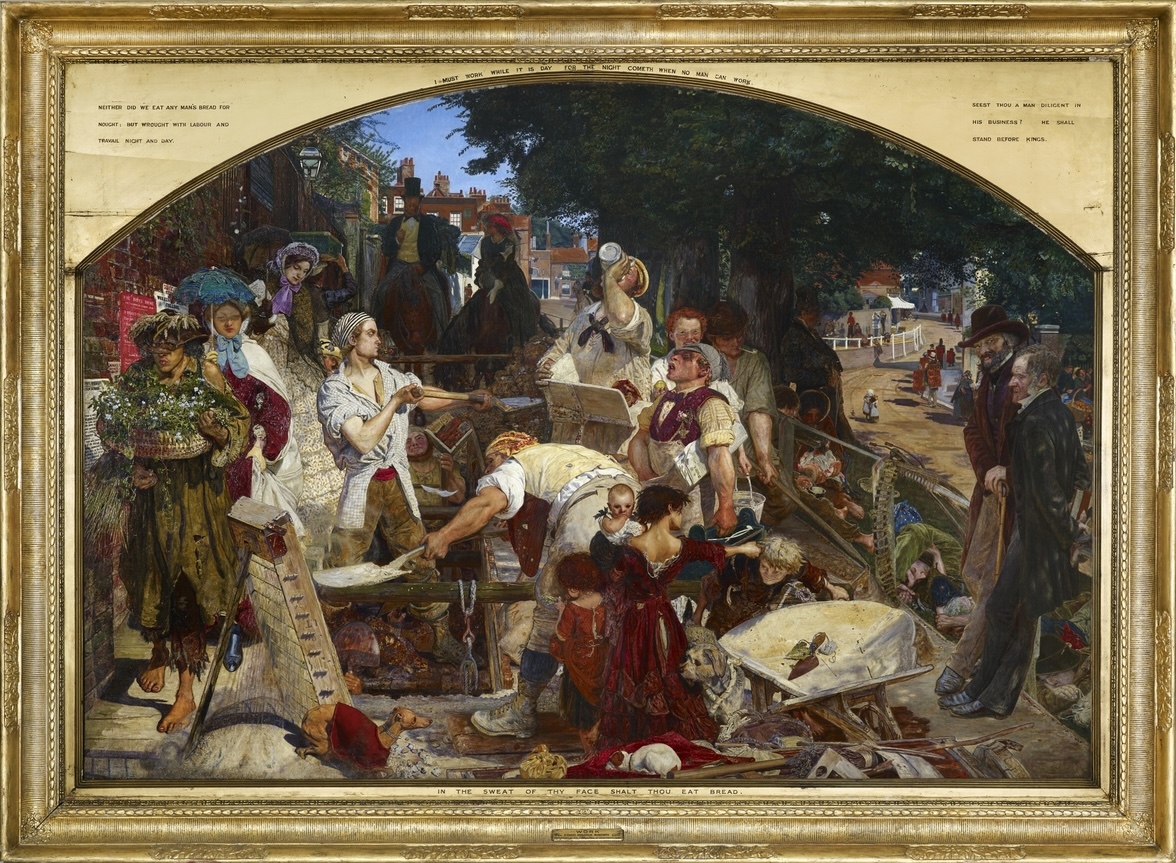
Five chapters of patient demolition have brought us here. Marx has shown that the surplus at the heart of capital cannot come from cheating, from markups, from the swing of supply and demand, or from a craftsman laboring alone. By Chapter Five’s end only one possibility remained standing: somewhere on the market there must exist a commodity whose use creates more value than the commodity itself costs. Chapter Six names that commodity, sets out the strange conditions under which it comes up for sale, works out its price — and then, with the secret almost in hand, leads us off the bright street of exchange and down into the place where the secret actually lives.
The Commodity That Makes Value
The commodity Marx has been circling is not labor but labor-power — and the distinction, which can sound like hair-splitting, is the pivot on which everything turns. Labor-power is the capacity to work: the bundle of muscle, nerve, skill, and brain that a human being can set in motion to produce things. Labor is the actual using of that capacity. What the worker sells, and what the capitalist buys, is the capacity — the power to labor for a stretch of time — not the labor itself, and certainly not its product.
Why does this matter so much? Because it threads the needle Chapter Five left impossibly narrow. The capitalist must buy at fair value and sell at fair value and still come out ahead. Labor-power lets him do exactly that. He pays the full, honest value of the worker’s capacity to work — and then, having bought it, he puts it to use, and its use is the creation of fresh value. If the value the working day produces exceeds the value of the capacity that produced it, the difference falls to the buyer, and no law of exchange has been broken anywhere. The whole secret of profit, Marx is signaling, lies in the gap between what labor-power costs and what labor does. Almost everything else in the book is the patient working-out of that single sentence.
Free in Two Senses
For labor-power to be on sale at all, a peculiar kind of person must exist, and Marx describes him with a phrase whose bitterness is easy to miss: the worker must be free in a double sense.
He must be free in the ordinary, dignified sense — the owner of his own capacity to work, able to bring it to market and strike a bargain as a legal equal of the man who buys it. And he must sell it only for a limited time, by the hour or the day or the week, never once and for all; for to sell himself outright, body and future, would be to stop being a free man and become a slave, a commodity rather than the owner of one. So far this is the cheerful language of liberty and contract.
But there is a second freedom, and it is the sting. The worker must also be free of everything he would need in order to work for himself — free of land, tools, materials, free of any means of production whatever. For if he owned a loom or a field, he would make and sell cloth or corn, not his own capacity to labor. It is precisely because he owns nothing but his own skin that he is driven to sell the one thing he has. The same word, “free,” names a right and a destitution: free to dispose of his labor-power, and free of any alternative to selling it. The elegance of the wage bargain rests on the worker having been emptied of every other option.
Marx then makes a point that quietly governs the rest of the book. This arrangement — owners of money and means of production facing the propertyless across a market — is not natural and not eternal. Nature, he writes, does not turn out capitalists on one side and the empty-handed on the other; the relation is the product of history, of many economic revolutions, of the wrecking of older ways of producing. A peasant with common rights to land, a craftsman with his own shop, do not appear in the labor market, because they have no need to. The free worker, free in both senses, had to be manufactured — and the story of how is one Marx defers to the book’s final chapters, where it turns out to be a story of dispossession rather than of thrift. For now it is enough that capital, the moment it appears, declares itself the mark of a particular and recent epoch, not a feature of the human condition.
What a Worker Is Worth
If labor-power is a commodity, it has a value, and that value is fixed the same way as any other: by the labor-time needed to produce it. But what does it take to produce a human capacity to work? It takes keeping the human being alive and able — feeding, clothing, housing, and warming him, so that tomorrow he can work as well as today. The value of labor-power, then, is the value of the means of subsistence required to maintain the worker in working order. A wage, at bottom, is the price of the basket of goods that keeps a worker on his feet.
Two refinements give the idea its real shape. First, the worker is mortal, and the supply of labor-power must outlast him, so the basket must be large enough to raise the next generation — to support a family, the workers who will replace him. And where skill is required, the cost of training enters too, which is why skilled labor-power is dearer: years of education are stored up in it. Second, and crucially, the basket is not a fixed biological minimum. What counts as a decent, normal life for a worker varies from country to country and age to age; it is shaped by history, custom, and the expectations a working class has won for itself. Into the value of labor-power, Marx says, there enters a historical and moral element. The floor is physical survival — below it the worker is maintained only in a crippled state — but the actual level floats well above that floor, set by the standard of living a society has come to treat as necessary.
One last peculiarity sets this commodity apart from all others. When you buy bread, you carry it off at once. But the worker delivers his labor-power only by working, which happens after the deal is struck — and almost everywhere wages are paid only at the end of the week or month, once the work is done. So the worker, in effect, advances his labor-power on credit and waits to be paid. The man with nothing extends a loan to the man with everything. Marx lets the irony sit, and notes, in passing, that the worker who is paid last is also the one ruined first when the employer goes bankrupt.
Eden and the Descent
Marx now pauses, at the very edge of the discovery, to survey the marketplace he is about to leave — and to mock it. Considered purely as a scene of exchange, the buying and selling of labor-power is a kind of paradise of liberal principle:
This sphere… is in fact a very Eden of the innate rights of man. There alone rule Freedom, Equality, Property and Bentham.
Freedom, because buyer and seller each act of their own free will and bind themselves only by contract. Equality, because they meet as two owners of commodities trading equivalent for equivalent. Property, because each disposes only of what is his own — the one his money, the other his labor-power. And Bentham — the philosopher of self-interest — because each party looks only to himself, and yet, as if guided by a benevolent providence, their selfishness is supposed to work out to the common good. This is the world as the free-trader sees it and judges it: a harmony of equals, freely contracting to mutual advantage. Marx’s point is not that these freedoms are simply false but that they are the surface — true as far as the eye can reach, and concealing everything beneath.
And then he descends. Buyer and seller, he says, must now be followed out of this noisy, sunlit sphere of exchange, where everything happens in the open, into the hidden abode of production — and over its entrance hangs the forbidding sign, “No admittance except on business.” There, and only there, will the secret of profit-making be forced into the light. As the two pass through the door, Marx watches their bearing change. The money-owner, now a capitalist, strides ahead, important and smirking, intent on the business at hand. The worker trails behind, timid and reluctant, like one who is bringing his own hide to market and has nothing to expect but — a hiding. On that grim pun the chapter, and with it the long approach of Part Two, comes to an end.
The Objections
The most common objection to this chapter is empirical and seems devastating at first hearing. Marx ties the wage to the cost of subsistence — yet across the rich world real wages have risen for a century and a half, and workers today live at a level their Victorian forebears could not have imagined. If the value of labor-power is the price of survival, why are so many workers not merely surviving but comfortable? And the usual Marxist escape — that historical and moral element, the customary standard built into the wage — looks to critics less like an insight than like an unfalsifiable patch: whatever wages turn out to be, one can always declare that the customary basket has simply moved to match them.
A second objection offers a rival theory of the wage altogether. Mainstream economics holds that workers are paid not according to what it costs to reproduce them but according to what their labor adds at the margin — the value of the output the last hour of work brings in. On this marginal-productivity account there is no hidden surplus quietly extracted: each factor of production, labor included, earns the value of its own contribution, and the wage is simply labor’s fair share. Marx’s whole drama of a gap between the cost of labor-power and the value labor creates dissolves; the worker is paid his product, not a fraction of it.
A third objection defends the very Eden Marx sneers at. The wage bargain, a liberal will insist, is genuinely free: the worker consents, may refuse this employer for that one, may quit, and gains real benefits from the deal. To redescribe this consent as veiled compulsion — to treat the man who chooses among jobs as no freer than a slave — is condescending, and it smuggles in a conclusion the argument has not earned. The libertarian philosopher Robert Nozick put the sharp version: a voluntary exchange made from a starting point that is itself just cannot be coercion merely because the alternatives are unpleasant. That a worker must work or go hungry is a fact about nature and scarcity, not a wrong done to him by the employer who offers him a job.
The Replies
To the charge that rising wages refute him, the Marxist answers that it rests on a misreading the chapter itself forecloses. Marx never said wages stay pinned to bare physical survival; he said the contrary, explicitly building a historical and moral element into the value of labor-power and noting that the standard of necessary wants climbs with a society’s development and with what its workers have managed to win. Rising real wages are not an embarrassment to the theory but something it anticipates. And the deeper claim was never that workers are kept at the edge of starvation; it is that exploitation persists at any wage level, so long as the value labor creates in a day exceeds the value of the labor-power bought for that day. A well-paid worker can be exploited as surely as a poor one — indeed, as later chapters argue, raising productivity is precisely how capital can let wages rise and enlarge its surplus at the same time. The objection mistakes a claim about the source of profit for a prophecy of universal misery. As for unfalsifiability, the defenders concede the historical-moral element is elastic, but insist the framework still says definite things — that the wage relation persists, that surplus is pumped out through it — and that in any given place and time the subsistence basket is, as Marx says, practically known.
Against the marginal-productivity theory, the Marxist reply runs deeper than a counter-assertion. The idea that labor is paid its marginal product presupposes a way of measuring the contribution of capital as an independent quantity — and a long technical dispute, the so-called Cambridge capital controversy of the mid-twentieth century, exposed serious incoherence in exactly that notion, with even some of its defenders conceding the logical points. More fundamentally, marginal productivity describes an equilibrium reached within a given distribution of property; it takes for granted who owns the means of production and who owns nothing. But that distribution — the worker’s double freedom, his propertylessness — is the very thing Marx says determines the bargain. To explain the wage by labor’s marginal product while treating the propertyless condition of the laborer as a neutral background fact is to answer the question by assuming away its hardest part.
On the freedom of the wage bargain, the Marxist makes a careful concession and then a structural point. Yes, each individual worker is free — free to choose his employer, to quit, even, now and then, to escape the working class entirely by some stroke of luck or enterprise. The analytical Marxist G. A. Cohen, who took Nozick’s challenge as seriously as anyone, granted all of this and answered that the freedom is nonetheless a collective fiction: there are not enough exits for every worker to take at once, so the open door through which any one of them may leave stays open only because the great mass of them cannot. Each is free on condition that the others stay put. The class is bound even where the individual is loose. And the last move returns to history. Nozick’s defense holds only if the propertyless starting point is itself just — and Marx’s closing chapters are devoted to arguing that it was not, that the dispossession which created the free worker was a matter of conquest, enclosure, and plunder rather than of anyone’s thrift. Whether the wage contract is a meeting of free equals or the polished surface of an old robbery cannot, in the end, be settled in the marketplace. It depends on the history Marx has reserved for last.
Toward the Hidden Abode
Chapter Six completes the long arc of Part Two and sets the stage for everything that follows. The riddle of where surplus comes from has been answered in principle: capital lives on the gap between the value of labor-power, which it pays in full, and the value labor creates, which it keeps. The peculiar commodity has been identified, its strange double-edged freedom described, its price worked out. All that remains is to watch the thing in operation — to step through the door marked “No admittance except on business” and see how, hour by hour, the working day is split into the part that pays for the worker and the part that enriches the man who hired him.
That is the work of Part Three, beginning with the chapter on the labor process and the production of surplus-value, where Marx at last makes good on his promise to force the secret of profit-making. He leaves the realm of Freedom, Equality, Property and Bentham behind with evident relief, trading the polite fictions of the contract for the unsentimental machinery of the workshop. Whether what he uncovers there is the long-hidden truth of exploitation or an artifact of the value theory he has carried down the stairs with him is, as ever, the question the reader must keep open. But the door is now open, and the noisy marketplace falls quiet behind us.