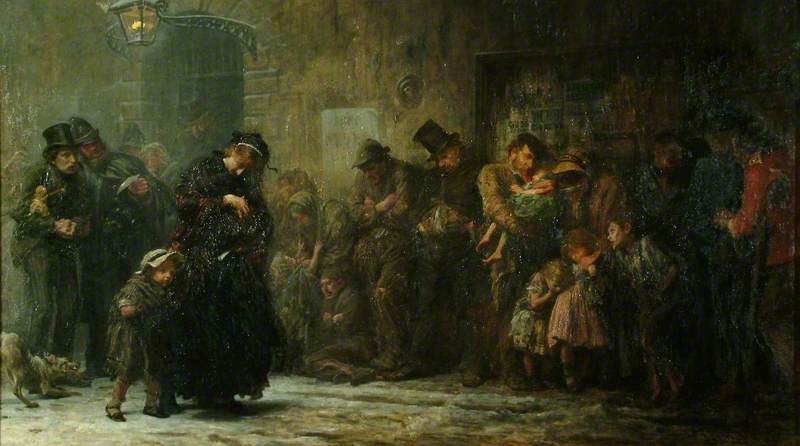
Until now Capital has mostly held time still, dissecting a single turn of the productive process to find where surplus-value comes from. Part Seven, the climax of the first volume, lets the clock run. It asks what happens when the surplus, once extracted, is fed back into production to make more capital, and then more again, cycle after cycle — what accumulation does to the system and, above all, to the people who live by selling their labour. Marx builds the answer in three steps. First he looks at the system merely repeating itself, and finds that bare repetition exposes what a single cycle hid. Then he lets it grow, and examines the drive to accumulate. Finally he states the law that governs the whole movement, and arrives at the industrial reserve army and the most quoted, most disputed sentence he ever wrote. The destination is the queue in Fildes’s painting: the workhouse door, in the cold.
The System Repeating
Marx begins, in Chapter Twenty-Three, with the simplest possible case, which he calls simple reproduction: suppose the capitalist consumes his entire surplus and reinvests nothing, so that production merely repeats next year on exactly the same scale. Nothing grows. And yet, viewed not as a single transaction but as a continuous, connected process, even this changeless repetition reveals three things the isolated cycle concealed.
The first concerns the wage. The capital the employer lays out on wages this year is value the worker himself produced in a previous cycle and was not paid for. The fund from which the worker is paid is, on closer inspection, the worker’s own past product, handed back to him in instalments. The second cuts deeper. However the capitalist originally came by his stake — by his own labour, by inheritance, by luck — it ceases, after enough cycles, to matter. The original capital is consumed and replaced, consumed and replaced, until, given enough time, the whole of the capital in his hands is nothing but accumulated surplus-value, congealed unpaid labour, whatever its honest beginnings. The third is the most quietly devastating: the worker’s own consumption — his eating, his sleeping, his recovery for tomorrow — is itself a moment in the reproduction of capital, since it maintains and renews the one instrument capital cannot do without, the worker himself. Even at rest he is being kept in trim for the next cycle.
What reproduction reproduces, then, is not merely goods, nor even surplus-value, but the relation itself: capitalist at one pole, wage-labourer at the other, the worker emerging from each cycle exactly as he entered it — propertyless, owning nothing but his capacity to work, and therefore compelled to sell it again. The single market transaction looked like a free exchange between equals. The process running through time reveals it as the constant reproduction of a bond.
Accumulate, Accumulate
Chapter Twenty-Four drops the artificial assumption and lets the system do what it really does: the capitalist reinvests part of the surplus, and production expands. Accumulation, stripped to its core, is simply surplus-value turned back into capital — used to buy additional means of production and additional labour-power, to extract a larger surplus, to be capitalized again, in a widening spiral. Marx lingers on two features of this movement.
The first is an inversion of the very principle on which commodity production seemed to rest. That principle looked fair: a person owns what their own labour produces. But set the system running, and the principle turns into its opposite. The surplus the worker produced and did not keep becomes capital; that capital commands more unpaid labour; and the worker’s propertylessness — the condition that made him sell his labour in the first place — is reproduced, enlarged, as the permanent basis of the whole arrangement. Property founded, in theory, on one’s own labour becomes in practice the right to appropriate the unpaid labour of others. The laws of property, by their own inner logic, flip into their contrary.
The second feature is the drive itself. Why does the capitalist plough the surplus back rather than simply enjoy it? Not, Marx insists, out of personal greed, and still less out of the virtue the economists called abstinence — Nassau Senior’s word, which dressed up a compulsion as a sacrifice deserving reward. The capitalist accumulates because competition leaves him no choice: expand, mechanize, and undersell, or be undersold and destroyed. He is capital personified, the conscious agent of a drive that is not really his own, the human bearer of value’s blind need to expand. Hence the famous war-cry Marx puts in his mouth — “Accumulate, accumulate! That is Moses and the prophets!” — accumulation for accumulation’s sake, production for production’s sake. The capitalist is not the system’s sovereign but its function, and that reframing matters: it means the cruelties to come are structural, not the work of wicked individuals who might simply choose better.
The General Law
Chapter Twenty-Five, the longest and most powerful in the book, asks the decisive question: what does this accumulation do to the working population? Everything turns on what Marx calls the composition of capital — the proportion between the part laid out on means of production and the part laid out on labour. He distinguishes its technical side (so many machines per worker) from its value side (so many pounds of constant capital per pound of variable), and calls the value-composition, in so far as it tracks the technical, the organic composition of capital.
Take first the case where that composition stays constant. Then accumulation raises the demand for labour, and wages may indeed rise. But Marx is emphatic about the direction of causation, against every economist who made wages the master variable: “the rate of accumulation is the independent, not the dependent, variable; the rate of wages, the dependent.” Wages rise only so long as their rise does not check accumulation; the moment higher wages eat far enough into surplus to slow the engine, accumulation slackens, the demand for labour falls, and wages sink back. A rise in wages, on this account, only lets the worker loosen “the golden chain the wage worker has already forged for himself” — never break it. The system can permit prosperity, but only within bounds it sets for its own continuance.
Now take the real case. As accumulation proceeds, productivity rises, and rising productivity means a rising composition — more machinery set in motion by proportionally less living labour, the variable part of capital shrinking relative to the constant. So the demand for labour grows more slowly than capital itself, and the lag accelerates. Concentration (large capitals growing) and centralisation (large capitals swallowing small ones, with competition and credit as their levers) speed the whole process; the railways, Marx notes, were built not by patient saving but by the joint-stock company’s overnight fusion of scattered capitals. And the cumulative result is that accumulation constantly produces a population surplus to its own immediate needs — a relatively redundant population, the industrial reserve army.
This reserve, Marx argues, is no accident and no mere by-product of bad years. It is a structural necessity — “the lever of capitalistic accumulation, nay, a condition of existence of the capitalist mode of production” — because capital requires a pool of disposable hands it can throw into new industries when markets suddenly open, and, always, a body of the unemployed whose competition holds the wages of the employed in check. The two halves of the class are set against each other: the overwork of those in jobs swells the reserve, and the pressure of the reserve forces those in jobs to submit to overwork. The army takes several forms — the floating (workers hired and fired in the industrial centres), the latent (the rural population on the verge of being driven into the towns), and the stagnant (the irregularly employed, the domestic outworkers, with maximum hours and minimum pay). And beneath them all lies the lowest layer: “The lowest sediment of the relative surplus population finally dwells in the sphere of pauperism” — the able-bodied without work, the orphaned, the demoralized, the mutilated victims of industry, the hospital and the dead weight of the active army. That sediment is precisely Fildes’s queue.
From this Marx draws the law that gives the chapter its name, and states it without flinching. The worsening is not contingent on wages falling; it holds, he writes, “be his payment high or low.” Then the sentence that has echoed for a century and a half:
Accumulation of wealth at one pole is, therefore, at the same time accumulation of misery, agony of toil, slavery, ignorance, brutality, mental degradation, at the opposite pole, i.e., on the side of the class that produces its own product in the form of capital.
The greater the wealth, the greater the reserve army and the deeper the pauperism at the bottom: “This is the absolute general law of capitalist accumulation,” qualified at once, and importantly, by the admission that “like all other laws it is modified in its working by many circumstances.” Marx then turns the chapter over to evidence — Gladstone confessing to Parliament an “intoxicating augmentation of wealth and power” entirely confined to the propertied while the poor had grown only “less poor,” the swelling pauper rolls, the inquiries into the half-starved nutrition and the infernal housing of London and Newcastle. To Gladstone’s consolation that the poor had grown less poor, Marx returns the retort that frames the whole law: a class that grows only “less poor” while producing an ever greater wealth for others has remained relatively just as poor as before.
The Objections
The first and gravest objection is that the immiseration thesis, read as it most naturally reads, is simply false. Marx says the worker’s lot must “grow worse” as capital accumulates; yet the century and a half since 1867 brought the working class of the developed capitalist world the largest sustained rise in living standards in human history — real wages, life expectancy, leisure, literacy, and consumption all multiplied many times over. No claim in Capital has been so often pronounced refuted by events, and not without reason.
A second objection holds that the reserve-army mechanism overpredicts. Permanent mass unemployment is not the steady state of advanced capitalism; economies have repeatedly come close to full employment, and unemployment behaves like a cyclical and frictional phenomenon rather than a fixed functional reservoir maintained for capital’s convenience.
A third objection presses on the foundations laid in the earlier chapters. The claims that all capital is congealed unpaid labour, and that property “inverts” into the right to appropriate others’ labour, rest wholly on the labour theory of value and the premise that the worker is entitled to the entire product. To anyone who rejects that premise, capital is accumulated saving and borne risk that earns a return, and the dramatic “inversion of property” is the original entitlement-assumption restated in Hegelian dress.
A fourth objection defends the abstinence Marx waved away. Saving and investment are genuinely costly choices; someone must forgo present consumption so that the means of production everyone later benefits from can be built, and the reward for that forbearance is a real economic function. To reduce the capitalist to a mere “personification of capital” erases a service that has a name and a cost.
The Replies
On immiseration, the honest reply concedes the strong reading and rescues a weaker one that may be the better reading of Marx in any case. The text itself resists absolute immiseration: Marx says the worker’s lot worsens “be his payment high or low,” and the chapter’s opening case grants outright that wages can rise. What the law then asserts is best understood as relative immiseration — a widening gulf between the wealth labour produces and the share it retains, the worker left “relatively just as poor” even as he grows absolutely richer. On that reading the evidence is far friendlier: the long ascent of living standards has indeed coincided with exactly the divergence between productivity and labour’s share, and the concentration of wealth at the top, that recent inequality research has documented in detail. And the “absolute general law” was stated from the first as a tendency “modified in its working by many circumstances” — checked in the rich world by trade unions, the welfare state, and productivity gains partly passed on to workers, and displaced outward to a colonial and post-colonial periphery where a vast global reserve army and immiseration in the strong, literal sense are not difficult to find. The fair verdict is mixed: the absolute thesis failed where Marx’s readers most expected it to hold, in the wealthy core; the relative and the global versions remain alive and partly borne out; and no one should pretend the question is closed in either direction.
On the reserve army, the most striking reply is that mainstream economics has quietly conceded the substance while rejecting the name. The proposition that there exists a rate of unemployment below which the economy cannot be pushed without accelerating inflation — the natural rate, the NAIRU — is the industrial reserve army in a grey suit: an admission that a buffer of joblessness is structurally required to keep wage demands in check, and one that central banks act on deliberately, cooling economies on purpose when labour markets grow “too tight.” The reserve, moreover, takes the newer forms Marx half-anticipated — underemployment, precarious and gig labour, discouraged workers who have stopped looking, and the immense informal workforce of the global South. The distance between the two pictures is smaller than the textbooks suggest.
On the value-theoretic objections, the reply is the one this series has had to make before. The reproduction argument — that the original capital is, in time, entirely replaced by capitalized surplus — is valid given the labour theory of value, and that theory is contested between rival frameworks rather than refuted inside a shared one. The inversion of property is a claim about where commodity production’s own principle of self-earned ownership leads once labour-power itself becomes a commodity; and how damning it is turns on a historical question the argument has so far bracketed — whether the original separation of the producers from the means of production was itself anyone’s honest earning, or the work of force.
On abstinence, the reply concedes the cost and disputes its meaning. Marx does not deny that building up the means of production requires forgoing present consumption; he denies that this forgoing is what creates the surplus — labour does that — and denies that it is freely chosen virtue rather than competitive compulsion. The time-preference story can explain a return to waiting; it cannot, on the Marxist account, explain the sheer scale of capital, its self-perpetuation, or its concentration in a class, and it cannot settle by itself whether the surplus is a reward earned or a surplus extracted. Once again the two frameworks face each other across a premise neither can compel the other to grant.
Toward the Origin
Part Seven carries the argument to its summit, and in doing so finally forces into the open the question it has leaned on at every step. The whole analysis of accumulation takes for granted a starting point: on one side, owners of the means of production; on the other, a mass of people with nothing to sell but their labour. Simple reproduction assumes that division, accumulation presupposes it, the reserve army continually refills it. But where did it come from — the original divorce of the producer from the means of production that the chapter on capital’s composition named “primitive accumulation” and then deliberately set aside?
Political economy, Marx observes, tells the story as a morality tale: long ago the diligent and frugal saved while the idle and spendthrift squandered, and so humanity sorted itself into propertied and propertyless, owners and workers. His final part, Part Eight, tells it as it actually happened — the enclosure of common land, the clearing of estates, the bloody statutes that whipped and branded the dispossessed into wage-labour, the plunder of the colonies, the trade in slaves — the real and violent history in which, as he will put it, capital comes into the world “dripping from head to foot, from every pore, with blood and dirt.” Whether one takes Part Seven as a rigorous demonstration that capitalist growth must throw off a reserve army and a pole of misery, or as a powerful tendency-claim whose strongest form the rich world disproved while its relative and global forms still cut, it ends where Fildes’s queue stands waiting — at the workhouse door, the human sediment of an age of unprecedented wealth — and turns, for its final reckoning, to the violence at the beginning.