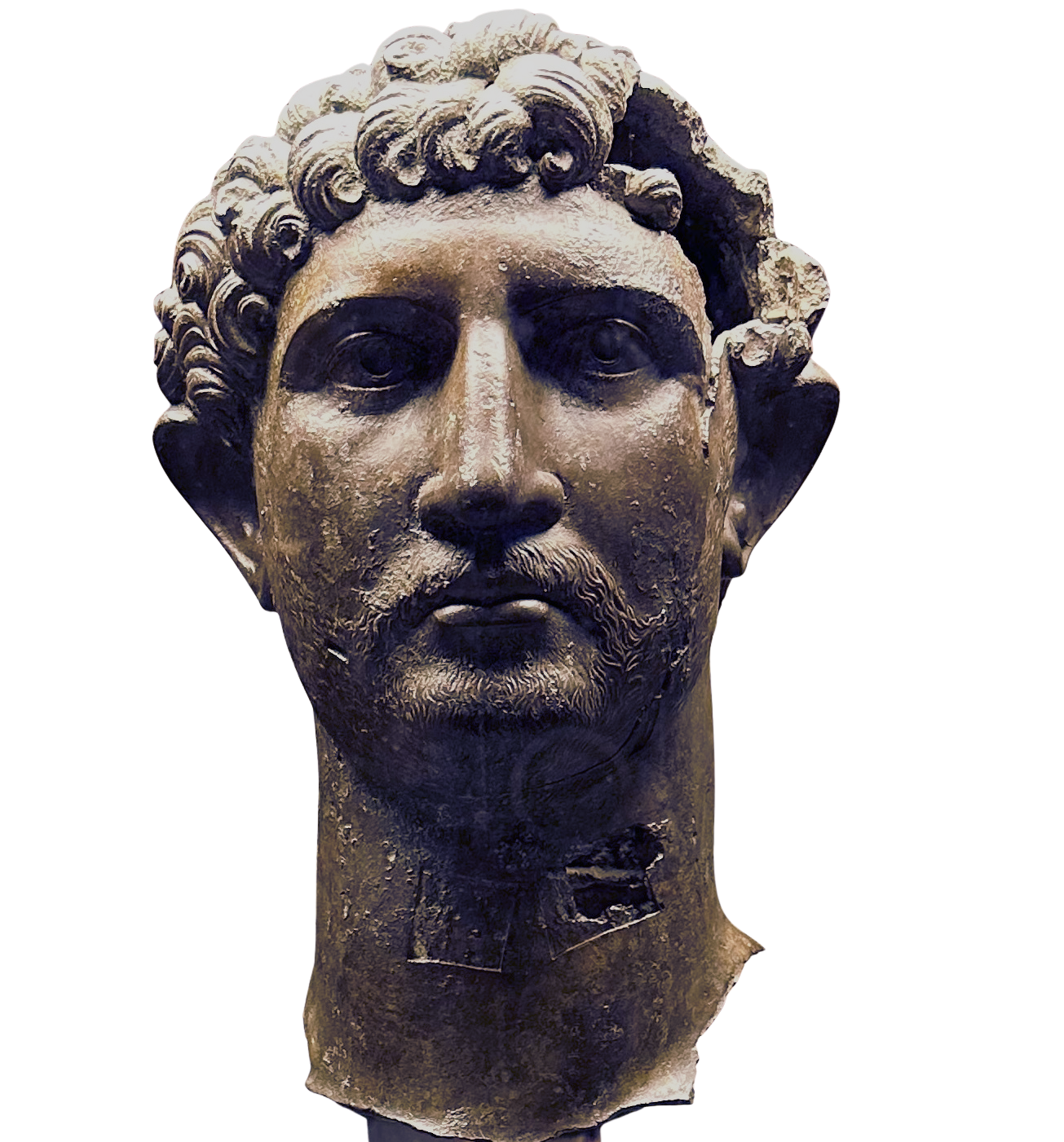
There are historical novels that work like costume parties — the period dress is convincing, but the people inside it think and speak like our contemporaries. And then there is Memoirs of Hadrian, which does something stranger and harder. Marguerite Yourcenar’s 1951 novel persuades you, page after page, that you are reading a document recovered from the second century. Not a forgery, not a pastiche. A voice.
The premise
The book takes the form of a long letter. The Emperor Hadrian, in his early sixties and aware that he is dying, sits down to write to the seventeen-year-old Marcus Annius Verus — the boy who will one day rule Rome as Marcus Aurelius. The letter is meant as a kind of inheritance: not advice exactly, and certainly not a defense of his reign, but an honest accounting. Animula vagula blandula, the little wandering soul, addressed by an old emperor who has loved, governed, hunted, built, lost, and is now examining the whole arc with a clarity that only the dying can afford.
That is the entire frame. There is no plot in the conventional sense. Hadrian remembers, reflects, doubles back, follows a thought wherever it leads. He talks about Trajan’s wars and his own decision to abandon the eastern conquests. He talks about architecture — the Pantheon, his villa at Tivoli, the wall in Britain that still bears his name. He talks about administration as a craft, about religious tolerance, about reading Greek philosophy in a military tent. And — running underneath all of it, surfacing again and again — he talks about Antinous.
How it was made
The book that Yourcenar published in 1951 had been with her since she was twenty. She drafted it, abandoned it, threw the manuscript into a trunk, rediscovered it in Connecticut after the war, and finally finished it in a kind of sustained fever. In the famous “Reflections on the Composition” she appended to later editions, she describes the method: she read everything Hadrian himself might have read, walked the places he walked, learned to think in his vocabulary. “One foot in scholarship, the other in that magic which, more accurately, is sympathetic magic.”
What she was after was harder than research. She wanted to occupy Hadrian’s interior. To know not just what he did but what it felt like to be him on a particular afternoon in a particular year, weighing a particular decision. The result is a prose so dense with thought that you read it slowly almost involuntarily, the way you’d walk through a gallery rather than a hallway.
Antinous
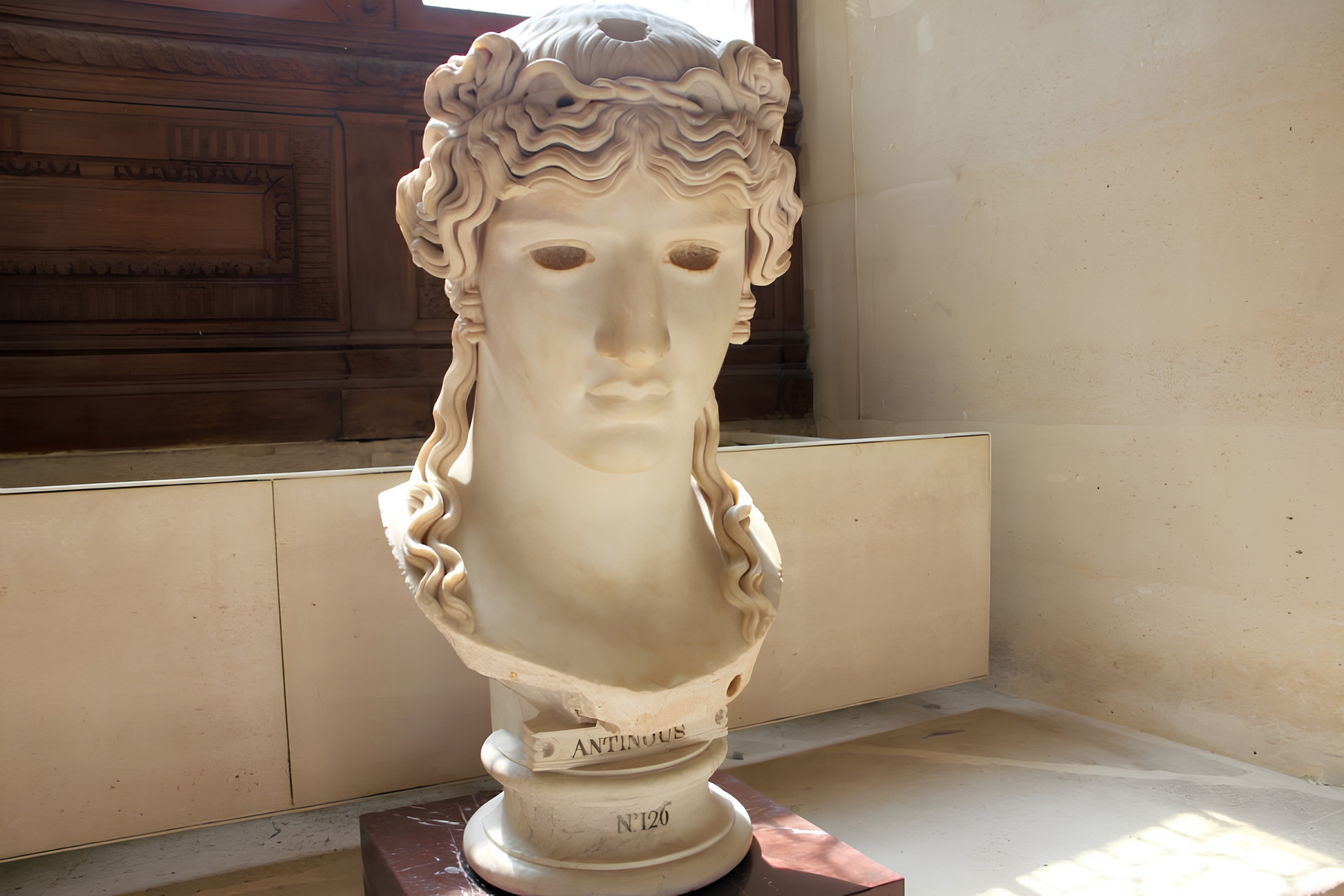
The Antinous Mondragone, a colossal marble portrait of Hadrian’s lover carved around 130 CE, soon after his death in the Nile. Discovered at the Villa Mondragone in Frascati and long held by the Borghese family, it was bought for Napoleon in 1807 and now stands in the Louvre. The holes drilled into the hair once secured a metal wreath; the eyes were originally inlaid with colored stones. Photo is my own.
The hinge of the book — the moment where its restraint becomes almost unbearable — is the death of Antinous.
He was a Bithynian Greek, around nineteen, who had been with Hadrian for perhaps six or seven years when he drowned in the Nile in October of 130 AD. The circumstances were never clear. Accident, ritual suicide, sacrifice, something darker — the ancient sources contradict each other and Yourcenar lets them. What she gives us instead is Hadrian afterward. The emperor who could move legions and reshape provinces, who had refused new conquests because he believed in the limits of empire, finds himself unable to do the single thing he wants: bring this boy back, or even properly grieve him.
Yourcenar’s portrait of that grief is one of the great achievements in twentieth-century prose because she writes it without sentimentality and without modern apology. She does not turn Hadrian into a tragic martyr; she does not impose later categories on him. She gives us the actual texture of the loss — the small objects that keep surfacing, a comb, a sandal, a hunting javelin. The way the public deification, the founding of Antinoöpolis on the bank where the body was found, the order that Antinous’s image be carved and cast in every corner of the empire, all begin to read like the flailing of someone who has run out of ways to keep a person near. Vast power, and it cannot return one face.
What stays with you is the absoluteness of the absence. Hadrian is the most powerful man in the world. He could change the law of any province by lifting a hand. And the one thing he wants — for this boy not to be dead — is the one thing he cannot do. Yourcenar understood, I think, that all love eventually contains some version of this hard edge. The grief of the bereaved, but also the grief of love that cannot be openly held, or that arrives at the wrong time, or that exists only across a distance one is not allowed to close. Anyone who has loved someone they could not be with, or could not name, recognizes Hadrian without translation. The specifics are imperial and second-century. The ache is not.
It matters, I think, that Yourcenar herself spent four decades in a quiet, devoted partnership with Grace Frick — the same Grace Frick who translated this book into English, working sentence by sentence beside the author. They lived together on Mount Desert Island in Maine, in a house called Petite Plaisance. Yourcenar was not writing about a love between men from the outside. She knew, in her own way, what it was to love across the categories the world hands you, and to hold that love unbroken across decades. When she writes Hadrian’s grief, she is writing about something she had been thinking about her whole life.
Why it endures
Plenty of historical fiction tells you what happened. Memoirs of Hadrian asks something else: what does a life look like from inside, at the end, when there is no more performing left to do? Hadrian on the page is not flattering himself. He notes his cruelties as carefully as his accomplishments. He records the moments when he was wrong without theatrically punishing himself for them. He has the particular honesty of someone who knows the audience he most needs to convince is already dead — himself, at every earlier age.
The book also contains some of the most quoted lines in twentieth-century literature about aging, power, and love. “When I consider my life, I am appalled to find it a shapeless mass.” “Like everyone else I have at my disposal only three means of evaluating human existence: the study of self, which is the most difficult and most dangerous method, but also the most fruitful; the observation of our fellowmen, who usually arrange to hide their secrets from us; and books, with the particular errors of perspective to which they inevitably give rise.”
In 1980, Yourcenar became the first woman elected to the Académie française. The novel was a large part of why. It has never gone out of print in French or in Grace Frick’s English translation, which Yourcenar collaborated on closely and considered effectively co-authored.
A note on reading it
This is not a book to race through. It rewards a chair, an evening, and the willingness to put it down for a day when a passage asks you to. Read with a pencil. There is something in it for almost any stage of life — the ambition of young Hadrian rising through Trajan’s court, the consolidating middle years, the bewildered grief of late love, the strange peace of an emperor who has finally stopped wanting anything except to tell the truth.