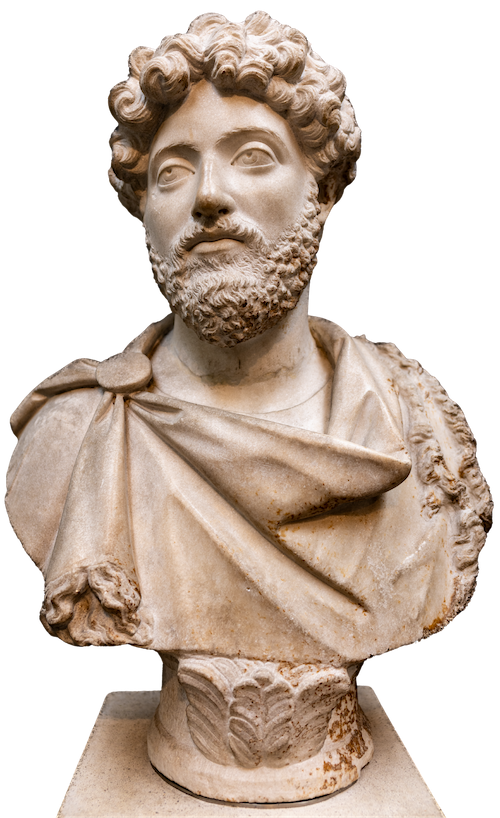
Marcus Aurelius (121–180 CE) was the sixteenth emperor of Rome — and, in a twist of history almost too good to be true, a genuine philosopher. Not a philosopher in the court-decoration sense, nor one who philosophized from the safety of a garden or a library, but one who carried the full, crushing burden of imperial rule while privately, doggedly working to become a better man.
The twelve books we know as the Meditations were written in Greek — the language of philosophy, not of Roman power — during the last decade of his reign, most likely while on military campaign along the Danube. They were never intended to be read by anyone. There is no rhetoric in them, no performance, no interest in posterity. What survives is a man in dialogue with himself: noting his failures, restating principles he feared he was forgetting, shoring up his resolve against the corrosions of vanity, anger, grief, and distraction.
He inherited his philosophical formation from the Stoic tradition, particularly the thought of Epictetus, the former slave whose Discourses established that freedom is entirely interior — that no external circumstance, however terrible, can touch the reasoning soul if that soul refuses to be shaken. Marcus returned to this insight again and again, not because he found it easy, but because he found it necessary.
The Meditations are organized into twelve books, though the organization is loose and was almost certainly not imposed by Marcus himself. The passages move without transition — from granular self-reproach to cosmic reflection, from the brevity of a single life to the indifference of eternity. What holds them together is not argument but practice: the daily work of re-centering on what is real, what is in our power, and what — inevitably, gratefully — is not.
That a man who commanded armies and administered an empire spanning millions of people felt it necessary to remind himself, repeatedly, not to be distracted by others’ opinions, not to speak more than necessary, not to waste the morning — this is not irony. It is the whole point.
Book I
«From my grandfather’s father, to dispense with attendance at public schools, and to enjoy good teachers at home, and to recognize that on such things money should be eagerly spent.»
«From Apollonius, self-reliance and an unequivocal determination not to leave anything to chance; and to look to nothing else even for a moment save Reason alone; and to remain ever the same, in the throes of pain, on the loss of a child, during a lingering illness; and to see plainly from a living example that one and the same man can be very vehement and yet gentle: not to be impatient in instructing others.»
Book II
«Say to yourself at daybreak: I shall come across the busy-body, the thankless, the bully, the treacherous, the envious, the unneighbourly. All this has befallen them because they know not good from evil. But I, in that I have comprehended the nature of the Good that it is beautiful, and the nature of Evil that it is ugly, and the nature of the wrong-doer himself that it is akin to me — not as partaker of the same blood and seed but of intelligence and a morsel of the Divine — can neither be injured by any of them, for no one can involve me in what is debasing, nor can I be wroth with my kinsman and hate him. For we have come into being for co-operation, as have the feet, the hands, the eyelids, the rows of upper and lower teeth.»
«Not easily is a man found to be unhappy by reason of his not regarding what is going on in another man’s soul; but those who do not attend closely to the motions of their own souls must inevitably be unhappy.»
«Even if thy life is to last three thousand years or for the matter of that thirty thousand, yet bear in mind that no one ever parts with any other life than the one he is now living nor lives any other than that which he now parts with.»
Book IV
«Efface the opinion, I am harmed, and at once the feeling of being harmed disappears; efface the feeling, and the harm disappears at once.»
«Behave not as though thou hadst ten thousand years to live. Thy doom hangs over thee. While thou livest, while thou mayest, become good.»
«As a river of all things that come into being, aye, a rushing torrent, is Time. No sooner is a thing sighted than it is carried past, and lo, another is passing, and it too will be carried away.»
Book VI
«Because thou findest a thing difficult for thyself to accomplish do not conceive it to be impracticable for others; but whatever is possible for a man and in keeping with his nature consider also attainable by thyself.»
«Death reduced to the same condition Alexander the Macedonian and his muleteer, for either they were taken back into the same Seminal Reason of the Universe or scattered alike into the atoms.»
«Asia, Europe, corners of the Universe: the whole Ocean a drop in the Universe: Athos but a little clod therein: all the present a point in Eternity: everything on a tiny scale, so easily changed, so quickly vanished.»
Book VII
«In conversation keep abreast of what is being said, and in every effort, of what is being done. In the latter see from the first to what end it has reference, and in the former be careful to catch the meaning.»
«A little while and thou wilt have forgotten everything, a little while and everything will have forgotten thee.»
«This is the mark of a perfect character, to pass through each day as if it were the last, without agitation, without torpor, without pretense.»
Book VIII
«In every action ask thyself, How does it affect me? Shall I regret it? But a little and I am dead and all that lies between is past. What more do I ask for, as long as my present work is that of a living creature, intelligent, social, and under one law with God?»
«Imagine a man to stand by a crystal-clear spring of sweet water, and to rail at it; yet it fails not to bubble up with wholesome water. Throw in mud or even filth and it will quickly winnow them away and purge itself of them and take never a stain. How then possess thyself of a living fountain and no mere well? By guiding thyself carefully every hour into freedom with kindliness, simplicity, and modesty.»
Book IX
«He that does wrong, does wrong to himself. The unjust man is unjust to himself, for he makes himself bad.»
«When men blame or hate thee or give utterance to some such feelings against thee, turn to their souls, enter into them, and see what sort of men they are. Thou wilt perceive that thou needest not be concerned as to what they think of thee. Yet must thou feel kindly towards them, for Nature made them dear to thee.»
«Take a bird’s-eye view of the world, its endless gatherings and endless ceremonials, voyagings manifold in storm and calm, and the vicissitudes of things coming into being, participating in being, ceasing to be. Reflect too on the life lived long ago by other men, and the life that shall be lived after thee, and is now being lived in barbarous countries; and how many have never even heard thy name, and how many will very soon forget it.»
Book XI
«What is thy vocation? To be a good man.»
«As those who withstand thy progress along the path of right reason will never be able to turn thee aside from sound action, so let them not wrest thee from a kindly attitude towards them; watch over thyself in both directions alike, not only in steadfastness of judgment and action but also in gentleness towards those who endeavour to stand in thy path or be in some other way a thorn in thy side.»
Book XII
«There must be either a predestined Necessity and inviolable plan, or a gracious Providence, or a chaos without design or director. If then there be an inevitable Necessity, why kick against the pricks? If a Providence that is ready to be gracious, render thyself worthy of divine succour. But if a chaos without guide, congratulate thyself that amid such a surging sea thou hast in thyself a guiding Reason.»
Author: Marcus Aurelius Antoninus
Written: c. 161–180 CE · Genre: Philosophical journal · Tradition: Stoicism
Translation: Charles Reginald Haines, 1916 · Harvard University Press / Loeb Classical Library