There is a particular kind of historical vertigo that strikes a visitor entering the Mausoleum Room of the British Museum. The room takes its name from a monument that no longer stands — a building destroyed by earthquakes, systematically dismantled for building materials, and looted across seventeen centuries — yet here its fragments endure: a colossal horse, a marble lion, reliefs of battling warriors, and the larger-than-life statues of a man and a woman draped in folds of stone that somehow still move with the weight of lived authority. These objects were pried from the walls of a medieval castle and lifted from beneath two thousand years of Anatolian earth by a British archaeologist in the 1850s. The story of how they got here is inseparable from the story of the world they came from — the world of Mausolus and Artemisia II of Caria, of the Classical Greek moment at its most extravagant and self-assured, and of the monument they built together that gave all subsequent grand tombs their name.
Caria and Its Dynasty
The photographs taken during an March visit to the British Museum capture objects that were once part of a single ensemble — one of the most ambitious building projects of the ancient Mediterranean world — commissioned in the middle of the fourth century BCE, at the height of what scholars call the Classical Greek period, roughly spanning from the Persian Wars in the early fifth century to the death of Alexander the Great in 323 BCE. It was an era that produced the Parthenon, the tragedies of Sophocles and Euripides, the philosophy of Plato and Aristotle, and a sculpture tradition of extraordinary naturalism and emotional range. The Mausoleum at Halicarnassus belongs at the apex of this tradition, though it was built not by Greeks but by Carians who had absorbed Greek culture so thoroughly that the line between imitation and innovation had long since dissolved.
Caria was a territory in the southwestern corner of what is now Turkey, occupying the peninsula that juts into the Aegean between the islands of Rhodes and Cos. Charles Thomas Newton, writing in his History of Discoveries at Halicarnassus, Cnidus and Branchidae — the foundational account of the nineteenth-century excavation — devotes his opening chapter to the region’s complicated ethnic and cultural genealogy, tracing its Phoenician, Carian, Lelegean, and eventually Greek settler populations. The coastal cities of Caria, Newton notes, were subject to successive waves of conquest — Lydian, then Persian — yet retained a character shaped as much by local dynastic ambition as by any imperial power. By the time of the Hecatomnid dynasty in the fourth century, a family of native Carian origin had managed to consolidate control of the region as hereditary satraps — provincial governors — nominally subordinate to the Persian crown but in practice operating with the independence of kings. Their capital was Halicarnassus, modern Bodrum, a naturally sheltered harbor city that Mausolus transformed, over the course of his long reign, into one of the most architecturally ambitious cities in the eastern Mediterranean.
Mausolus ruled Caria from approximately 377 BCE until his death in 353 BCE. He was, by any measure, a remarkable ruler: he moved the capital from Mylasa to Halicarnassus, unified outlying Lelegean settlements into a coherent civic structure, projected power across the Aegean, and cultivated Greek artistic and architectural traditions with the deliberate energy of a patron who understood that culture was also politics. He extended Carian territory to the southwest coast of Anatolia and into the Aegean islands, including Rhodes. He deepened Halicarnassus’s harbor, built fortifications and a palace, constructed temples and a theater, and began planning the monument that would render his name immortal in a way he almost certainly did not intend — by becoming the root of a common noun.
Artemisia II: Widow, Warrior, Builder
Mausolus died in 353 BCE. He was survived by his sister and wife, Artemisia — a dynastic marriage following an ancient Carian custom that the Greeks found strange and that later ages would find alternately romantic and disturbing. Artemisia II of Caria, born around 395 BCE, had been both co-ruler and consort of Mausolus for most of her adult life. She was, as Britannica records, “sole ruler for about three years after the king’s death,” inheriting both his political responsibilities and the unfinished ambition of his building projects. She was also, by the testimony of ancient sources, a woman undone by grief in a way that became legendary and literary in its own right.
The ancient accounts of Artemisia’s mourning are extraordinary. She is said to have mixed the ashes of Mausolus into her daily drink, gradually consuming what remained of him, a daily act of devotion that made her, in the words of Giovanni Boccaccio writing more than a millennium later, “a lasting example of chaste widowhood and of the purest and rarest kind of love.” Rembrandt painted her in 1634, at the moment of drinking. The image circulated widely through Dutch Golden Age culture. Yet the literary image of the grief-mad widow somewhat obscures the more formidable aspects of her actual reign. When her accession to the throne prompted a revolt in some of the island and coastal cities under her command — objecting to a female ruler — she responded with military decisiveness. The Rhodians dispatched a fleet to Halicarnassus to depose her. Artemisia commanded the citizens to appear on the walls and cry out their willingness to surrender. The Rhodian fleet, deceived, disembarked and entered the city; Artemisia’s warships slipped around them through a hidden channel, captured the Rhodian fleet in the harbor, and used it to carry her own troops to Rhodes, where she installed a trophy commemorating her conquest. The place where the trophy stood was later called the Abaton — the inaccessible place — because the Rhodians, ashamed, barred entry to it forever.
Artemisia’s great project was not the military campaign but the Mausoleum. She directed and funded the monument’s completion, summoning the most celebrated sculptors of the Greek world and sparing no expense on materials, design, or decoration. She died around 351 BCE, only two years after Mausolus, before the building was fully complete. The sculptors, Pliny the Elder records, chose to remain and finish the work after her death, “considering that it was at once a memorial of their own fame and of the sculptor’s art.” The ashes of both Mausolus and Artemisia were placed together in the underground burial chamber below the podium — united in death as they had been in life, in a monument designed to preserve that union against the erosion of time.
The Architecture of Permanence: Pytheos, Satyros, and the Classical Mathematical Plan
The Mausoleum was designed by two principal architects, Pytheos (sometimes rendered Pythius) of Priene and Satyros of Paros, who, as the Roman architect Vitruvius records in his De Architectura, also wrote a treatise on the building — a work now lost but known to have been used by Pliny the Elder in his account of the monument. Their design followed the Classical Greek preference for proportion and geometric discipline, applying a set of ratios that determined the relative scale of each component part. The structure rose in three clearly articulated zones, each following a strict proportional relationship to the others.
At the base was a massive podium — a raised platform of Anatolian and Pentelic marble, roughly rectangular in plan, serving both as the visual foundation of the monument and as the structural system within which the burial chamber was concealed. Above the podium rose the pteron (from the Greek word for wing, referring to the colonnaded surround): a peristyle of thirty-six Ionic columns, nine per side, with sculptures placed between each pair. Above the pteron, a stepped pyramid of twenty-four steps tapered upward to a platform at the summit. The entire composition was crowned by a quadriga — a chariot drawn by four horses — carrying colossal representations of Mausolus and Artemisia, the work of Pytheos himself. Pliny records that the total circumference of the building was approximately 440 classical feet, around 125 meters, and that the height from base to summit was approximately 140 feet, roughly 43 meters. Some scholars, working from later sources and from Newton’s excavations, have estimated the full height at nearer 45 meters, or 148 feet.
Several architectural terms require unpacking for a modern reader. The pteron, as noted, was the colonnaded gallery surrounding the central tomb mass — literally a “wing” of columns that gave the structure its distinctive silhouette and provided sheltered space for statuary. The Ionic order, one of three principal orders of Classical Greek architecture alongside Doric and Corinthian, is characterized by columns with bases, a relatively slender shaft, and capitals decorated with scrolled forms called volutes. The Mausoleum’s columns were tall and closely spaced, their capitals generating a visual rhythm around the entire structure. The pyramid in this context was not an Egyptian type but a stepped, tapering form — essentially a sequence of successively smaller receding stages, each step slightly back and up from the one below — a form derived from Lycian tomb architecture but deployed here on a scale and with a refinement that was entirely unprecedented.
The sculptural program was divided among four of the most distinguished sculptors of the age. Pliny records that Scopas worked the eastern frieze, Bryaxis the northern, Timotheus the southern, and Leochares the western. Vitruvius adds Praxiteles to the list and notes that all four submitted their work to mutual appraisal. These reliefs — among them the celebrated Amazonomachy, depicting Greeks and Amazons in combat — were mounted on the outer walls of the podium. Free-standing statues, some colossal in scale, occupied the spaces between the columns of the pteron and stood along the steps of the podium. Stone lions, originally numbering around twenty, flanked the approach stairway. At the four corners of the pyramid stood equestrian figures of warriors mounted on horseback. On the summit, the quadriga rose against the Aegean sky.
The Hidden Burial Chamber
For all its architectural pageantry, the Mausoleum’s central purpose was to keep the remains of Mausolus and Artemisia permanently secure. This was achieved through an engineering solution of extraordinary thoroughness, concealed beneath the elaborate display of the exterior.
Deep inside the lower podium foundation, entirely below ground level, lay the burial chamber itself, preceded by a narrow entrance corridor known in Greek architectural terminology as the dromos — literally a “running way” or passage, the covered approach leading to the innermost room. Both the dromos and the chamber were constructed using sturdy stone barrel vaults — semicircular arched forms built in heavy masonry — engineered to distribute the immense compressive weight of the podium and all its superstructure downward and outward without crushing the space below. The barrel vault, one of the most fundamental structural devices in ancient architecture, works by converting the downward force of the load above into lateral thrust at the base of the arch, which the surrounding rock and masonry absorb. In this case, the vaulting was extraordinarily thick, designed not just to carry weight but to resist any attempt at forced entry from above.
The principal object within the chamber was a monolithic sarcophagus — a massive container for the royal remains carved from a single block of white marble, its scale and the unity of its material serving as symbolic assertions of permanence and integrity. In it, the ashes of the royal pair were placed, the urn contents mingled or placed side by side, together within the stone body of a vessel designed to outlast the city above it.
After the death of Artemisia, a sacrificial ritual sealed the chamber for eternity — or was intended to. Dozens of animal bodies, including oxen, sheep, lambs, and birds (evidence of which was confirmed by excavation in both the nineteenth century and in later Danish campaigns), were laid across the entrance stairs as offerings, combining funerary piety with physical obstruction. Workers then filled the entire stairwell with compacted rubble, earth, and stone, converting the dromos into a solid plug of material. The main entrance to the underground section was then sealed definitively using a single massive monolithic stone block, fitted tightly into the opening and secured, according to some accounts, with metal bolts. The entrance was buried below the level of the surrounding earth. To any future intruder, there was simply no way in.
The intention was absolute. The monument above advertised the presence of the royal dead; the engineering below was designed to make that presence permanently, physically unreachable. In this respect the Mausoleum represented a convergence of two anxieties endemic to ancient royal burial: the need to honor the dead publicly and grandly, and the need to protect them from the violation that public display inevitably invited.
Seventeen Centuries of Erosion
The Mausoleum stood for more than sixteen centuries. When Alexander the Great captured Halicarnassus in 334 BCE — storming a city defended in part by the Carian princess Ada’s forces — the building was left intact. Pirates raided the city in 62 BCE and again in 58 BCE without disturbing the tomb. Byzantine writers described it into the twelfth century CE. Newton, in his chapter on medieval literary evidence, assembles a sequence of Byzantine textual notices attesting that the structure remained recognizable, if damaged, through successive centuries of neglect and earthquake activity. He treats this documentary record with scholarly care, assessing the credibility of each notice against the internal consistency of its description.
At some point between the twelfth century and 1402, a series of earthquakes destroyed the upper portions of the monument, toppling the colonnade and bringing the quadriga down from its summit. When the Knights of St. John of Jerusalem arrived at Halicarnassus in 1402, they found the Mausoleum already in ruins. They established themselves on the harbor promontory and began building the Castle of St. Peter — Bodrum Castle — using the Mausoleum’s marble blocks as ready-cut building material. The castle’s walls still contain sections of polished marble that were once part of the monument. Newton, examining the castle carefully in 1855 and 1856, identified lions and other sculptural fragments embedded in its masonry, providing one of his first confirmations that the Mausoleum’s site was nearby.
In 1522, as the Ottoman sultan Suleiman the Magnificent was preparing his assault on Rhodes, the Knights reinforced the castle. Claude Guichard, writing in his Funerailles des Rommains in 1581, preserved the most detailed account of what happened next — a narrative that Newton quotes and analyzes at length in his History of Discoveries. During the works, a party of knights broke through into the underground chamber. They found, at the bottom of the stairwell, a burial room containing a great coffin of white marble decorated with carvings and inlaid with colored glass and gold patterns. The hour was late. They resolved to return the next morning. When they came back, the tomb had been plundered overnight — the coffin broken open, the bones and royal remains scattered, any treasure gone. Whether local villagers, the Ottoman forces already infiltrating the region, or the knights’ own number were responsible has never been established. Newton examines the plausibility of Guichard’s narrative with characteristic caution, concluding that its internal detail is too specific and too consistent with what later excavation would confirm to be dismissed as invention.
Charles Thomas Newton and the Expedition of 1856
The modern story of the Mausoleum’s physical remains begins with Charles Thomas Newton, a British archaeologist who had served as an assistant in the British Museum’s Department of Antiquities from 1840 and who, from 1852, had been posted to the Aegean as vice consul at Mytilene on the island of Lesbos, with an explicit brief to identify and secure antiquities of interest for the Museum. He excavated on Kalymnos in 1854 and 1855, recovering inscriptions with funds advanced by Lord Stratford de Redcliffe. But the project that had long occupied his imagination was the Mausoleum — a monument known from Pliny and Vitruvius and from fragments embedded in Bodrum Castle, but whose exact site had been lost to systematic memory.
Newton visited Bodrum in 1855 and identified lions in the castle walls. In 1856 he made a further reconnaissance aboard HMS Medusa. His official reports to the Secretary of State for Foreign Affairs, later laid before Parliament, form the documentary backbone of his History of Discoveries at Halicarnassus, Cnidus and Branchidae, published in two volumes in 1862, written in conjunction with the architect R. P. Pullan. The expedition itself, financed by Her Majesty’s Government during the premiership of Viscount Palmerston, ran from October 1856 to June 1859. Newton was assisted by Pullan, who produced the architectural drawings and reports; by Lieutenant R. M. Smith of the Royal Engineers, who commanded a small detachment of sappers and whose systematic survey of the site was critical to locating the monument’s foundations; and by Royal Engineers corporals Spackman and McCartney, who made the photographic record — Newton being, as the Royal Academy of Arts notes, one of the first archaeologists to employ a photographer on his staff.
Newton describes the arrival of HMS Gorgon at Budrum — the Turkish name for Bodrum — in November 1856. The identification of the Mausoleum’s site required legal maneuver as much as archaeological intuition: Newton calculated which plots of land, based on the ancient descriptions, must overlie the foundations, and arranged the purchase of those plots from their local owners. The excavation began in earnest on January 1, 1857. Within weeks, his team had located the outline of the structure’s foundations, confirmed by the correspondence of dimensions with those recorded by Pliny. They found sections of the Amazon frieze, portions of the stepped roof, an alabastron — a small stone vessel — bearing the name of Xerxes, and the great stone that had once blocked the entrance to the burial chamber. The chamber itself was reached: it was empty, its contents long since disturbed or removed, but its structural form was intact, with the barrel vaulting of the dromos still in place and the scale of the chamber confirming the ancient accounts.
What Newton’s expedition recovered was not the burial goods — those had gone in 1522 or before — but the sculptural program and architectural members that had fallen into the soil when the superstructure collapsed. He found the colossal free-standing statues, sections of the Amazon frieze, stone lions, equestrian figures, and fragments of the quadriga’s chariot and horses. He also found, embedded among the ruins, the broken wheel of the great chariot sculpture that had crowned the pyramid — a fragment suggesting the complete wheel would have exceeded two meters in diameter. The statues, reliefs, architectural members, and other significant finds were transported to London, where they have remained ever since in the Mausoleum Room at the British Museum.
The Photographs: Fragments of a Wonder
The photographs taken during an March visit to the British Museum show four objects that were once part of a single architectural and sculptural system. Each repays close attention.
The Colossal Marble Horse
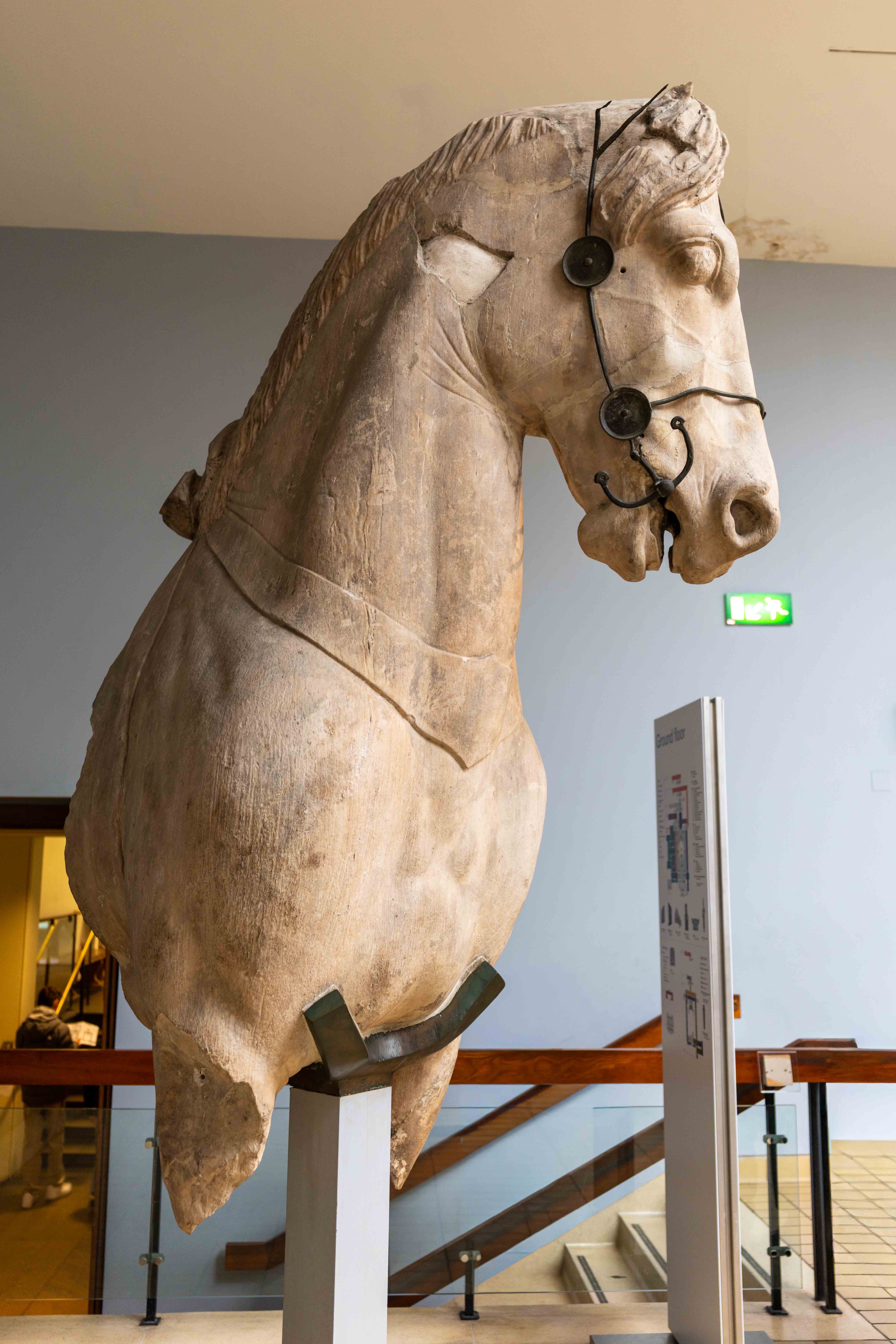
Colossal marble horse, once part of the quadriga crowning the Mausoleum at Halicarnassus, c. 350 BCE. The bridle still retains its metal fittings. British Museum, London. Photograph by the author, March 2026.
The largest and most immediately commanding object in the images is the colossal marble horse — a fragment of the upper body and head of one of the four horses that drew the quadriga at the summit of the Mausoleum, some forty-three meters above the ground. The horse is displayed on a modern metal armature that places its head approximately four meters from the gallery floor, and still it dominates the space. The scale alone communicates the ambition of the original design: these horses, seen from street level in ancient Halicarnassus, would have been nearly invisible in their individual detail but would have generated an unmistakable silhouette against the sky — the universal symbol of royal power and divine victory.
What arrests the eye at close quarters is not the scale but the sensitivity of the carving. The mane is rendered in precise, rhythmically repeated waves, not stylized into abstraction but observed from life and then idealized into something more concentrated than nature. The nostrils are wide, the eye sockets deep, the musculature of the neck and chest conveyed through the subtlest modulation of the stone surface. Most striking of all is the survival of the metal bridle — its cheek pieces and bit rings still in place, a reminder that the original figure would have been polychromed and equipped with metal accessories that integrated the marble with materials of a different register. The ancient statuary that fills museums today is almost always denuded of its original color and fittings; this horse, retaining its metal bridle, gives a fragmentary but vivid sense of the multi-material richness of the original.
The figure was sculpted in the workshop tradition associated with Pytheos, the architect who also served as a sculptor and who, according to Pliny, made the quadriga group himself. It belongs to a moment in Greek sculpture — roughly 350 BCE — when the representation of animal forms had achieved a naturalism unprecedented in the tradition, building on the advances of fifth-century workshops but pushing further toward the individual and the particular. Newton’s team found the great fragments of the chariot wheel separately; that this horse survives with such completeness is a testimony both to the depth of its burial and to the care of the excavation.
The Amazon Frieze
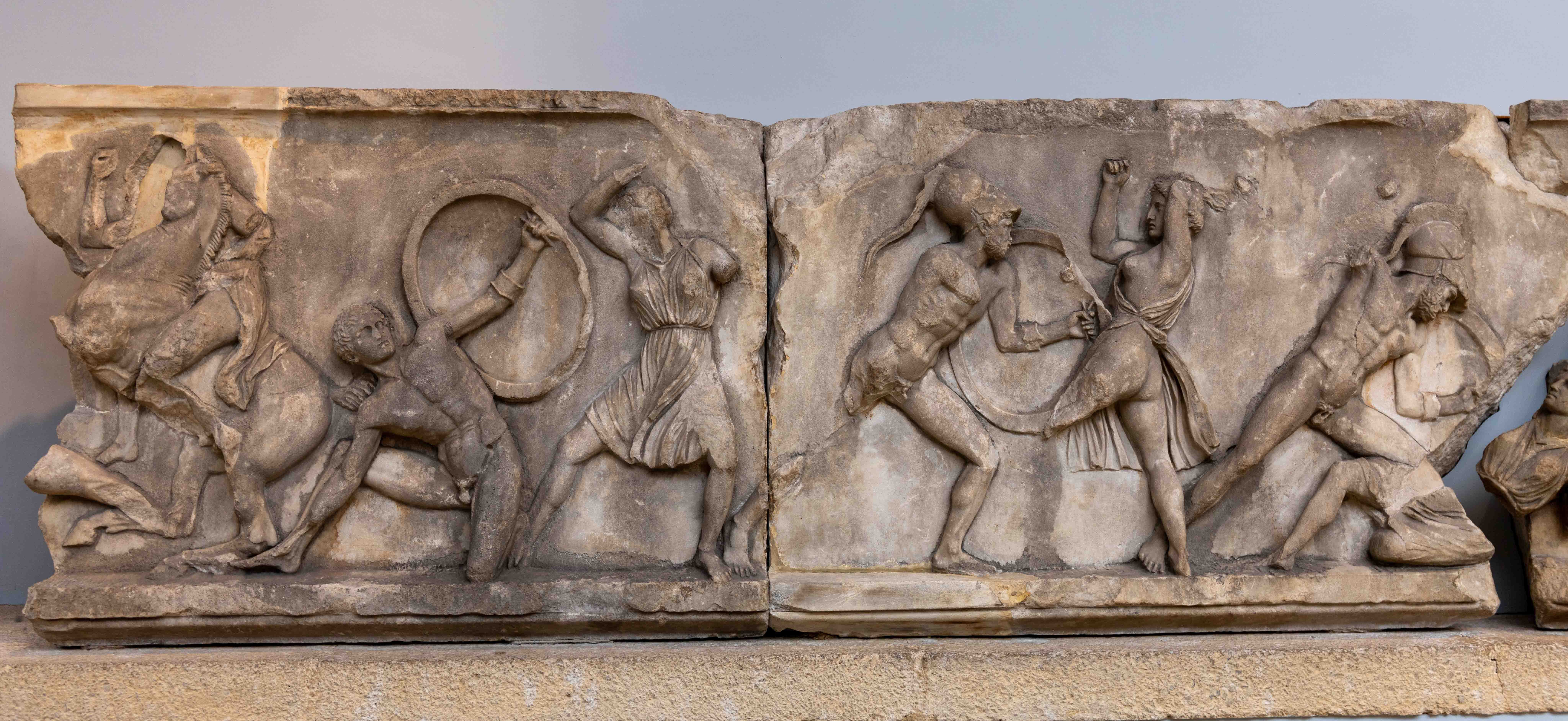 Two sections of the Amazonomachy frieze from the outer wall of the Mausoleum’s podium, c. 350 BCE. At left, a centaur is visible beside a Greek warrior; at center and right, Amazons and Greeks engage in close combat. British Museum, London. Photograph by the author, March 2026.
These two adjacent slabs of relief sculpture formed part of the Amazonomachy — the mythological battle between Greek warriors and the Amazons, a race of female warriors from the steppes who appear repeatedly in Greek art as a metaphor for the struggle between civilization and its threatening outside. The Amazon frieze ran around the outer wall of the Mausoleum’s podium, and scholars believe it was carved by the studio of Scopas, who was assigned the eastern face of the building. The slabs shown in the photograph represent a westward-running section of the composition.
The relief technique is high and deeply cut — what in architectural terminology is called alto rilievo, or high relief, where the figures project far enough from the background to create genuine shadow and three-dimensionality. In lower sections of the composition, figures overlap and interpenetrate in ways that would have been difficult to read from a distance but reward close inspection, revealing the precise articulation of drapery, musculature, and expression. The figure at left, partially preserved, shows a rearing centaur — the half-human, half-horse creature of Greek mythology — pressed back against a shield-bearing warrior. At center and right, Amazon warriors in short chitons grapple with Greek men in a composition of compressed, spiral energy. The drapery of the Amazons, clearly distinguishable from the nudity of the Greek male warriors, streams behind their bodies in the manner — and this is key — of Lysippan dynamism: figures whose motion reaches beyond their own bodies into the surrounding space.
Newton recovered these slabs both from the soil of the excavation and, crucially, from the walls of Bodrum Castle, where the Knights of St. John had embedded them as construction material face-forward, which paradoxically preserved their carved surfaces from the worst weathering. An earlier section of the frieze had been removed from the castle by Lord Stratford de Redcliffe in 1840 and sent to the British Museum; Newton’s expedition recovered the larger portion.
The Marble Lion
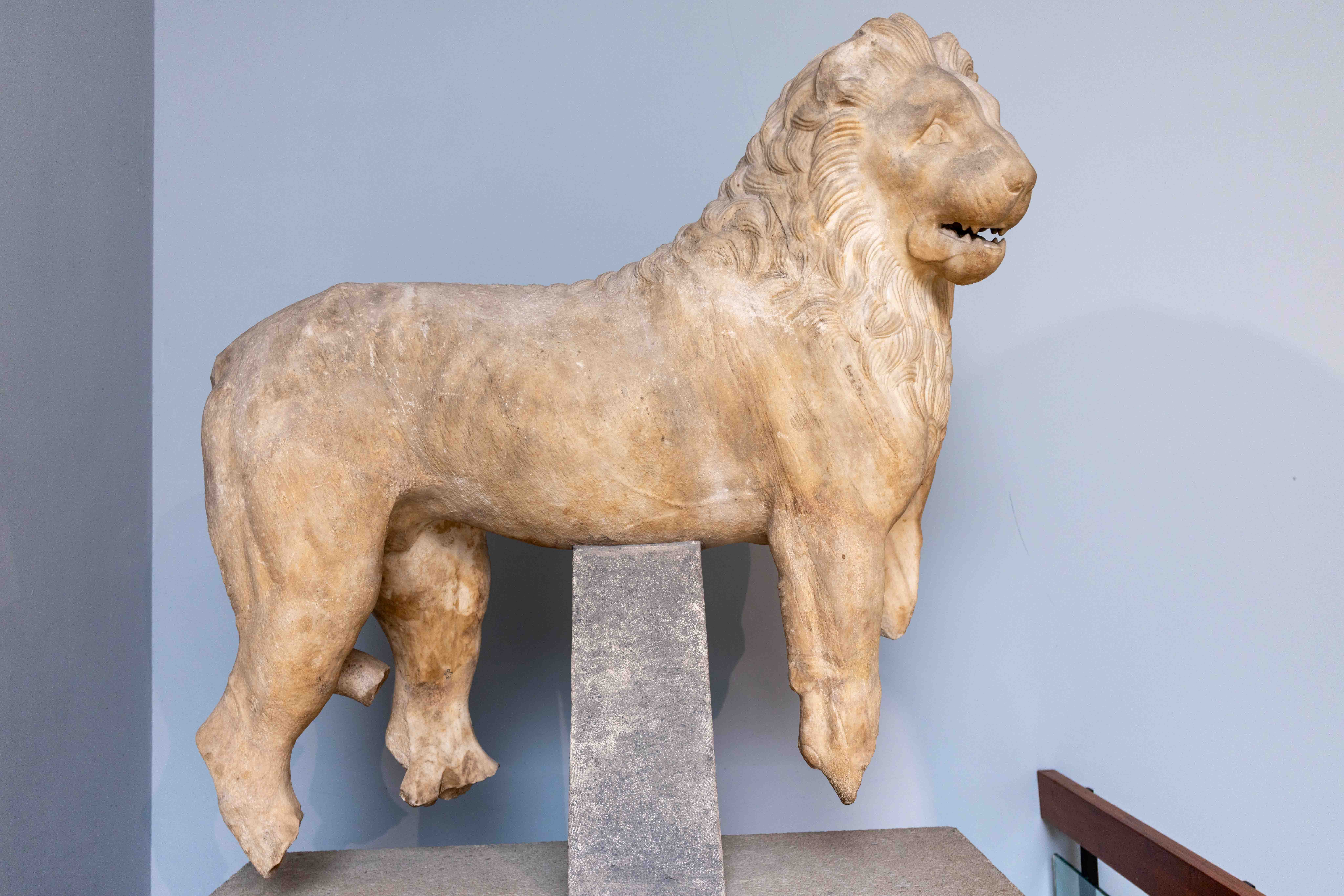 One of the colossal marble lions that flanked the approach stairway of the Mausoleum, c. 350 BCE. The animal is rendered with a physical presence that suggests direct observation of living lions. British Museum, London. Photograph by the author, March 2026.
The colossal marble lion is one of approximately twenty such figures that originally flanked the processional approach to the Mausoleum, standing guard along the stairway that led up through the podium toward the building’s outer colonnaded gallery. It is displayed on a low stone pedestal in the corner of the Mausoleum Room, and its scale — roughly life-size, perhaps very slightly larger — combined with the physical energy still evident in the posture creates an impression of tremendous contained force. The lion stands with its head slightly raised and turned, mouth open and showing teeth, mane rendered in carefully differentiated ridges and waves that suggest both the texture of real fur and a formalized system of linear rhythms derived from earlier Archaic conventions.
Newton identified lions in the walls of Bodrum Castle during his 1855 visit, and their discovery was one of the first pieces of evidence confirming that the Mausoleum’s site lay nearby. In his History of Discoveries, he describes the process of extracting the lions from the castle fabric — a technically complex operation requiring the careful dismantling of medieval masonry without damaging the ancient sculpture beneath. Several lions were shipped to London; others remained in Turkey. The lion shown in the photograph was found partly embedded in the castle walls and partly buried in the surrounding soil, its lower portions less well preserved than the upper body.
The lion in Classical Greek sculpture is always a charged political symbol — an emblem of royal power, of boundary and protection, and of the threshold between the living world and the realm of the dead. Its placement at the base of the Mausoleum’s approach, flanking the stairway where the sacrificial animals were laid and where the entrance to the underground chamber was concealed, was not merely decorative. These creatures marked and guarded the crossing point between the visible monument above and the invisible chamber below.
The Colossal Portraits: Mausolus and Artemisia
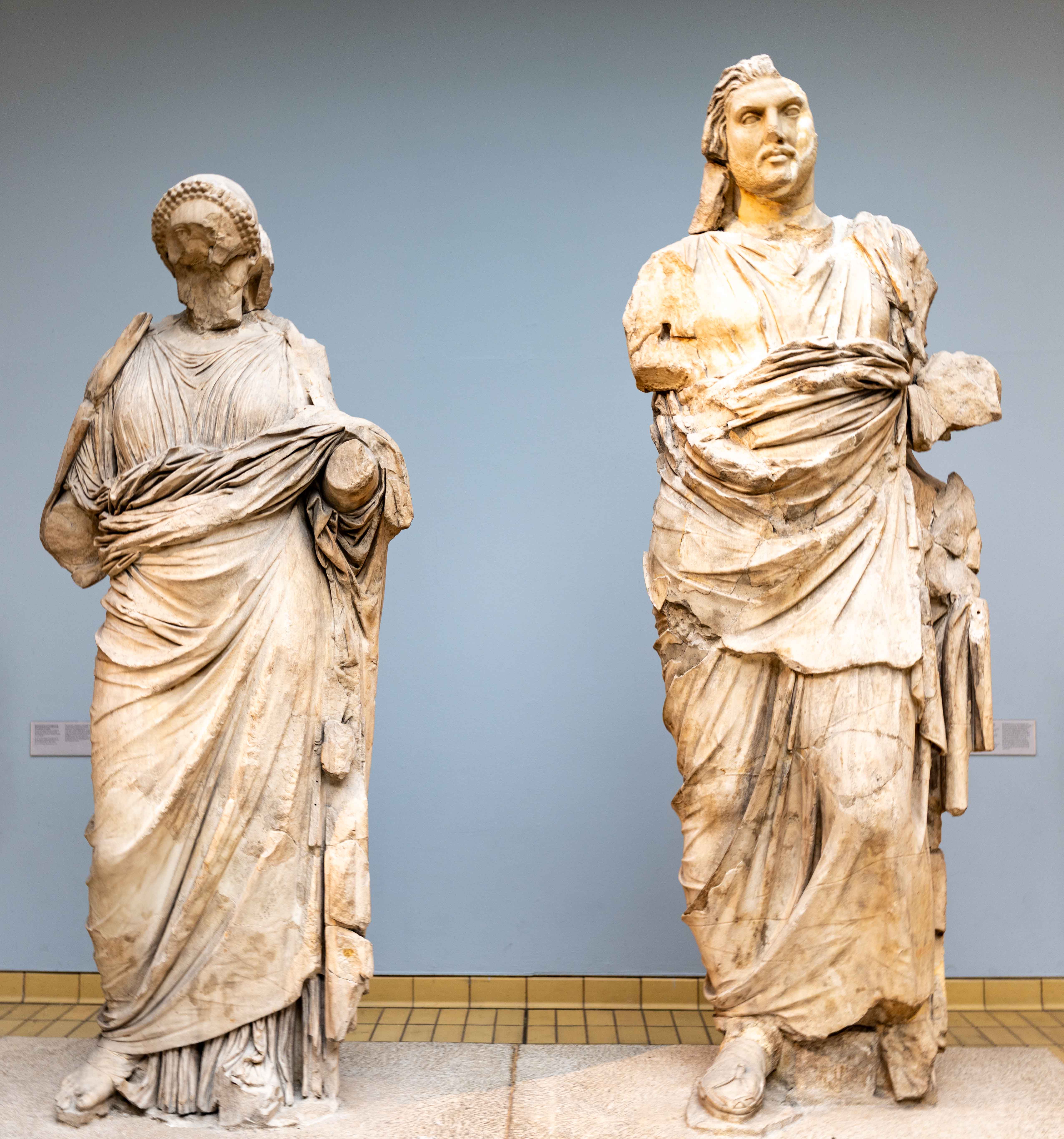 Two colossal marble portrait statues identified by scholars as Mausolus (right) and Artemisia (left), c. 350 BCE. Each stands approximately three meters in height. Their positions near the summit of the Mausoleum made them the largest free-standing figures in the sculptural program. British Museum, London. Photograph by the author, March 2026.
These two colossal figures, approximately three meters in height, are the most emotionally affecting objects in the Mausoleum Room. They have been identified by the majority of scholars — though the identification is not universally accepted — as the portrait statues of Mausolus and Artemisia that stood at the apex of the monument, either within or immediately beside the quadriga on the summit platform. They are the royal pair themselves, translated into marble at a scale that would have made them, at forty-three meters above the ground, almost impossible to identify in their individual features, but unmistakable as human presences crowning the pyramid.
The male figure — Mausolus, in the prevailing identification — is remarkable for the degree to which it departs from the Greek canon of male portraiture. He is not an idealized athlete, not a generic Olympian divinity, but something more specific: a face of pronounced individual character, with fleshy cheeks, wide-set eyes, and long hair that does not conform to any Greek stylistic convention. There is something about this face that feels Carian rather than Greek — the features of a man from a tradition in which individuality in portraiture was not subordinated to type. He wears what appears to be a himation — a rectangular outer garment draped over the body — in a manner that reflects Greek dress conventions while simultaneously suggesting the weight and authority of a ruler who stands above ordinary convention.
The female figure — identified as Artemisia — is headless above the neck, which gives her a particular quality of abstraction despite the vivid specificity of the drapery. Her clothing is rendered with extraordinary care: the fine linen of her under-garment (the chiton) is conveyed through close, dense pleats that cluster around her crossed arms, while the heavier outer garment (the himation) falls in broader, more monumental folds over her lower body. The quality of the carving — the way the sculptor has differentiated between the translucent clinging of the lighter fabric and the stiffer weight of the outer cloth — places this figure among the finest achievements of fourth-century Greek drapery sculpture. She holds something against her chest: a round object, possibly a vessel, possibly an element of a sacrificial ritual.
Newton found these statues during his excavation of the site, buried in the rubble of the collapsed superstructure. Their survival, given the weight of fallen masonry around them, was something close to miraculous. He describes their recovery with the precision and restrained excitement of an archaeologist who knows he has found something that will define his career.
The Newton Account and the Gift of Documentation
What distinguishes Newton’s expedition from earlier and less systematic efforts to recover antiquities from Ottoman territory is the insistence on documentation. The History of Discoveries at Halicarnassus, Cnidus and Branchidae, published in 1862, is not merely a triumphalist account of objects acquired but a carefully structured archaeological report, compiled from Newton’s official dispatches to the Foreign Office, from Pullan’s architectural drawings and descriptions, from Lieutenant Smith’s plans and surveys, and from the photographic record made by the Royal Engineers. Newton writes in his preface that his aim was to present “an authentic and exact narrative of the proceedings of an Expedition, to Asia Minor,” and that the official dispatches form the core of his text precisely because “descriptions drawn up during the progress, and on the actual site of the several excavations, will be more valued by archaeologists, than if an attempt had been made to recast them in a more popular and abridged form.”
This methodological self-consciousness — the preference for primary documentation over retrospective reconstruction — places Newton at the beginning of a tradition of systematic archaeological practice. He was not simply a collector. He was attempting to record a process: the progressive uncovering of a buried structure, with attention to the stratigraphic context of each find, to the architectural relationships between objects, and to the correspondence between the evidence in the ground and the evidence in the ancient texts. His comparison of the excavated dimensions with those recorded by Pliny — and the degree to which they corresponded — became one of the defining confirmations of the site’s identity and of the reliability of ancient literary testimony when used as archaeological evidence.
The correspondence with Pliny deserves emphasis. Pliny the Elder, writing in the first century CE in his Naturalis Historia, provides the most detailed ancient description of the Mausoleum: its circumference, its dimensions north to south, the thirty-six columns of the pteron, the twenty-four steps of the pyramid, the quadriga on top. For seventeen centuries, this description floated free of any physical referent, a set of numbers attached to a building no one could locate with certainty. Newton’s excavation anchored the text back to the earth. When the foundations he uncovered matched the dimensions Pliny had preserved, it was the first time since late antiquity that the word and the stone had been brought into alignment.
What Remains, and Where
The British Museum’s Mausoleum Room holds the largest single collection of surviving material from the monument. It includes sections of the Amazon frieze and the chariot-battle frieze, the colossal portrait statues traditionally identified as Mausolus and Artemisia, the great marble horse from the quadriga, multiple lions, fragments of the architectural structure, and the broken chariot wheel. A smaller number of pieces remain in Turkey, including fragments in the Bodrum Castle museum and at the Mausoleum site itself, where the foundations are visible and a small site museum preserves additional finds. Danish archaeological campaigns between 1966 and 1976 continued and substantially extended Newton’s work, clarifying the site’s stratigraphy and recovering further fragments, many of which remain unpublished.
What the photographs taken in March bring back is not primarily information — though they carry information in abundance — but something closer to testimony. These objects have been looked at for two and a half millennia. They were looked at by ancient Carians and Greeks who came to honor or simply to marvel at the monument their queen had built. They were looked at by Crusader knights who embedded them in walls for purely structural reasons. They were looked at by Newton and his team, who lifted them from the ground and recorded their positions and dimensions with scrupulous care. They are looked at today by museum visitors who may or may not know whose ashes once lay in the chamber below them.
Artemisia II died around 351 BCE, two years after Mausolus, consumed by her grief or by whatever biological process she would have called by a different name. She never saw the monument completed. The sculptors finished it without her. The ashes were placed in the chamber. The stairway was filled with rubble, the animals laid across the steps, the monolithic stone block lowered into the entrance. And for seventeen hundred years, give or take the depredations of earthquakes and knights and anonymous midnight thieves, the Mausoleum stood over Halicarnassus — the most famous tomb in the ancient world, which taught the world the very word for a tomb of ambition — advertising in marble and bronze and polychrome stone the grief of a woman who loved her brother, and the pride of a dynasty that believed, for a little while, that architecture could defeat time.
Primary Source
Charles Thomas Newton, A History of Discoveries at Halicarnassus, Cnidus and Branchidae, London: Day & Son, 1862. Available via Internet Archive: https://archive.org/details/bub_gb_9bxLAAAAcAAJ/mode/2up
Select Bibliography
Pliny the Elder, Naturalis Historia, Book XXXVI.
Vitruvius, De Architectura, Book VII, preface.
Pedersen, Poul, and Kristian Jeppesen, The Mausolleion at Halikarnassos: Reports of the Danish Archaeological Expedition to Bodrum, multiple volumes (Copenhagen: Jutland Archaeological Society, 1981–2004).
Waywell, Geoffrey B., The Free-Standing Sculptures of the Mausoleum at Halicarnassus in the British Museum (London: British Museum Publications, 1978).