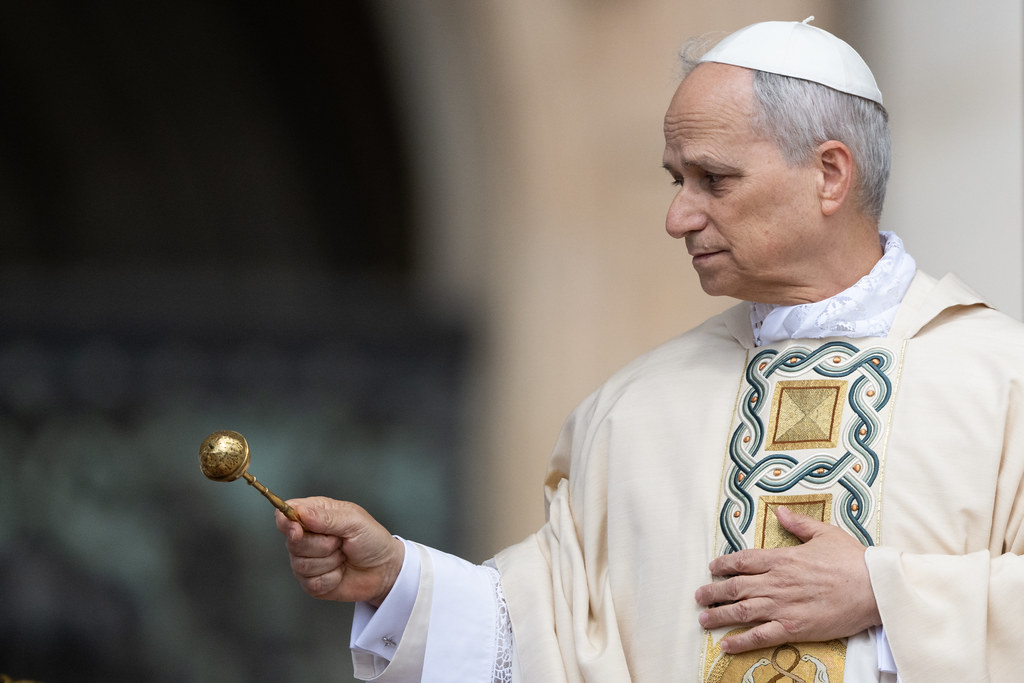
Source. Pope Leo XIV, Magnifica Humanitas. Encyclical Letter on Safeguarding the Human Person in the Time of Artificial Intelligence, 15 May 2026. Full English text at the Vatican website.
The encyclical’s task and its title
Leo XIV’s first major social encyclical, addressed “On Safeguarding the Human Person in the Time of Artificial Intelligence,” is offered as a deliberate inheritance of Leo XIII’s Rerum Novarum, whose 135th anniversary falls in 2026. The choice of name is not incidental: where the original Leo took up the res novae of industrial labor and capital, his namesake takes up the res novae of a technological order in which power has migrated from states to private transnational actors, and in which the very category of “intelligence” is being contested by machines that imitate without understanding. The title — Magnifica Humanitas, “The Grandeur of Humanity” — is meant as a counter-thesis to the imagined transcendence of the human condition through technical means. The grandeur of the human, Leo insists, is given, revealed in the Incarnation, and incapable of being either replaced or surpassed by a machine.
The framing images
The whole document is structured around two biblical scenes, established in the introduction and returned to as a kind of organizing typology throughout. The Tower of Babel — single language, single technology, single direction, conceived without reference to God, sacrificing dignity for efficiency — is the figure of Promethean self-affirmation that ends in dispersion rather than unity. The rebuilding of Jerusalem under Nehemiah — patient, distributed labor in which families, artisans, priests, women, and young people are each given a section of the wall, beginning in fasting and prayer and proceeding by listening — is the counter-figure of communion built through shared responsibility. Leo’s claim is that the choice between Babel and Nehemiah is not a choice for or against technology but a choice between two ways of organizing human power. He names the “Babel syndrome” as a threefold pathology: the idolatry of profit that sacrifices the weak; a uniformity that neutralizes differences; and the pretense that a single language, even a digital one, can translate the mystery of the person into data and performance.
Chapter One: the historiographical argument
The first chapter is essentially a methodological and historiographical preamble. Before introducing the principles, Leo wants to establish what kind of teaching social doctrine is — and what kind it is not. It is not a code imposed from above, nor a list of technical solutions, nor a competing political model. It is a “theology of communion in history,” a process of shared discernment in which the unchanging Christian understanding of the person is brought into dialogue with each era’s res novae and with the human sciences. Leo is careful to insist on the autonomy of earthly realities (Gaudium et Spes §36) and on the distinction between ecclesial and political competences. He also reaffirms, citing John Paul II and his own prior statements, that the Church does not “possess a monopoly on truth”; truth is “a good to be shared, not a territory to be defended.” Francis’s polyhedron image — one truth refracted from many angles — is used as the figure of catholicity.
The chapter then offers a survey of the social magisterium from Rerum Novarum to the present, drawing forward the elements Leo wants to put to work. From Leo XIII, the primacy of labor over the logic of finance and the inseparability of evangelization from the structures of society. From Pius XI’s Quadragesimo Anno, the formal articulation of subsidiarity and the diagnosis of structural injustice. From Pius XII, natural law as the basis of international order and the necessity of mediating associations. From John XXIII, the language of universal rights addressed to all people of goodwill. From Vatican II — particularly Gaudium et Spes (whose 60th anniversary was marked on 7 December 2025) and Dignitatis Humanae — the turn to interpretation through dialogue with the world. From Paul VI, development as “the new name for peace” (Populorum Progressio). From John Paul II, Laborem Exercens on labor, Sollicitudo Rei Socialis on the structures of sin, and Centesimus Annus on the conditioned legitimacy of the market and democracy. From Benedict XVI, the centrality of charity in truth and the diagnosis that globalization has reduced the political power of states. From Francis, the synodal Church, the integral ecology of Laudato Si’, the universal fraternity of Fratelli Tutti, and the inseparability of social commitment from the love of the heart of Jesus in Dilexit Nos. The trajectory Leo sketches is harmonious but not linear: each generation has had to read its own changes in light of an ancient inheritance.
Chapter Two: foundations and principles
The second chapter restates the architecture of Catholic social doctrine but with the digital question already in view. The foundations come first. The human person is created in the image of the Triune God, ordered to relationship and communion. Dignity is not earned, justified, or contingent on capacity; Leo here cites the recent Dignitas Infinita (2024) on the “infinite dignity” of every person and distinguishes ontological dignity — which can never be diminished — from moral, social, and existential dignity, which can fluctuate. He singles out as “particularly insidious” the ideology that holds each person must “earn or justify his or her own worth,” noting that the value of persons does not depend on what they achieve or produce. Human rights, including the right to life from conception to natural end, are not external additions to dignity but its expression; Leo voices concern that rights today are exposed to two dangers: their merely formal proclamation alongside actual violations, and the abandonment of the philosophical inquiry that could give them rational foundation — leaving them vulnerable to revision by those in power who obtain “only an apparent consensus from populations that are frightened or manipulated.”
The five operative principles are then taken up in sequence. The common good is described as the social expression of dignity, irreducible to the sum of individual interests; a “plus” that emerges from interaction. The universal destination of goods is given a crucial extension: it applies not only to material goods but to patents, algorithms, digital platforms, technological infrastructure, and data. When such goods remain concentrated, “a new imbalance is created that contradicts the universal destination of goods.” Subsidiarity is reread for digital conditions: today the relevant “higher level” is often not the state but the major economic and technological actors whose platforms exercise de facto power over the conditions of daily life — which means subsidiarity now requires transparency about algorithms, equitable access to data, and avenues of recourse. Solidarity, both principle and virtue, is extended to the “digital ecosystem,” which can be preserved or exploited. Social justice is given a restorative dimension: it must mend broken bonds, including the bonds broken by wars, colonialism, racial and gender discrimination. Integral human development, drawn from Populorum Progressio, is offered as the framework that gathers these principles together. Leo closes the chapter with what he calls “an examen for the Church” — a reminder that subsidiarity, solidarity, and justice must be lived first in the Church’s own structures, which means transparency, accountability, the participation of the baptized in decision-making, and serious listening to victims of spiritual, economic, institutional, sexual, and conscience abuse.
Chapter Three: technology, dominance, and the grandeur of the human person
This is the philosophical core of the encyclical. Leo extends Francis’s critique of the technocratic paradigm and offers a sustained reflection on AI specifically. He observes that current AI systems are “more ‘cultivated’ than ‘built’” — developers do not directly design every detail but rather create a framework within which the system grows, so that even those who design them possess only limited understanding of their actual functioning. This calls for both deeper scientific research and moral discernment. He is explicit against the conflation of artificial and human intelligence: AI systems “do not undergo experiences, do not possess a body, do not feel joy or pain, do not mature through relationships and do not know from within what love, work, friendship or responsibility mean.” Their “learning” is statistical adaptation, not the experience of those shaped by life through “choices, mistakes, forgiveness and fidelity.”
In a long and concrete section on the governance of AI, Leo argues that AI is not morally neutral: every system embodies choices through what it measures, what it ignores, and how it classifies. The danger he names most sharply is that the delegation of judgments to automated systems hollows out political responsibility itself — when an algorithm decides who is worthy and no one bears responsibility for that judgment, “compassion, mercy, forgiveness — understood not as mere appearances but as real political actions — gradually disappear from view.” Calls for “alignment” of AI with human values are insufficient if the values in question are determined by a few. He invokes a striking phrase — “to disarm AI” — by which he means not technological rejection but the freeing of AI from “the mentality of ‘armed’ competition” (military, economic, cognitive), the discrediting of the assumption that technical power confers the right to govern, and the management of data as a common or shared good rather than private property. He also flags environmental cost: AI’s enormous energy and water demands require sustainable solutions for the sake of the common home.
The middle of the chapter turns to underlying narratives. Leo treats transhumanism and posthumanism as “an archipelago of conceptual islands” connected by a shared sea of assumptions: the central role of technology and the aspiration to transcend the human condition. Transhumanism in his characterization aims at performance-enhancement through biomedicine, body engineering, devices, and algorithms; posthumanism in its more radical forms challenges anthropocentrism altogether and envisions human-machine-environment hybridization as an evolutionary threshold. The key issue, he says, is not the use of technology but the underlying vision: if the human is treated as something to be perfected or surpassed, it becomes easier to accept that some lives are less worthy.
Against this, Leo mounts an extended defense of human finitude as the very condition of compassion, love, and moral seriousness. He cites Viktor Frankl on Auschwitz — humanity is “that being who invented the gas chambers” and also “that being who entered those gas chambers upright, with the Lord’s Prayer or the Shema Yisrael on his lips.” Authentic art preserves this spark of finitude — Beethoven’s Ninth, Guernica, Schindler’s List are mentioned. So do public institutions: the Red Cross (1863), the abolition of slavery, the UN (1945), the Universal Declaration (1948), the 1951 Refugee Convention. So do witnesses — King, Mandela, and a striking list of women that includes Laura Montoya, Teresa of Calcutta, Dorothy Day, Marie Skłodowska-Curie, Maria Montessori, Elisabeth Elliot, Wangari Maathai, and Benazir Bhutto — alongside the “martyrs of everyday life”: parents, nurses, doctors, volunteers. The argument’s edge is that there is an authentic “more than human,” but it is grace, not enhancement. Citing Aquinas on the donum supernaturale, Leo argues that what transcends human nature is not self-augmentation but communion with the God who closes the infinite gap from his side. The chapter closes with the Augustinian framing of the two cities and two loves — the choice between Babel and Jerusalem “begins within each one of us.”
Chapter Four: truth, work, freedom
The fourth chapter applies the principles to three concrete goods under stress.
On truth, Leo addresses disinformation and the manipulation of public discourse. He invokes Hannah Arendt’s observation that the ideal subjects of totalitarianism are “people for whom the distinction between fact and fiction… and the distinction between true and false… no longer exist.” He calls for an “ecology of communication,” combining transparency norms for platforms, strengthening of intermediary bodies and serious journalism, integration of knowledge in universities (against fragmentation and the reduction of inquiry to information retrieval), and digital literacy in schools and families. He is unsparing about the Church’s own responsibility for transparency, thanking journalists who have exposed abuse and insisting the Church must not wait for others to compel it to confront uncomfortable truths. He sets out an “educational alliance” oriented around finding the patience to ask questions — citing Plato on how the deepest things are learned only “by engaging in discussion with others, ‘striking upon’ ideas and experiences together like flint” — and he is sharp about the harms documented in psychological and psychiatric literature on early, unsupervised digital exposure for minors: effects on sleep, attention, emotional regulation, vulnerability to grooming, sexual exploitation, and trafficking. He calls explicitly for legislative interventions setting age limits and holding platforms accountable, rather than shifting the whole burden of supervision onto families.
On work, Leo extends Laborem Exercens into the era of automation and AI. Work is not merely a means of income but the matrix in which identity, relationships, vocation, and citizenship are formed. He gives a sober diagnosis of the labor effects of the convergence of automation, robotics, and AI: outsized remuneration for a specialized minority alongside declining wages and insecurity for many; uneven effects between wealthy societies that automate rapidly and regions trapped in “hybrid economies” where underpaid human labor and partial technologies coexist. The protection of employment opportunities and the irreplaceable role of the individual must remain the rule; the pursuit of greater profits cannot justify systematic sacrifice of jobs. He calls for verifiable social criteria for innovation (any introduction of automation accompanied by measures for employment, retraining, and worker participation), continuous training as a right, and corporate accountability for the quality and dignity of work as a success metric. He calls for moving beyond GDP as the sole measure of development. He addresses cryptocurrencies and financialization with concern, arguing that “income from capital risks replacing income from labor” and that the social function of credit remains irreplaceable. He warns of “anthropological regression” — a paradox in which material progress coexists with mass unemployment, lost responsibility, the absence of daily tasks, and a corresponding human and cultural impoverishment that undermines social peace.
On freedom, Leo addresses the “digital attention economy” and the new forms of social control made possible by mass data collection and algorithmic profiling. When business models thrive on human weakness, the person is treated as a means rather than as an end. He calls for digital sobriety in education, protection of minors, and proportionate limits on intrusive technologies. He then turns to what he calls “new forms of slavery”: the data labeling, model training, and content moderation labor — often performed by young women under demanding conditions for minimal wages — and the extractive mining for rare earth elements often performed by children. Trafficking networks, he notes, now use online platforms, anonymous payments, and AI-generated content as recruitment infrastructure. He places this within a striking historiographical reflection on the Church’s own slow recognition of the incompatibility of Christian doctrine with slavery: it took eighteen centuries before the dignity of every human image of God was articulated into “a formal, absolute and universal condemnation of slavery,” notably under Leo XIII. Acknowledging that past events cannot be judged anachronistically but also refusing to minimize “the delay with which both society and the Church came to denounce the scourge,” Leo asks, “in the name of the Church,” for pardon for past complicity. The historiographical lesson is also a present obligation: vigilance now against the new forms of subordination and data colonialism, lest the future require another such pardon.
Chapter Five: the culture of power and the civilization of love
The final chapter is the most directly political. Following Paul VI’s “civilization of love” against what Leo names a contemporary “culture of power,” the chapter addresses the normalization of war, the use of force without limits, the integration of artificial intelligence into weapons systems, the crisis of multilateralism, and what he characterizes as a “supposed political realism” that licenses violence in the name of necessity. Against these, Leo proposes a constructive program for “building the civilization of love”: each person doing their part; the “disarmament of words” (rhetoric that does not humiliate or dehumanize the adversary); building peace through justice rather than through the suppression of grievance; adopting the perspective of victims; cultivating a “healthy realism” that distinguishes itself from the cynical realism of force; the revival of dialogue and diplomacy; and a renewal of multilateral institutions adequate to a world in which power has migrated beyond states. The chapter concludes in a register of prayer and hope.
Conclusion: the Word made flesh, one body in Christ, the song of the Magnificat
The conclusion returns to the Christological frame. The Incarnation — the Word becoming flesh — is the deepest answer to a culture that would surpass the human; the body of Christ is the deepest answer to fragmentation. Leo closes with the Magnificat as the counter-song to Babel: the song in which the rejected stones — the poor, the sick, migrants, the least — become the cornerstone. The “construction site of our time” is to be approached, in the manner of Nehemiah, with prayer and patient distributed labor.
The encyclical’s distinctive contributions
Three things make Magnifica Humanitas more than a restatement. First, the explicit application of the universal destination of goods to the immaterial goods of the digital order — patents, algorithms, platforms, infrastructure, data — and the proposal that data be managed as a common good rather than left to private appropriation. Second, the rereading of subsidiarity for a condition in which power lies not with states but with transnational platforms, which entails a positive program for transparency, accountability, algorithmic disclosure, and the protection of intermediary bodies. Third, the philosophical engagement with transhumanism and posthumanism as the underlying narratives of contemporary technological power, and the development of a counter-account in which the authentic “more than human” is grace rather than enhancement — an Augustinian and Thomistic reframing of what self-transcendence actually means.
Its diagnostic register — the Babel/Jerusalem typology, the warning about delegating moral judgment to algorithms, the historiographical self-criticism on slavery and its analogues today, the call to “disarm” AI from monopolistic and competitive dynamics — gives it a distinctive voice within the tradition while keeping it in clear continuity with Laudato Si’, Fratelli Tutti, and the Vatican II understanding of the Church’s pastoral engagement with the world articulated in Gaudium et Spes.