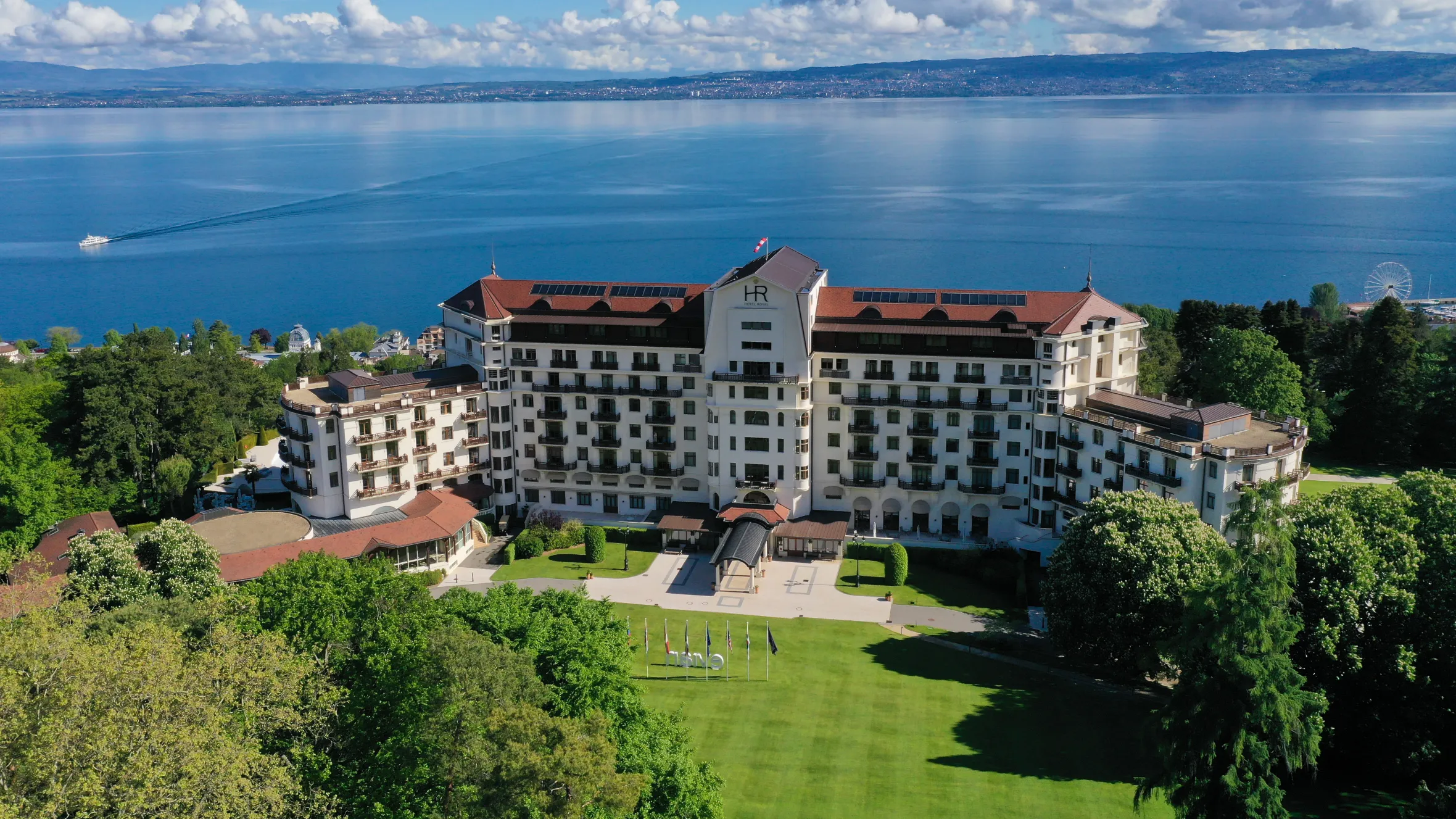
The leaders of the Group of 7 opened their annual summit in Évian-les-Bains, France, on Monday, gathering on the shore of Lake Geneva for a three-day meeting that France had designed around the global economy but that arrived overshadowed by President Trump’s announcement, a day earlier, of a preliminary agreement to end his four-month war with Iran.
France, holding the rotating presidency, built the summit around three priorities carried over from recent meetings: reducing the world’s large macroeconomic imbalances, strengthening economic security and critical-mineral supply chains, and overhauling the model of international development partnerships. President Emmanuel Macron, hosting his second summit after Biarritz in 2019, has also pushed artificial intelligence up the agenda. Over several working sessions through June 17, the leaders are scheduled to take up geopolitical challenges, peace and security for Ukraine, the situation in the Middle East, international partnerships, more balanced economic growth, and the future of AI. The summit brings together Canada, France, Germany, Italy, Japan, the United Kingdom and the United States, with the European Union’s two presidents, and France has invited leaders from Brazil, Egypt, India, Kenya and South Korea, along with Ukraine and Gulf states, to join parts of the program.
But the agenda France planned was not the one events delivered. The U.S. and Israeli assault on Iran that began on February 28, Iran’s retaliation, and its subsequent closure of the Strait of Hormuz sent energy and shipping costs higher and revived inflation worldwide — and the deal Mr. Trump unveiled on Sunday to unwind that crisis dominated the run-up to Évian.
The Middle East: a deal announced, and contested
Mr. Trump announced on Sunday — his 80th birthday — that the United States and Iran had reached an initial agreement to halt hostilities. Under the framework, which both governments confirmed but whose full text has not been released, the United States would lift its naval blockade of Iranian ports and the Strait of Hormuz would reopen to shipping once the accord is signed, at a ceremony slated for Friday in Switzerland. Regional officials said the agreement opens a 60-day window for negotiations on Iran’s nuclear program, during which Tehran is expected to surrender its stockpile of highly enriched uranium; Iranian media reported it also releases frozen funds to Iran. The deal halts the war but leaves the central nuclear questions to later talks. Ayatollah Ali Khamenei, Iran’s supreme leader, was killed in the opening strikes on February 28.
The framework drew an immediate and pointed response in Jerusalem. In a defiant evening news conference on Monday, Prime Minister Benjamin Netanyahu — whose government launched the war alongside Washington but was not a party to the negotiations and, by several accounts, was kept in the dark during them — signaled that Israel did not consider itself bound by an accord it had no hand in shaping. He said Israel did not yet know the deal’s terms, declared that Iran would never acquire nuclear weapons “with or without an agreement,” and said Israeli forces would remain in the southern Lebanon buffer zone for as long as necessary, adding that “the struggle is not over.” Members of his cabinet went further, stating plainly that Israel would not be bound by the agreement and would keep fighting on its northern front. The opposition leader, Yair Lapid, called the outcome one of the most damaging failures in Israel’s security history, arguing that the military had done its job while the prime minister had not.
In Washington, the reaction was muted and wary, slowed by the absence of disclosed terms. Even among the president’s allies, praise came in a trickle rather than a flood. Senator Lindsey Graham, Republican of South Carolina and a longtime hawk on Iran, said he hoped a genuine diplomatic solution had been reached but insisted any agreement be submitted to Congress for review and approval. Senator Rand Paul, Republican of Kentucky, defended the president’s negotiating approach. The caution followed a striking rebuke earlier in the month: on June 3 the Republican-led House passed a war-powers resolution directing the president to end hostilities, 215 to 208, with four Republicans joining Democrats. The war has been unpopular at home, has cost American taxpayers at least $29 billion by official tallies, has killed 13 U.S. service members, and pushed gasoline prices up by roughly $1.40 a gallon since late February.
The assessment from the editorial page of The New York Times on Monday was blunter still. In an editorial headlined “President Trump Lost This War,” the paper’s editorial board argued that the president had made a grave error in starting the conflict, prosecuted it recklessly and without congressional authorization, and emerged weaker by every measure, leaving the United States with terms likely to resemble the 2015 nuclear agreement that President Obama negotiated and that Mr. Trump withdrew from in 2018. The board described the reopening of the Strait — Mr. Trump’s clearest gain — as a return to the prewar status quo, and judged Iran the war’s strategic winner despite heavy losses, on the grounds that its government survived and learned it could wield the Strait as an economic weapon. The White House has not detailed the agreement it will sign on Friday.
For the summit, the practical consequence is immediate: if the Strait reopens on schedule, the energy-price spike that has fed global inflation since February should begin to ease, a development that bears directly on every other economic item at Évian.
More balanced economic growth
The centerpiece of France’s economic agenda is what Mr. Macron has called the world’s dangerous imbalances. Writing in the Financial Times late last year, he noted that China’s trade surplus with the rest of the world had reached roughly a trillion dollars and declared that correcting such imbalances would define the French presidency. In the days before the summit, he chaired a video call that drew in China and other non-G7 economies to confront competing views of the problem and the question of shared responsibility. The French diagnosis names American tariffs, weak Chinese consumption, soft European productivity, and a sluggish Chinese property sector that has pushed Beijing to flood emerging markets with high-tech exports.
That agenda now meets a different American one. Mr. Trump arrived with an America First program built around more transactional development deals, commercial openings for U.S. firms abroad, wider deployment of American technology, a harder push to cut dependence on Chinese supply chains, and increased fossil-fuel production. A separate deadline shadows the talks: a 15 percent universal U.S. import tariff is set to expire by law on July 24, and several of the other members arrive seeking relief from, or clarity on, American trade measures. On most questions beyond the formal agenda — trade, Ukraine, digital regulation, climate — the other six members have increasingly coordinated among themselves, a pattern sharpened by personal friction between Mr. Trump and several counterparts.
Economic security and critical minerals
Closely tied to the imbalance debate is the scramble over critical minerals — lithium, copper, nickel and the rare earths that feed batteries, grids and semiconductors, supply chains that China largely dominates. France has framed this as an economic-security question, building on the Critical Minerals Action Plan that last year’s Canadian-hosted summit at Kananaskis produced. Here French and American aims partly align: both governments want to reduce strategic dependence on Chinese-controlled processing, and the topic is among the few where Washington and its allies expect to find common ground.
Ukraine
Peace and security for Ukraine remain fixed on the agenda, and President Volodymyr Zelensky was invited to press for continued support, particularly for Ukraine’s battered energy infrastructure. Mr. Macron has framed the discussion as an effort to reinforce backing for Kyiv while preparing conditions for eventual negotiations. The war is also one of the issues on which the European members and Canada have grown most anxious to coordinate independently of Washington, given uncertainty about the durability of American commitment.
The future of artificial intelligence
France has used its presidency to position itself as Europe’s leading hub for artificial intelligence, and Mr. Macron elevated AI to a leaders’ session. He underscored the ambition by inviting Sam Altman, the chief executive of OpenAI, to take part in the discussions. The American delegation, for its part, is expected to press for wider international adoption of U.S. technology platforms and AI systems. A parallel French initiative addresses online safety for minors, building on the AI summit Paris hosted in 2025.
Partnerships, the Global South, and the smaller files
France’s third priority — reforming international development partnerships — is also the clearest test of whether the invited guests leave with anything. Kenya’s president, William Ruto, came to argue for changes to the global financial system that would widen Africa’s access to credit and investment and improve trade and infrastructure financing, a longstanding grievance of heavily indebted developing countries facing steep dollar-denominated debt costs. India’s Narendra Modi, attending his seventh consecutive G7, presses India’s role as a partner in technology and trade; Brazil’s Luiz Inácio Lula da Silva brings the case for a less Western-centered financial order; South Korea’s Lee Jae-myung speaks for a country at the center of the semiconductor supply chain; and Egypt’s Abdel Fattah el-Sisi, with Gulf leaders, anchors the Middle East discussions. France has also placed two narrower files on the agenda: securing ports against drug trafficking and other illicit flows, and the protection of children online.
What comes next
The leaders are expected to issue several statements over the course of the summit, which closes on June 17, after which the United States takes over the G7 presidency for 2027. The more consequential date may be Friday, when the United States and Iran are due to sign their agreement in Switzerland and the 60-day clock on nuclear negotiations begins — and when the world will learn whether the terms match the framework Mr. Trump described, or the more modest accord his critics, at home and in Jerusalem, expect.
This is a developing story; the summit runs through June 17, 2026, and its leaders’ statements had not been finalized at the time of writing. Reporting drawn from the European Council, the Élysée, the Council on Foreign Relations, the Banque de France, CNN, NPR, Al Jazeera, The Times of Israel, The Jerusalem Post, PBS, The Hill, Reuters and AP wire coverage, and the June 15, 2026 New York Times editorial.