
On the afternoon of June 18, the National Assembly of People’s Power, meeting in the third extraordinary session of its Tenth Legislature, approved the most far-reaching economic transformation Cuba has attempted since 1959. The package—176 measures grouped into twenty-three axes—was read into the record by Prime Minister Manuel Marrero Cruz and ratified, after a few hours of largely supportive speeches, by a chamber that the day before had watched the Communist Party’s Central Committee bless the same text in an extraordinary plenary. Raúl Castro, ninety-five and present by videoconference, lent his signature and a letter of endorsement. Díaz-Canel, closing the debate, insisted twice that the country was not abandoning socialism, and reached for a formula that did most of the rhetorical work of the day: socialism, Cuban-style. The cadence was characteristic. Announced on the 12th, approved by the Party on the 17th, enacted by the Assembly on the 18th: the Party decides, the parliament endorses.
What was endorsed, however, breaks with the doctrine the Revolution defended for six decades. Stripped of the language of preservation in which it was wrapped, the document legalizes private banks and private exchange houses, lets foreign and émigré capital buy shares in Cuban enterprises, converts state firms into joint-stock companies that can be partly sold, opens fuel importation and retail to private and foreign hands, permits the sale of residential property to foreigners, abandons general price caps and the rationed family basket, and authorizes enterprises to lay off workers at their own discretion. A revolution that built much of its legitimacy on not being a market economy has just legislated one—qualified, gradual, and hedged, but a market economy nonetheless.
The admissions that mattered
The reforms were notable less for their boldness than for the confessions that accompanied them. Two stood out. The first was historical. For perhaps the first time from a Cuban head of state in such plain terms, Díaz-Canel conceded that the social model had been sustained not by political will alone but by resources arriving from elsewhere—at one time from the socialist bloc, at another from friendly countries. The implication, left unspoken but unmistakable, is that the achievements the Revolution attributes to its system were underwritten for three decades by Soviet subsidy, and that the system as designed has never been able to pay for itself. The debate now, he said, is how to go on building socialism without that external scaffolding, on Cuban talent and effort alone.
The second admission was diagnostic, and arguably more damaging to the regime’s own narrative. Díaz-Canel acknowledged that not all of the country’s paralysis comes from Washington. There are barriers, he said, that do not come from outside or from the blockade—internal sluggishness, bureaucracy, regulations that strangle anyone who wants to produce, decisions postponed for years. Even in a more favorable external climate, he allowed, these changes would have been necessary, only undertaken in greater comfort. It was a remarkable concession from a government that has spent decades making the U.S. embargo the explanation for everything. The ideological permission slip for all of it had been issued in 1993 by Fidel himself, quoted approvingly by Marrero: the collapse of the bipolar world, the Comandante had said, forced Cuba “to do what we would otherwise never have done” had it possessed capital and technology of its own. Three decades later, the heirs invoked that line not as a lament but as a mandate.
The scope of the turn
The architecture of the package is best understood not axis by axis but as a coordinated retreat of the state from three functions it had monopolized: ownership, allocation, and price.
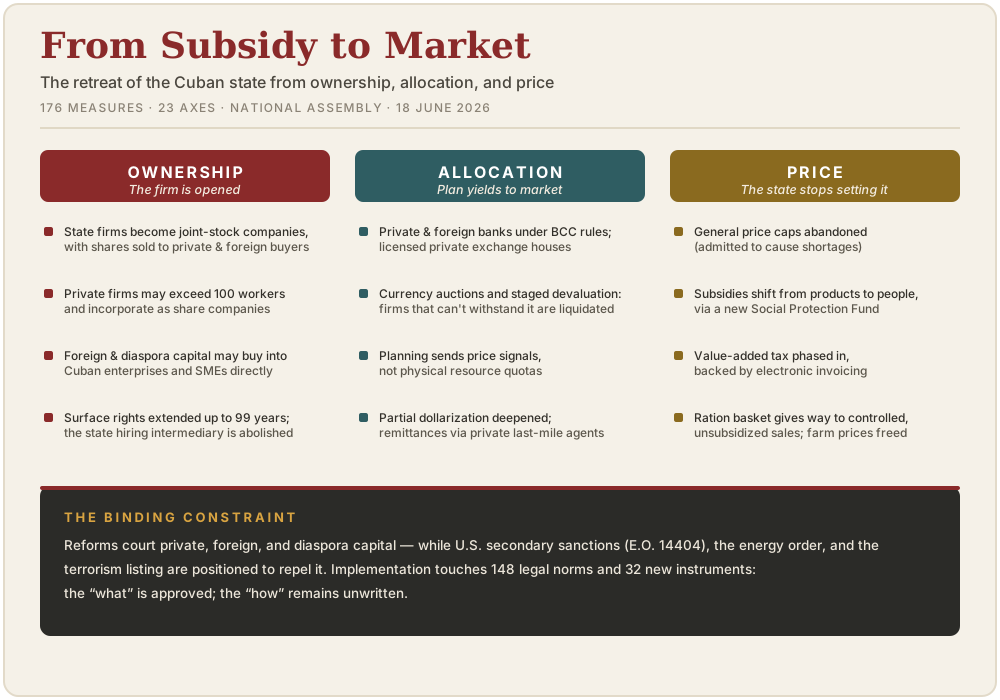
The package at a glance: the Cuban state retreats from ownership, allocation, and price—courting the very capital that U.S. sanctions are positioned to repel.
On ownership, the state enterprise is to be remade. It gains real autonomy to set its own wages and prices, to invest financially, to keep more of its after-tax profit—and, decisively, it is to be converted into a commercial company issuing shares. The state will define its stake sector by sector, keeping a majority only in those it deems strategic; elsewhere, cooperatives, private firms, and natural persons—Cuban or foreign, resident or in the diaspora—may buy in. A national program will inventory and title state assets at market value so they can serve as bankable collateral or be leased to private and foreign operators. In parallel, the private sector is unbound: firms may exceed one hundred workers, organize as joint-stock corporations, hold stakes in more than one company, and a single person may now own several. Foreign direct investment is invited straight into private firms and SMEs, with surface rights extended to ninety-nine years and the obligatory state hiring intermediary abolished.
On allocation, the planning system is to stop distributing physical resources and start sending price signals. State firms will source inputs, foreign currency, and capital through market mechanisms rather than ministerial assignment; the “state order” becomes a contract between willing parties. The banking and currency reforms make the shift concrete. Private and foreign banks may operate under central-bank supervision on equal terms with state banks; private exchange houses are licensed; a real-time digital foreign-exchange market and currency auctions are to be created; remittances are to be formalized through private last-mile agents; virtual assets get a regulatory frame. The peso is to be devalued in successive steps until the exchange-rate distortions narrow—and the document is candid about the cost: enterprises that cannot withstand devaluation will be liquidated. Partial dollarization, already a fact of daily life, is to be deepened and rationalized.
On price, the retreat is most visible to ordinary Cubans. General price caps are abandoned outright—Díaz-Canel admitting that they never contained inflation and instead produced shortages, black markets, and lost revenue. Price formation is decentralized to enterprises and localities. A value-added tax will be phased in, backed by mandatory electronic invoicing. Subsidies migrate from products to people: fuel, electricity, transport, and water are to carry their real costs into final prices, with a new Social Protection Fund—built from the savings on eliminated product subsidies—as the declared precondition. The rationed basket gives way to controlled, unsubsidized sales, with guarantees promised only to pensioners, the chronically ill, and the vulnerable. Land follows the same logic: indefinite usufruct, the direct-work requirement dropped, cooperatives free to trade abroad and hold foreign accounts, farm prices set by buyer and seller. “There is no sovereignty with an empty plate,” Díaz-Canel said, declaring food a matter of national security and idle land a thing of the past—produce it, or surrender it to someone who will.
Around this core sit the enabling pieces: private fuel imports and solar build-out, real-estate sales in tourist zones, foreign investment in Old Havana, a slimmer central state with fewer ministries, layoffs at enterprise discretion cushioned by three to six months’ severance, and municipal governments handed the power to export, import, and court foreign capital on their own account.
What the regime itself conceded it cannot control
The candor extended to the risks. Marrero enumerated the contradictions the government already foresees: the inflationary bite of partial dollarization, the collision between removing subsidies and holding down prices, decentralization to municipalities that lack the capacity to wield it, and the freeing of farm prices without the production gains that would justify them. He drew the line that will frame every coming dispute—the package is the “what,” and the “how” remains to be written. That distinction is not modest. Implementation touches more than 148 legal norms, requiring fifteen repeals, twenty-two full rewrites, seventy-nine partial amendments, and thirty-two entirely new instruments of higher rank, among them ten laws. The Assembly approved a direction of travel; the consolidated, executable document does not yet exist.
Immediate consequences
The reforms arrive into an economy in something close to free fall. CEPAL projects a 6.5 percent contraction in 2026 on top of 3.8 percent in 2025, a cumulative loss above ten percent across the two years and roughly a quarter of output gone since 2020—the worst performance in Latin America for a second consecutive year. Annual inflation reached nearly 16 percent by May, with food prices up almost a fifth; the informal dollar touched 600 pesos in early June; the sugar harvest fell below 150,000 tons, a low not seen in a century; emigration exceeded a quarter of a million people in 2024; and blackouts run beyond twenty hours a day in parts of the island.
Against that backdrop the immediate effects of the reforms are likely to be felt as pain before relief. Devaluation, the end of price caps, the migration of subsidies, and the introduction of a value-added tax all push prices up in the short run, and the promised cushions—the Social Protection Fund, the wage and pension reform, the targeted basket—are precisely the elements most dependent on a fiscal capacity the state does not yet have. Díaz-Canel conceded the central danger himself: that deepening dollarization, by privileging those with access to hard currency, widens the very inequality the Revolution exists to deny. The government’s wager is starkly framed in the documents—that failing to act now risks consequences that are, in Marrero’s word, irreversible. It is the logic of a managed opening undertaken not from confidence but from the absence of any alternative.
A conjecture: how Washington responds
The sharpest irony of June 18 is that the reforms court exactly the kind of private, foreign, and diaspora capital that U.S. policy claims to want flowing into an “independent” Cuban private sector—and that the United States has spent the past eighteen months building the machinery to keep out. Cuba returned to the State Sponsors of Terrorism list in January 2025. A January 29, 2026 executive order declared a national emergency and threatened tariffs on any country shipping oil to Cuba, the “energy starvation” measure that UN experts condemned as a fuel blockade. Then, on May 1, Executive Order 14404 imposed an Iran- and Russia-style secondary-sanctions regime, exposing any foreign person operating in Cuba’s energy, financial-services, mining, defense, or security sectors to designation, and any foreign bank that deals with them to loss of access to the U.S. financial system. GAESA, the military conglomerate that controls much of the economy and whose revenues are estimated at several times the state budget, was among the first designated in May.
Read against that architecture, the most probable U.S. response is to do nothing new—because nothing new is required. A Cuban private bank, a licensed exchange house, a foreign fuel importer: each is precisely the kind of financial or energy actor the existing orders already reach. Washington can let the sanctions do the strangling and narrate the result as vindication. Expect three overlapping postures. The first, and likeliest, is dismissal: the reforms framed as a survival maneuver to capture hard currency through military-controlled channels, proof not of liberalization but of desperation, with maximum pressure continued on the bet that collapse is nearer than recovery. The second is a rhetorical victory lap—the opening presented as a confession of failure and as evidence that the embargo works. The third, a minority possibility, is tactical exploitation: a faction invoking the “independent private sector” language of the administration’s own policy memorandum to argue for narrow general licenses that channel support to genuinely private actors while squeezing the state and the military. The difficulty there is practical—telling a truly private firm from a GAESA-adjacent one is nearly impossible—and political, since any gesture that looks like a lifeline carries a cost in Florida that this administration is unlikely to pay.
The structural point survives all three. For the reforms to deliver, capital must come, and the capital most plausibly available—third-country investors, foreign banks, the exiled Cubans Díaz-Canel pointedly invited to come home and invest—now operates in the shadow of secondary sanctions that make any Cuba exposure a liability against the U.S. market. Havana has opened a door that Washington is positioned to hold shut. Whether the regime’s wager pays off may depend less on the design of the reforms than on whether anyone with money is willing to walk through it.
The weight of it
There is a temptation to read the day as capitulation, and the regime worked hard to forbid that reading—Raúl’s signature, the invocations of Fidel, the litany of martyrs that closed Díaz-Canel’s speech, the insistence that the state enterprise remains the pillar and the land the property of all the people. But the more honest description is that a system has finally legislated what its own survival required and what it spent a generation refusing to admit it required. Whether “socialism, Cuban-style” turns out to be an accurate description of what emerges or merely the epitaph affixed to its transformation is, for now, an open question. What is no longer open is the door.