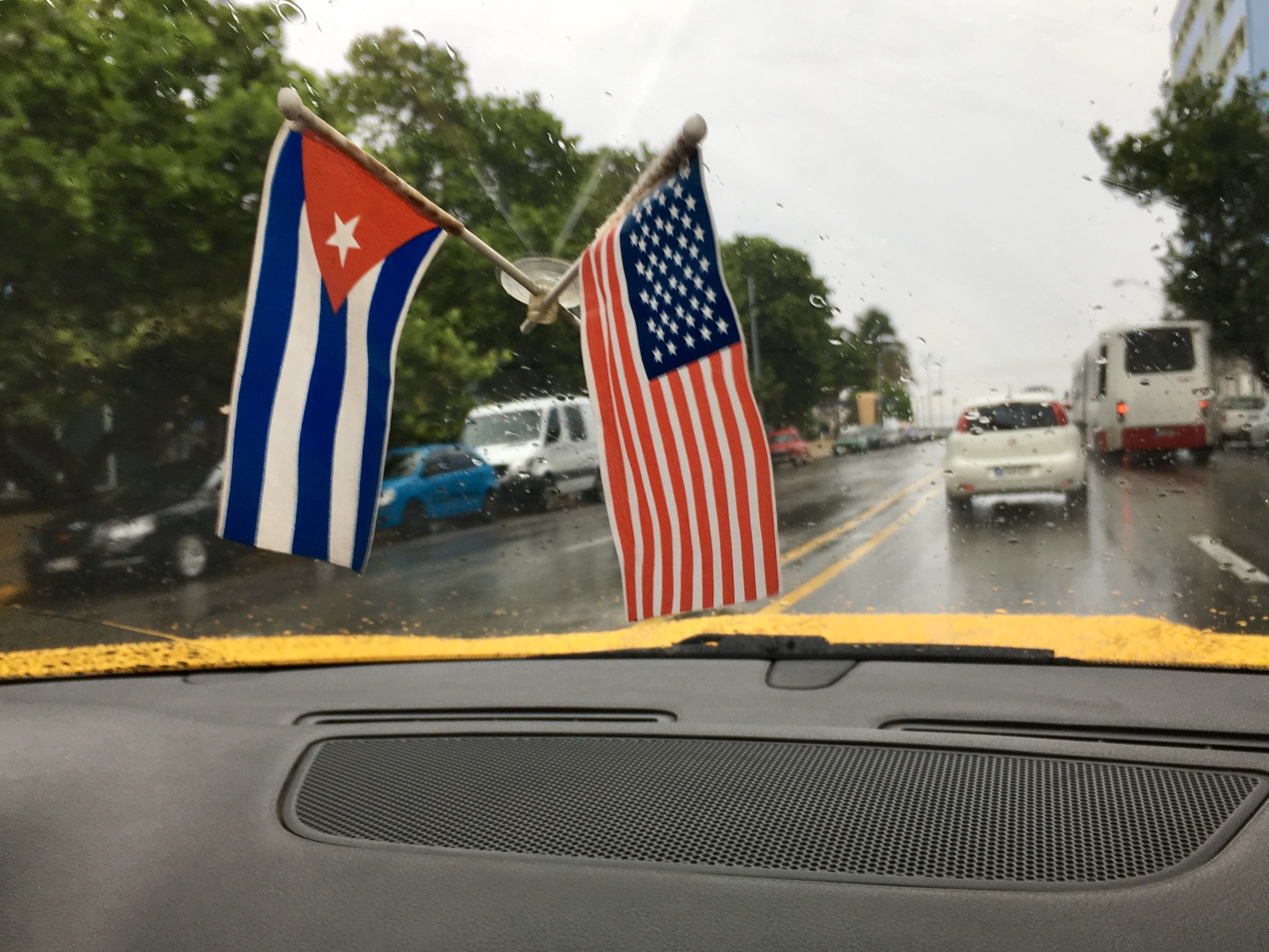
Cuba on the News
The Trump administration has intensified its pressure on Cuba through a carrot-and-stick strategy designed to force political and economic liberalization on the island. Aggressive sanctions, an effective oil blockade, and implicit military threats are paired with humanitarian-aid offers contingent on the regime’s acceptance of independent distribution. Against a backdrop of severe domestic economic and energy crisis, a surprise May 14 visit to Havana by CIA Director John Ratcliffe — the highest-ranking U.S. official to set foot on the island in years — signaled growing American frustration with the pace of any diplomatic resolution.
The blockade has pushed Cuba to a breaking point. Government officials have publicly admitted that fuel stocks are exhausted; blackouts in Havana now run well over twenty hours a day, water supplies are disrupted, and civil unrest is widespread. Havana, for its part, insists through state outlets like Granma that Cuba poses no threat to U.S. national security, and continues to demand removal from the U.S. list of state sponsors of terrorism.
Washington is wielding both punitive measures and financial inducements to extract concessions — the release of political prisoners and a structural opening of the economy. Enhanced secondary sanctions and restrictions on military-linked companies have undermined foreign investment, including the long-standing Cuban operations of Canada’s Sherritt International; reports suggest federal prosecutors in Miami are preparing an indictment against the 94-year-old Raúl Castro, with possible charges tied to the 1996 downing of two Brothers to the Rescue aircraft. On the inducement side, the United States has publicly reiterated an offer of $100 million in humanitarian aid — contingent on distribution through the Catholic Church and other independent organizations rather than through state agencies.
The diplomatic theater accompanying the pressure has been deliberately conspicuous. During his unannounced Havana mission, Ratcliffe reportedly told Cuban interlocutors that while economic stabilization remained possible, the United States would not compromise on its established “red lines.” Implicit military warnings have been reinforced by the example of January’s U.S. operation in Venezuela, which culminated in the capture of Nicolás Maduro and Washington’s effective seizure of Venezuelan oil infrastructure — the same operation that cut Cuba off from the Venezuelan crude on which its electrical grid depended. Concerns have meanwhile mounted that Havana is intentionally protracting the talks begun in February, betting that regional crises or shifts in the U.S. political cycle will eventually divert Washington’s attention.
Few observers expect a clean resolution. Secretary of State Marco Rubio has openly expressed doubt that the Cuban government is willing or able to implement genuine reform; analysts such as Ricardo Zúñiga have suggested the ruling elite will prioritize regime survival over averting economic collapse; and within the U.S. policy community, the old debate has reopened over the feasibility of a precision military strike versus the risks of a protracted occupation — a debate whose terms, as the historical record below makes clear, are not new.
The Long Arc
The roots of this confrontation run deeper than the current crisis. A brief history of Cuba’s relationship with the United States may help illuminate how we got here — and what is at stake in the choice Washington faces now.
The history is complex, and it would be a mistake to read it as simple villainy on one side and simple victimhood on the other. But the broad pattern is hard to miss. Across two centuries, the United States has been, on balance, a negative force in Cuban life: it intervened in a war Cubans had nearly already won, wrote into Cuban law a right of intervention it then exercised repeatedly, leased a naval base in perpetuity over Cuban objections, propped up a sequence of corrupt allied governments, profited from Cuba’s economy as a neocolony of American capital, and — when the Cuban people finally produced a revolution — spent the next six decades trying to strangle it. The one durable exception runs from the mid-1930s through the Second World War, when Franklin Roosevelt’s Good Neighbor Policy and the 1934 Treaty of Relations abrogated the most flagrant instruments of formal tutelage and allowed Cubans, for the first time in a generation, to chart something approaching their own course. Even then, U.S. ambassadors in Havana — Sumner Welles and Jefferson Caffery foremost — continued to engineer Cuban politics from behind the scenes. But the legal framework had changed, and the change was enough to make possible the constituent assembly of 1940 and the most ambitious charter the Western Hemisphere had yet seen.
What the United States did when it respected Cuban sovereignty, and what it did when it did not, is the central thread of the story that follows.
The Monroe Doctrine
In his 1823 annual address to Congress, President James Monroe declared the Western Hemisphere a sphere of United States influence and warned European powers against further interference in the Americas. The Monroe Doctrine was originally meant to deter European colonization, and the South American republics — short on naval strength and freshly independent — initially welcomed it as a safeguard. Through the administration of Ulysses S. Grant it was still largely read as a protective measure for hemispheric liberty: in the mid-1860s, U.S. diplomatic pressure had backed Benito Juárez against the French-installed Emperor Maximilian in Mexico, and that was the kind of intervention the doctrine had been written to authorize.
The Spanish-American War of 1898 changed all that. The acquisition of Puerto Rico, Guam, and the Philippines, the annexation of Hawaii in the same year, and the imposition of North American legal and social systems on captive populations transformed the doctrine from a defensive posture into an interventionist license. By 1904, Theodore Roosevelt had formalized the shift in the Roosevelt Corollary, which asserted an “international police power” to manage financial instability and “chronic wrongdoing” in Latin America. The corollary justified the dispatch of Marines to Nicaragua in 1912, to Haiti in 1915, to the Dominican Republic in 1916. What Monroe had described as a hemisphere insulated from European empire had become a hemisphere managed by a North American one, and the resentment that grew out of those interventions hardened into the political vocabulary of Latin America for the next century.
A War Almost Won
By the time the United States entered the Cuban war in 1898, the Cubans had been fighting for thirty years. The Ten Years’ War (1868–1878), the Little War (1879–1880), and the war of independence properly so called (begun in 1895) had cost roughly 300,000 lives on an island whose population then numbered fewer than 1.6 million — a per-capita toll comparable to the bloodiest European wars of the same century. By the time Antonio Maceo fell at Punta Brava in December 1896 and Máximo Gómez’s columns held the central plain, the mambí army had reduced Spanish authority to the garrisoned cities and a few fortified railroads. The countryside was theirs.
In October 1897, in a Camagüey pasture at La Yaya, the insurgents convened a constitutional assembly. Twenty-four delegates from the Liberating Army’s six corps ratified, on October 29, what is celebrated as the most comprehensive charter of the Republic of Cuba in Arms — one of the first constitutions in the hemisphere to guarantee universal suffrage and equal civil rights. They were drafting the legal architecture of a country they expected, with reason, to win.
They did not yet know that the war’s conclusion would be settled elsewhere. On August 12, 1898 — six months after the explosion of the USS Maine in Havana harbor had given Washington its pretext — Spain and the United States signed a bilateral armistice. Cuba was not represented. The patriots who had endured and led the violent three-year campaign against Spanish authority were excluded from the official transfer of power. Máximo Gómez and the Cuban army were conspicuously absent from the ceremonies at which Spanish sovereignty was handed across to American officers. Gómez, arriving later in Cienfuegos with a Black military escort, did not pretend otherwise: local speakers pointedly refused to credit the United States with Spain’s defeat. To many Cubans, then and since, 1898 was the moment Washington intervened in a war already nearly won, claimed the triumph as its own, and converted a Spanish colony into a de facto American protectorate without firing a substantial fraction of the shots that decided it.
This is not nostalgia; it is the record. The Cuban historian Emilio Roig de Leuchsenring titled one of his books, with precision, Cuba no debe su independencia a los Estados Unidos — Cuba does not owe its independence to the United States — and the title has stuck because the documentary case for it is overwhelming. The mambises had fought a thirty-year war. The Americans arrived at the end of it.
The Platt Amendment: A Republic Born Mortgaged
What the United States did with the victory it had not earned was to write the terms of Cuban sovereignty into U.S. law and then require the Cubans to incorporate those terms into their own constitution. The instrument was the Platt Amendment, attached as a rider to the U.S. Army appropriations bill of March 2, 1901, and named for its Senate sponsor, Orville Platt of Connecticut. Its eight clauses were a remarkable document: Cuba was forbidden to enter treaties with foreign powers that might impair its independence; Cuba was forbidden to contract public debt beyond what its ordinary revenues could service; Cuba was required to ratify the acts of the U.S. military occupation; Cuba was required to lease coaling and naval stations to the United States; and — the clause that mattered most — Cuba conceded “the right of the United States to intervene for the preservation of Cuban independence, the maintenance of a government adequate for the protection of life, property, and individual liberty.”
The fiction of the document was that the right of intervention was a guarantee of Cuban liberty. The reality of the document was that it placed a foreign veto over Cuban politics and made the new republic a tutelary state from its first day. The Cuban Constitutional Convention, sitting in Havana that spring, understood this perfectly. It rejected the amendment in its first vote. General Leonard Wood — the U.S. military governor, who had given General José Miró Argenter his word “as a gentleman and a soldier” that Washington was moving toward Cuban independence — promptly made the convention’s choice clear: incorporate the Platt Amendment into the Cuban constitution, or the occupation would not end. A note in The New York Times of March 13, 1901, reports, in the politely euphemistic language of the time, that Wood had sent the convention “a communication … pointing out that the warrant calling the elections gave the delegates this power.” The convention complied on June 12, 1901, by a margin of one vote. The republic that came into being on May 20, 1902, did so on terms it had not chosen.
The Platt Amendment was not a dead letter. Under its authority, U.S. Marines reoccupied Cuba from 1906 to 1909, after President Tomás Estrada Palma asked Washington to suppress a domestic uprising and Roosevelt obliged. Marines returned in 1912, during the so-called “Negro Rebellion.” Marines returned in 1917, to suppress the Guerra de La Chambelona, an insurrection by Liberal Party factions who contested Mario García Menocal’s reelection. Each intervention validated the underlying logic: when Cuban politics produced an outcome Washington disliked, Washington had the legal right to send troops to alter it. Cuban politicians, knowing this, framed their conduct accordingly. Oppositionists appealed to Washington rather than to the electorate. Governments cultivated American ambassadors more carefully than they cultivated their own constituencies. The center of gravity of Cuban political life lay, for thirty-three years, in the U.S. embassy on the Malecón.
The psychological cost of this arrangement has been the subject of an enormous Cuban literature, and the literature is unanimous on one point. To grow up in republican Cuba was to grow up knowing that one’s country was, in the formal sense, not entirely one’s own. The mambí generation had fought a war for sovereignty and watched sovereignty pass to a foreign power. The republican generation inherited the resentment, refined it, and made of it a political tradition. When the journalist Emilio Roig wrote, in 1921, La doctrina de Monroe y el pacto de la Liga de las naciones, he was articulating what almost every literate Cuban already felt: that the Monroe Doctrine, having begun as a shield against European empire, had become a charter for a new one.
Guantánamo
The leases were the geographic expression of the Platt Amendment. On July 2, 1903, in fulfillment of the amendment’s coaling-station clause, Cuba leased Bahía Honda and Guantánamo to the United States. The annual rent for Guantánamo was set at $2,000 in gold — a sum that, by 1934, had been redenominated to roughly $4,085 in dollars, and that the Cuban government, after 1959, declined to cash. (The first check, the story goes, was deposited by error during the chaos of the early revolutionary months. Every check since has sat uncashed in a desk drawer in the office of the Cuban Commander-in-Chief.) The lease itself was perpetual: it could be terminated only by mutual agreement, and the United States has never agreed.
Guantánamo Bay is a deep-water harbor at the eastern end of the island, on the Caribbean side, of obvious strategic value. The naval base built there has, over the course of the twentieth century and into the twenty-first, functioned as a coaling station, a refueling depot, a forward operating point for Caribbean and Atlantic patrols, a refugee processing center for Haitian and Cuban balseros, and — most notoriously, since 2002 — a detention facility for prisoners taken in the so-called Global War on Terror. From the Cuban point of view, however, the base has always been one thing first: a piece of Cuban territory under foreign military occupation, on a lease the Cubans never freely granted, that cannot be ended by any Cuban act.
For the political imagination of twentieth-century Cuba, Guantánamo was the open wound. The map of the country was disfigured. The sovereignty of the country was, by treaty, partial. Every Cuban schoolchild grew up knowing that the easternmost province contained a piece of the United States, and that the piece could not be reclaimed. Whatever else one might say about the rhetoric of the revolution after 1959, the rhetoric of patria sin Plattismo — a homeland without Plattism — was not invented in Havana in 1959. It had been the rhetoric of Cuban nationalism since 1902.
Humiliations
The legal architecture sat atop a daily texture of small humiliations, and the daily texture mattered as much as the legal architecture. From the first weeks of the U.S. military occupation in 1899, Cubans experienced what every memoir of the period describes as a profound sense of being unrecognized — not defeated, exactly, since they had won, but ignored. The disbandment of the Liberating Army was negotiated, in Washington, by a Cuban commission led by Calixto García Iñiguez, José Antonio González Lanuza, Manuel Sanguily, José Miguel Gómez, and José Ramón Villalón. They had been authorized by an assembly of the mambises themselves; they came armed with the resolutions of the U.S. Congress of April 19, 1898, which had proclaimed the independence of the island; they asked for the modest sum required to settle their veterans into civilian life. They obtained almost none of the concrete objectives the assembly had set for them. Calixto García, the great campaigner of the eastern theater, died in Washington during the negotiations.
In Havana, the friction was physical. American soldiers, weary of a population that did not act sufficiently grateful for its liberation, looked openly for fights with Cuban veterans; the Cuban veterans, for their part, found ways to oblige. The newspaper El Cubano Libre — the journalistic organ of the eastern mambises — was a steady irritant to the occupation authorities and, by Miró Argenter’s later testimony, perhaps a steady tutor of them. On one occasion General Wood reassured the Cuban general, “upon my honor as a gentleman and a soldier, that per my government’s instructions, we are moving toward independence; the government of the Island will be handed over to the Cubans.” Within months he was telling the Cuban Constitutional Convention what its constitution would say.
The humiliations did not end with the formal occupation. They were embedded in the structure of the relationship that replaced it. American managers ran the largest sugar mills. American banks held the public debt. American firms owned the utilities, the railroads, the telephone system. Havana’s social register — Country Club, Vedado Tennis, Yacht Club — listed members who were guests in their own country, since the most exclusive of these clubs would not, in the early decades, admit Black or mestizo Cubans, even those whose ancestors had led the army Maceo had commanded. The geography of leisure replicated the geography of power. Cubans who wished to enter certain spaces in their own capital had to do so on terms set by foreigners. A century of such small refusals leaves a deposit, and the deposit was nationalism.
The Neocolonial Republic
What the Platt Amendment authorized in law, the sugar economy ratified in fact. The First World War, by destroying European beet production, returned Cuba to its nineteenth-century position as the world’s premier sugar provider. By 1916, annual sugar earnings reached $308 million, sharp rises from $163 million in 1914 and $202 million in 1915. The wealth was real, but the structure beneath it was not Cuban. By the 1920s, U.S. capital owned roughly two-thirds of Cuba’s sugar production; the largest mills were subsidiaries of the United Fruit Company, the Cuban-American Sugar Company, and a handful of New York and Boston banks. Cuban colonos grew cane on contract for these mills; Cuban workers cut it at piecework rates; Cuban shopkeepers sold groceries to the workers on credit during tiempo muerto, the long dead season between harvests; and the profits flowed north. Cuba had political independence and economic vassalage, which is roughly the definition of a neocolony.
The political class that operated this arrangement — the allied presidencies of José Miguel Gómez, Mario García Menocal, Alfredo Zayas, and Gerardo Machado — was the perfect counterpart to the structure. Its job was to keep the wheels turning, to keep American property safe, and to extract from the system the rents that the system allowed.
Gómez
By 1909, the demographic landscape of Cuba had been transformed. The population had reached roughly two million, making the island the most populous of the small Caribbean nations. Much of this growth owed to the public-health campaigns of the U.S. occupation — especially the eradication of yellow fever by Walter Reed’s commission, building on the mosquito hypothesis of the Cuban physician Carlos Finlay. (The episode is one of the few in which American activity in Cuba produced unambiguous Cuban benefit.) But the political culture that consolidated under the first elected Cuban president, José Miguel Gómez, was something else: an institutionalization of graft so thorough that the slang for it, chivo — literally, “goat” — entered everyday speech. The Customs service alone was estimated to lose between fifteen and twenty-five per cent of its total revenue. Because many members of Congress profited directly from these transactions, no opposition formed. Many Cubans regarded chivo as a means of extracting extra resources from the United States; the financial burden, given the structure of taxation, rarely fell on the poorer segments of society.
Three scandals defined the period. The first concerned the $16.5 million loan that Charles Magoon, Gómez’s predecessor and the U.S. provisional governor, had floated through Speyer & Co.; despite massive expenditures, Gómez announced in 1912 that millions more were needed, sparking public outcry. The second was the Arsenal Lands affair, a fraudulent railroad relocation. The third, and most consequential, was the Ports Company scandal: a thirty-year contract to collect harbor fees on goods entering Cuban ports, awarded to political cronies that included the American engineer Colonel Tillinghast L’Hommedieu Huston (later, a co-owner of the New York Yankees). The arrangement was annulled by Gómez’s successor amid allegations of illegal advances and a massive deficit.
The pattern was set: large foreign loans to fund public works, public works contracted to political cronies, kickbacks to ministers and to the president, and a press subsidized into compliance. La Lucha, decades later, would openly state that the press had “broken lances” on behalf of particular transactions only when money was forthcoming.
Menocal
Mario García Menocal began his presidency in May 1913 with progressive measures — mandatory worker insurance, a stable currency pegging the peso to the dollar, state mediation for labor disputes. He continued the 1913 policy of allowing the United Fruit Company to import Haitian workers while actively encouraging white European immigration, an early sign that elite anxieties about the racial composition of the labor force would shape Cuban politics for the next two decades.
The corruption, however, was Menocal’s signature. He expanded the Ministry of the Interior’s secret-service budget; he sought a $10 million J. P. Morgan loan at five per cent through what was widely understood to be strategic bribery; he broke his vow to end the national lottery and shielded it from official accounting. In February and March 1917, President Wilson deployed U.S. Marines to Cuba to support Menocal’s administration against the Guerra de La Chambelona, the Liberal insurrection contesting his fraudulent reelection. The pattern by now was familiar: a contested Cuban election, an appeal to Washington, Marines on Cuban soil under the Platt Amendment’s authority. By the end of his eight-year tenure, Menocal had reportedly spent $800 million; the national treasury was in overdraft.
Machado
Gerardo Machado came to office in May 1925 on a platform of “water, roads, and schools” and on initial promises of administrative reform. His first years brought genuine public works — the Central Highway connecting the length of the island, the Capitolio Nacional in Havana — and a measure of public goodwill. The global collapse of sugar prices in the late 1920s, deepened by the onset of the Great Depression, then undermined both the economic basis of his program and his political legitimacy. In 1928, after seizing control of the electoral framework, Machado secured his reelection and decreed a new six-year presidential mandate. As internal rebellions intensified, his security forces acquired a gruesome reputation for systemic torture and extrajudicial executions. Opposition meanwhile gathered momentum at the University of Havana, where the Directorio Estudiantil Universitario — reconstituted in 1927 — became one of the principal vehicles of resistance. Confrontation reached a critical juncture on September 30, 1930, when police killed the Directorio leader Rafael Trejo during a student demonstration; his death catalyzed the broader urban opposition that would, over the next three years, draw in the clandestine ABC Society, the Communist Party, and dissident officers within the armed forces.
By 1933, the traditional 120-day Cuban sugar harvest had shrunk to just 66 days. The country went into open revolution. President Franklin D. Roosevelt, newly inaugurated, dispatched Assistant Secretary of State Sumner Welles to Havana as Ambassador Extraordinary and Plenipotentiary. Recognizing that Machado was beyond saving, Welles began exploring political alternatives — an arrangement that would preserve U.S. interests through an orderly succession rather than allow the revolution to determine the outcome on its own terms. On August 12, 1933, besieged by a nationwide general strike and abandoned by his own military, Machado fled the country. With Welles’s backing, the elder statesman Carlos Manuel de Céspedes y Quesada — son of the founding father of Cuban independence — was installed as provisional president. The appointment was meant to reassure both Washington and the Cuban establishment, but it satisfied none of the revolutionary factions, students, or junior officers who had brought the regime down. Within weeks, on September 4, 1933, the so-called Sergeants’ Revolt led by Fulgencio Batista swept Céspedes from office and inaugurated the next phase of the crisis.
The Roosevelt Interlude
It is here that the one durable exception to the long pattern of U.S. meddling enters the story, and it is worth pausing on it.
The brief revolutionary government of Ramón Grau San Martín (September 1933 – January 1934), backed by the radical students of the Directorio and the energetic young intellectual Antonio Guiteras, attempted in roughly a hundred days what no previous Cuban government had attempted: it abrogated the Platt Amendment unilaterally, granted women the vote, decreed an eight-hour workday, established a minimum wage in the sugar industry, lowered electricity rates, and seized two American-owned sugar mills. Welles refused to recognize the government, briefed Washington against it, and worked to assemble a coalition — built around Batista, who had by then promoted himself from sergeant-stenographer to army chief of staff — to bring it down. On January 14, 1934, Batista forced Grau to resign. The radical experiment was over.
What followed, however, was unexpected. Roosevelt, having promised in his inaugural address a “good neighbor” foreign policy, decided that the formal instruments of U.S. tutelage in the hemisphere — the Roosevelt Corollary, the Platt Amendment, the routine dispatch of Marines — had become a liability rather than an asset. On May 29, 1934, the United States and Cuba signed a new Treaty of Relations that explicitly abrogated the Platt Amendment. The right of unilateral U.S. intervention in Cuban affairs, which had structured the relationship since 1903, was — on paper — extinguished. Only the Guantánamo lease survived, as a separate instrument.
This was real. It was, in cold legal terms, the most consequential act of restraint by the United States toward Cuba in the twentieth century. It opened the political space within which the constituent assembly of 1940 became possible. It allowed the slow growth of a properly Cuban politics, contested between Cuban factions on Cuban terms, that the previous thirty years had largely foreclosed.
It was also incomplete. Welles continued to manage Cuban politics from the U.S. embassy well after the treaty, as did his successor Jefferson Caffery; the State Department’s preference for Batista as a “stabilizing force” against the liberal-revolutionary Grau shaped Cuban politics through the rest of the 1930s. The U.S. ambassador in Havana remained, as the historian Lars Schoultz has put it, “the second most powerful figure” in Cuban politics for another two decades. The legal framework had changed; the habits of the relationship had not. Even so, the change was enough. Within seven years it produced a constitution.
The Constitution of 1940
The seven years between the September 1933 Sergeants’ Revolt and the inauguration of the 1940 Constitution were a long, unstable rehearsal for democracy. From the wings, Batista managed a rapid succession of civilian presidents — Mendieta, Barnet, Gómez, Laredo Brú — without ever assuming the office himself. He used the army aggressively to break the 1935 general strike, deploying troops to run transit lines, secure post offices, occupy the university, and protect strike-breakers; constitutional rights were stripped; independent unions outlawed. He then pivoted, in 1936, to a progressive populism that co-opted the platforms of his suppressed rivals: 705 civic-military rural schools, an agrarian reform that distributed over 33,000 acres of state land to poor laborers by early 1938, the 1937 Plan Trienal with its corporatist promises of profit-sharing, pension insurance, and national literacy. The plan stalled in a downturn. But by the end of the decade, the formula had run its course. Pressure from the opposition, from within Batista’s own coalition, and from a generation of politicians who had cut their teeth in the 1933 Revolution converged on a single demand: a new constitution, written by a freely elected assembly, that would close the long Plattist parenthesis once and for all.
The Constituent Assembly was elected on November 15, 1939, under the constitutional presidency of Federico Laredo Brú — the legitimately elected head of state who shepherded the process to completion. Seventy-six delegates from nine parties sat in Havana for six months of public debate. The composition was the document’s most surprising feature: liberals, conservatives, Auténticos, and the Unión Revolucionaria Comunista — Cuba’s communist party — argued together over labor codes, suffrage, and land tenure. The assembly elected Ramón Grau San Martín its first chairman; when the conservative bloc shifted, Grau was replaced by Carlos Márquez Sterling, a Batista ally. The text was signed on July 1, 1940, at Guáimaro in Camagüey — a deliberate gesture toward the 1869 founding constitution drafted there during the wars of independence — and took effect on October 10.
On paper, the 1940 Constitution was one of the most ambitious legal documents in the Western Hemisphere. It guaranteed the eight-hour workday, paid vacations, a minimum wage scaled to the economy, and three months of paid maternity leave. It banned discrimination by race and sex; it granted women full civil equality; it legalized divorce; it abolished capital punishment. Its economic articles restricted foreign ownership of agricultural land and prohibited the latifundio — the vast, often U.S.-owned sugar estates that had hollowed out rural Cuba — and committed the state to gradually breaking up land held in common by sugar companies. It established an independent Tribunal of Constitutional and Social Guarantees, a forerunner of the modern constitutional courts that would proliferate in Latin America fifty years later. It enshrined the right to housing, to education, to medical care, and — strikingly for the moment — to “work as an inalienable right of the individual.”
Many of these provisions were programmatic rather than self-executing: they required enabling legislation, and Congress, dominated by the very interests the articles were meant to constrain, never passed most of it. The 1940 Constitution would be more honored in citation than in practice. Yet it acquired, within a generation, the status of a national charter — the standard against which every subsequent regime would be measured and found wanting. When Castro, on trial after the Moncada assault thirteen years later, declared in his defense that he had taken up arms not to overthrow the constitutional order but to restore it, the document he meant was the Constitution of 1940. When the Cuban exile press in Miami denounces the current government, the document it implicitly invokes is the Constitution of 1940. The charter that had been written to close the Plattist parenthesis became, in the decades that followed, the moral standard for what an independent Cuba was supposed to be.
Batista’s First Presidency, 1940–1944
Batista, who had spent the 1930s as the army’s gray eminence, completed his transformation into a constitutional officeholder by winning the July 1940 election against Grau. The coalition that carried him was improbable. To shore up his left flank and broaden the regime’s legitimacy, Batista had legalized the Unión Revolucionaria Comunista in 1938 and accepted communist support; in exchange, he brought communist leaders into the cabinet and tolerated their organizing work in the sugar and tobacco unions. The arrangement was opportunistic on both sides — the communists later judged it a useful interlude, while Batista treated them as a counterweight to the Auténticos — but it gave the first Batista presidency a corporatist, popular-front quality that distinguished it sharply from what would follow in the 1950s.
The war reshaped the presidency. After Pearl Harbor, Cuba promptly declared war on the Axis and made itself an exemplary U.S. ally. Cuban patrol vessels searched the Caribbean for German U-boats — one of which, U-176, was sunk off Cayo Blanquizal in May 1943 with Cuban participation — and the island’s sugar economy was placed at the service of the Allied war effort under a long-term U.S. purchase contract that subsidized production at wartime prices. The country prospered. So did the president: when he stepped down in October 1944, having honored the constitution’s ban on consecutive re-election, Batista carried a substantial personal fortune into exile in Daytona Beach and New York, where he settled comfortably to wait for the political weather to change.
The Auténtico Years: Boom and Graft
The election of Ramón Grau San Martín in 1944 was received as a kind of national catharsis. Grau had been the short-lived revolutionary president of 1933, ousted by Welles and Batista before he could implement the most radical pieces of his program; his return after a decade in opposition seemed to redeem the promise of the 1933 generation. Cubanidad — a Cuba run by Cubans, for Cubans — was the slogan, and the Partido Auténtico the vehicle. What followed, instead, was a master class in how a constitutionally democratic state can rot from within while every formal institution remains standing.
Grau’s term (1944–1948) and that of his Auténtico successor, Carlos Prío Socarrás (1948–1952), coincided with one of the great commercial booms in Cuban history. Postwar sugar prices, freed from wartime controls, climbed steeply; the U.S. continued to buy under preferential quotas; and the dollars poured into Havana. The capital became, for a brief moment, one of the most cosmopolitan cities in the Americas. Vedado filled with modernist apartment towers; the Malecón was extended; the Tropicana drew Carmen Miranda, Nat King Cole, and a steady traffic of Hollywood visitors. A Cuban middle class — professionals, civil servants, sugar-mill technicians, broadcasters — expanded rapidly, and with it a popular culture (radio, then television; Cuban television began broadcasting in 1950, ahead of most of Latin America) that gave the era a distinctive glamour in retrospect.
Beneath the glamour, the Auténtico administrations devoured the state. Public funds disappeared at a scale that staggered even seasoned observers of Cuban politics. The most notorious episode of the Grau years was the so-called asalto a la tesorería — the “Invasion of the Subtreasury” — in which a senator-linked operation removed roughly $174 million from government accounts over the course of the administration. Education ministers became infamous for skimming school construction funds; sugar quotas were traded for kickbacks; the customs service ran as a private fief. By the late 1940s the government’s reputation for graft was so universal that malversación — embezzlement — entered everyday Cuban speech as a kind of shrug.
The corruption was inseparable from a second, more violent pathology: gangsterismo, or bonchismo. The bonches were not common street gangs but armed political factions, many of them rooted in the University of Havana, that had originated in the 1930s anti-Machado struggle and survived as patronage militias attached to ministries, police precincts, and party machines. By the late 1940s, their feuds spilled regularly into the streets of Havana. Ministers were assassinated; rival groups shot at each other across the steps of the university; the police, themselves penetrated by bonche networks, were as often participants as referees. It was in this milieu that a law student named Fidel Castro served his political apprenticeship, navigating — and occasionally fighting in — the bonche world while building the constituency that would later carry him into national politics.
Against this backdrop rose Eduardo Chibás, a former Auténtico turned crusading prosecutor of his old party. Chibás split from the Auténticos in 1947 to found the Partido Ortodoxo on a single, devastatingly simple platform: vergüenza contra dinero — shame against money. From his Sunday-night radio program on CMQ, he flayed the Grau and Prío administrations with a forensic intensity that no Cuban politician had ever brought to broadcasting. By 1951 he was the runaway favorite to win the 1952 election. On August 5 of that year, Chibás concluded his weekly broadcast by drawing a pistol and shooting himself in the abdomen, an act he intended as a final gesture against the corruption he could not legally prove. He died eleven days later. His funeral drew the largest crowds Havana had seen in living memory, and his death left the Ortodoxos — Castro among their congressional candidates — leaderless on the eve of the most consequential election in republican history.
The 1952 Coup
The election was scheduled for June 1, 1952. The three principal candidates were Carlos Hevia (Auténtico), Roberto Agramonte (Ortodoxo, Chibás’s posthumous heir), and Fulgencio Batista, returned from American exile and running on a small coalition ticket. Polls — and Batista’s own private soundings — placed him a distant third. Recognizing that the ballot would deny him what the ballot in 1940 had given him, Batista chose the alternative.
In the early hours of March 10, 1952, three months before the vote, Batista entered Camp Columbia, the army headquarters in Marianao, with a small group of officers, seized the high command without firing a shot, and announced himself in power. By dawn the coup was complete. President Prío, taken by surprise, took refuge in the Mexican embassy and flew into exile. The 1940 Constitution was suspended; Congress was dissolved; the elections cancelled. Within days the United States, under President Truman, extended diplomatic recognition. A bloodless coup against a corrupt and unloved government provoked, in those first weeks, more relief than resistance. The judgment of history would form more slowly.
The political class did not so much resist as fragment. The Auténticos, beached by Prío’s flight, were leaderless within a week. The Ortodoxos — still mourning Chibás and split between an old guard and a younger, angrier faction — issued statements of protest and went home. The Cuban Confederation of Workers, controlled by Batistiano labor functionaries, declared its loyalty to the new order on the day of the coup. Among the few who attempted a formal response was a twenty-five-year-old Ortodoxo congressional candidate, Fidel Castro, who in late March filed a brief before the Cuban courts demanding Batista’s prosecution for the violation of six articles of the 1940 Constitution and calling, with prosecutorial precision, for cumulative sentences amounting to over a hundred years. The brief was set aside without a hearing. From the silence Castro drew the conclusion that the institutions of the republic could no longer be repaired through the institutions of the republic. The Constitution itself was formally replaced on April 4 by a set of Estatutos Constitucionales that preserved much of the 1940 text on paper while suspending political rights and concentrating legislative authority in a Consejo Consultivo hand-picked by the president. Batista promised elections within a year. When they were finally held in November 1954, the major parties boycotted and Batista ran effectively unopposed — the kind of single-candidate ratification that does not earn an asterisk in any history of Latin American democracy.
The Mafia State
What Batista built between 1952 and 1958 was something Cuba had not seen before: a regime that married authoritarian rule to an explicit financial partnership with American organized crime. The architect of the partnership was Meyer Lansky, an old acquaintance of Batista’s from the 1930s. Appointed in 1952 as an informal adviser on gambling, Lansky cleaned up Havana’s notoriously crooked casino floors — a necessary step for attracting middle-class American tourists — and oversaw a building boom in licensed hotel-casino properties along the Malecón and in Vedado. The Hotel Nacional, the Capri, the Riviera, and the new Habana Hilton were the showpieces of the partnership; Santo Trafficante Jr. ran the Sans Souci and the Capri’s casino, and through them managed a Caribbean narcotics pipeline that moved heroin from Marseilles and cocaine from the Andes through Havana to the eastern U.S. seaboard. The skim — the portion of gross casino revenue diverted before tax — went to the mafia and to Batista’s inner circle in agreed shares. The Cuban treasury saw a fraction; the Cuban public saw less.
Across the rest of the island, the boom on the Malecón had little echo. The sugar economy gave the guajiros of the interior eight months of work and four months of tiempo muerto — the “dead time” between harvest seasons during which rural workers and their families lived on credit, charity, or hunger. The 1953 census, the last taken under the republic, recorded that 68.5 per cent of Cuban campesinos lived in bohíos — palm-thatched huts without running water or electricity — that fewer than half the children in the countryside attended school, and that life expectancy in the rural east lagged Havana’s by more than a decade. The geographic divide between the neon city and the dark interior would become, within five years, the operational map of the revolution.
The Apparatus of Repression
Batista’s second regime built the security state it needed to defend itself. The Servicio de Inteligencia Militar (SIM), a military intelligence unit that had existed in earlier form during his first presidency, was rebuilt under army command and given a broad mandate over surveillance, interrogation, and the elimination of political opponents. Operating from bases including the colonial fortress of La Cabaña, SIM became — in the testimony of survivors and the post-revolutionary trials of its officers — synonymous with torture and extrajudicial execution. To it was added, on May 4, 1955, the Buró para la Represión de las Actividades Comunistas (BRAC), created by presidential decree with the active assistance of the CIA, which trained its agents in counterintelligence and interrogation techniques. BRAC’s director, Mariano Faget — a former Nazi-hunter of the war years — was described by one of his detainees, Carlos Franqui, as “a technician of torture, a scientist of the North American school: continuous blows to the head, leaving no marks but producing tremendous pain.” The corpses of Movimiento 26 de Julio sympathizers, dumped at roadsides in Havana and Santiago, became a regular feature of the city pages of the few newspapers willing to print them.
As the insurgency grew, the apparatus grew with it, and so did the casualness of its violence. Police chiefs in Santiago, Havana, and the central provinces acquired private reputations for the things they were known to do in interrogation rooms; certain names — Esteban Ventura Novo of the Havana police’s Fifth Division; the senator-warlord Rolando Masferrer, whose private paramilitary force of Tigres operated with impunity across Oriente — recurred in the underground press and, after 1959, in the trial records. The killing of Frank País, the M-26-7’s urban coordinator and the most effective organizer the movement had produced outside the Sierra, by Santiago police on July 30, 1957, turned the eastern capital into a city of strikes and funerals. A few months earlier, on April 20, 1957, the police had cornered and killed four young members of the Directorio Revolucionario at the Humboldt 7 apartment in Havana; the dead were survivors of the March 13 assault on the Presidential Palace, in which the Directorio’s leader, José Antonio Echeverría, had also been killed. Each prominent death produced more recruits than it suppressed.
The political effect of the violence was the inverse of its operational intent. The middle class that had at first welcomed Batista’s restoration of order in 1952 turned, slowly and then quickly, against a regime whose response to dissent had become indistinguishable from criminality. The Catholic hierarchy, traditionally cautious, issued a joint pastoral letter on February 25, 1958 calling for a national unity government — a step short of demanding Batista’s resignation, but a step nonetheless. The professional associations — the bar, the medical society, the engineers’ college — issued increasingly pointed public statements. The press, what was left of it after the closure of Bohemia’s most aggressive issues and the harassment of Diario de la Marina’s reporters, found ways to print the things that mattered. By the autumn of 1958, the regime was visibly losing the constituencies it had been built to serve. The army would discover the next phase, in the mountains, three months later.
An Open Invitation to Revolution
Years later, Arthur Schlesinger Jr. — Kennedy’s special assistant and the historian of his Latin American policy — would summarize the second Batista regime in language that has been quoted often enough that it has come to read like a verdict. “The character of the Batista regime in Cuba,” he wrote, “made a violent popular reaction almost inevitable. The rapacity of the leadership, the corruption of the government, the brutality of the police, the regime’s indifference to the needs of the people for education, medical care, housing, for social justice and economic opportunity — all these, in Cuba as elsewhere, constituted an open invitation to revolution.”
It is worth dwelling on the four nouns. The rapacity was the partnership with Lansky and Trafficante and the diversion of casino revenue into private accounts; it was Batista’s personal fortune, estimated at over $300 million when he fled. The corruption was inherited and refined: the Auténtico apparatus of malversación still functioning, now under a regime no longer constrained by election cycles. The brutality was SIM and BRAC and the bodies in the ditches. The indifference was the 1953 census — the bohíos, the rural schools that did not exist, the life expectancy in Oriente that lagged the capital by more than a decade. Cuba in 1958 had one of the highest per-capita incomes in Latin America and one of the most starkly unequal distributions of that income on the continent. The Constitution of 1940, with its land-reform articles, its anti-latifundio clauses, its right to work and education and medical care, was on the books. It was simply not enforced.
When the Schlesinger formula came down to “open invitation to revolution,” it was not a metaphor. The young men and women who would, beginning in 1953, take up arms against the regime were not extremists denouncing a functioning democracy. They were constitutionalists, in the most literal sense, denouncing a regime that had suspended the constitution. The most common rhetorical device in the early Castroist literature is not Marxist; it is constitutional. La historia me absolverá, the speech Castro delivered in his own defense after the Moncada attack, is a long quotation from the 1940 Constitution and a long indictment of the regime that had nullified it. Cubans had spent forty years building the legal architecture for an independent and modern republic. Batista, with American recognition and American training of his secret police, had spent six years dismantling it.
The Revolution
Moncada and the Trial
On the morning of July 26, 1953 — the eve of the carnival in Santiago de Cuba, chosen so that the streets and the garrison would be sleepy and disordered — Castro led roughly 135 men in a coordinated assault on the Moncada Barracks, the second-largest military installation in Cuba, and a smaller force against the Bayamo garrison. The plan was to seize the armoury, broadcast a call to insurrection over the local radio, and trigger a popular rising. The military side of it failed almost immediately: the lead vehicles missed the route, a chance encounter with a patrol gave the alarm, and the assault collapsed under heavy fire. Most of the attackers who survived the initial fighting were tortured and executed in the hours that followed; perhaps half of the dead were killed after surrender. Castro escaped to the hills, was captured a week later by a lieutenant who refused to murder him on the spot, and was tried in October.
He turned the trial into a stage. Speaking in his own defence for what observers reconstructed as nearly four hours, Castro delivered the speech later published, in revised form, as La historia me absolverá: a programmatic indictment of Batista’s regime and a sketch of the social legislation a revolutionary government would enact — land reform, profit-sharing, free education, expropriation of corrupt fortunes. The speech was not the apologia of a defeated radical; it was a manifesto, and its frame was the restoration of the 1940 Constitution. Sentenced to fifteen years on the Isle of Pines, Castro spent twenty-two months there before a general amnesty — granted, with extraordinary political miscalculation, by Batista in May 1955 — released him into Mexican exile.
Granma and the Sierra Maestra
In Mexico City Castro consolidated the Movimiento 26 de Julio (M-26-7), trained a small expeditionary force under the former Spanish Republican officer Alberto Bayo, and recruited the Argentine doctor Ernesto Guevara, whom the other Cubans soon came to call simply Che. On November 25, 1956, eighty-two men — Fidel and Raúl Castro, Guevara, Camilo Cienfuegos, Juan Almeida, and the rest — embarked from Tuxpan on the Granma, a sixty-foot cabin cruiser built for twelve passengers. Bad weather and an overloaded hull delayed the crossing; the urban M-26-7 rising in Santiago that the landing was supposed to coincide with had already been suppressed by the time the boat ran aground in the swamps of Playa Las Coloradas on December 2. Three days later, at Alegría de Pío, the column was ambushed and dispersed; perhaps twenty men, in scattered groups, made it into the Sierra Maestra.
From that toehold the war was rebuilt, slowly, over the next two years. The strategy that emerged was as much political as military. In the territory the column gradually controlled, the rebels organized literacy classes, set up rudimentary clinics under Che’s direction, paid for what they requisitioned, and — most consequentially — enforced a rough but real land reform on the latifundios whose absentee owners had treated the guajiros as a captive labor force. The peasants returned the favor with food, shelter, intelligence, and recruits. By mid-1957 the M-26-7 had a second front opening in the Sierra del Escambray and an urban underground in Havana and Santiago capable of strikes, sabotage, and propaganda.
The propaganda war proved decisive. In February 1957, the New York Times correspondent Herbert Matthews was smuggled into the Sierra Maestra and given a long interview with Castro. Matthews’s three resulting articles — published with photographs of the rebel leader very much alive, in defiance of regime claims that he had been killed at Alegría de Pío — destroyed the dictatorship’s international credibility almost overnight. Matthews’s Castro was the romantic revolutionary the American liberal reader was prepared to embrace: a constitutionalist, a democrat, a Cuban patriot in the mould of José Martí. The Castro of 1957 was complicated enough that this was not exactly a lie, but it was not the whole truth either, and the Matthews interview would become, after 1959, a touchstone of the long American argument over how Cuba had been “lost.”
The Collapse of the Batista Regime and the Fall of the Republic
The swift and unexpected collapse of the Batista government was driven by rampant state repression, international isolation, and decisive military defeat, all capitalized on by the coordinated dual strategy of the 26 July Movement. Brutal violence by security agencies like SIM and BRAC deeply alienated the urban middle class, rendering every discovered casualty a symbol of the regime’s lost moral authority. Simultaneously, the United States dealt a massive psychological blow in March 1958 by suspending military shipments under the Mutual Defense Assistance Agreement. While the material constraint was modest, as Batista sourced weapons elsewhere, it signaled to Cuba’s military officer corps and the bourgeoisie that Washington had abandoned the administration. This erosion of authority occurred alongside a highly effective rebel strategy that united an urban underground engaged in sabotage and propaganda with a rural guerrilla wing supported by local peasants and sugar workers in the Sierra Maestra and northern Oriente Province.
The regime’s ultimate undoing occurred on the battlefield, beginning with a catastrophic failure during the summer 1958 offensive where roughly twelve thousand government troops failed to defeat a mere three hundred guerrillas in the mountains. By autumn, rebel columns led by Camilo Cienfuegos and Che Guevara pushed westward across the central plains, culminating in late December when Guevara’s forces besieged Santa Clara, a vital transportation hub. After the rebels derailed an armored reinforcement train carrying ammunition, the city fell on December 31, leaving the road to Havana completely undefended.
In the early hours of January 1, 1959, Batista abruptly gathered his closest associates at Camp Columbia, packed large suitcases of cash, and fled into exile in the Dominican Republic without addressing the nation or organizing a managed transition. A brief attempt by the army’s high command to establish a junta under General Eulogio Cantillo immediately collapsed upon contact with reality. Hearing the news while hundreds of miles away in Santiago de Cuba, Fidel Castro turned his geographical disadvantage into a historic stage, proclaiming the revolution’s triumph from the balcony of city hall to an enormous crowd before embarking on a week-long westward procession known as the Caravan of Liberty. This slow march across the island consolidated his visibility and legitimacy as crowds transferred their allegiance to the rebels. Castro finally entered Havana on January 8, 1959, speaking that night at Camp Columbia, the very garrison where Batista had launched his coup six and a half years earlier. This marked the definitive end of the 1940 Second Republic, paving the way for a new order that would redraw the political map of the Western Hemisphere within thirty-six months.
The Schlesinger Memorandum
In his memoirs, Nikita Khrushchev recounts a significant dialogue with Fidel Castro from the early 1960s regarding the success of the Cuban Revolution. The Soviet leader argued that the United States had effectively facilitated the 1959 victory by withholding full support from Batista’s militarily superior forces; Washington, in this reading, had allowed the transition to occur under the mistaken belief that Cuba would revert to a traditional Latin American trajectory, eventually settling back into a regional client state dominated by American capital. Castro firmly rejected this interpretation. “We defeated them,” he said, dismissing the notion that U.S. restraint had been the catalyst, and emphasising instead the agency and militant resistance of the Cuban populace.
He was, on the merits, right. But the more interesting question — the one Schlesinger would put on paper less than two years after the revolutionary triumph — was not whether the United States had permitted Castro’s victory. It was what the United States would do next.
Schlesinger, who had taken up his appointment as Special Assistant to President Kennedy on January 30, 1961, was told of the “Cuba operation” — the plan that would become the Bay of Pigs invasion three months later — in early February. He recognized it for what it was: a return, after the briefest of pauses, to the older logic of Monroe and of the Roosevelt Corollary, dressed up in the new vocabulary of Cold War containment. He opposed the plan in a memorandum to the president. “At one stroke,” he wrote, “you would dissipate all the extraordinary good will which has been rising toward the new Administration through the world. It would fix a malevolent image of the new Administration in the minds of millions.”
The memorandum is worth reading in full not only for its prescience but for the dark proposal that follows. Having warned the president against the operation as conceived, Schlesinger offered an alternative: “Would it not be possible to induce Castro to take offensive action first? He has already launched expeditions against Panama and against the Dominican Republic. One can conceive a black operation in, say, Haiti which might in time lure Castro into sending a few boatloads of men on to a Haitian beach in what could be portrayed as an effort to overthrow the Haitian regime. If only Castro could be induced to commit an offensive act, then the moral issue would be” — and here the memorandum reads “butted,” in what is almost certainly a typist’s transcription of “blurred” or “blunted” — “and the anti-US campaign would be hobbled from the start.”
What is striking about the memorandum is not the proposal — which is squalid, and which Schlesinger himself, after the Bay of Pigs failure, would describe with regret — but the diagnosis. The historian of liberalism understood, in February 1961, that the United States stood at a hinge. It could continue the long arc of the Good Neighbor Policy, treat the Cuban revolution as a problem of accommodation rather than of conquest, and trade some leverage for some legitimacy. Or it could revert to the older instrument: the proxy invasion, the proxy government, the Marines if necessary. Schlesinger predicted, with what now reads as eerie accuracy, what the second course would cost. A malevolent image of the new Administration in the minds of millions: the goodwill of the Alliance for Progress, of the Peace Corps, of the inaugural address — all of it spent at one stroke. The plan went forward. The image was fixed. The cost has been paid down, in installments, every year since.
Schlesinger himself recognized, in the months after the failure, that he had not opposed the plan vigorously enough in cabinet. “I bitterly reproached myself,” he wrote later, “for having kept so silent during those crucial discussions in the cabinet room. … I can only explain my failure to do more than raise a few timid questions by reporting that one’s impulse to blow the whistle on this nonsense was simply undone by the circumstances of the discussion.” It is, on its way to becoming a kind of confession, also a description of how the institutional habits of empire reproduce themselves. The room is the problem. The men in the room are the problem. The historian who can see the cost from the next desk over learns, in the room, to defer.
From Monroe to Trumproe
This is the history against which the events of May 2026 take place. The visit of the CIA director to Havana, the secondary sanctions, the oil blockade, the implicit comparison to the Venezuelan operation of January, the leaked indictment of a 94-year-old former president, the carrot of $100 million conditioned on a method of distribution Washington would set — these are not novelties. They are the latest entries in a ledger that opens with the Platt Amendment, runs through the Marines of 1906, 1912, and 1917, and has its longest twentieth-century chapter in the Bay of Pigs.
What is new is the candor. The current administration’s approach to Cuba is not framed as the application of a containment doctrine to a Soviet proxy, since the proxy is gone. It is not framed as the protection of Cubans from a regime, since the regime has long since outlasted the strategic argument that supplied the original pretext. It is framed, in plain language, as the application of pressure until a recalcitrant neighbor accepts the terms its larger neighbor proposes. Call it, for shorthand, Trumproe — the Monroe Doctrine restored to its post-1898 maximal sense, shorn of the Cold War framing and the Good Neighbor hedging, an open assertion that the hemisphere is and ought to be managed from Washington. It has the merit of saying what it means.
The cost Schlesinger named in February 1961 is also the cost on offer in May 2026, and it is steeper than it was then. The United States in 1961 was the unquestioned moral leader of the West; it could afford to spend goodwill in Havana because it had reserves of goodwill in Bonn, Tokyo, Paris, and São Paulo. The United States in 2026 has spent down those reserves rather more thoroughly. A return to the older Monroe — to gunboats and embargoes and indictments of foreign heads of state — does not register, in the capitals that matter, as an unfortunate but understandable reaction to a regional irritant. It registers as evidence of decline. Great powers act this way at the end of their arcs, not at the beginning. The president of the United States, asked in the 1820s why the hemisphere mattered, could give an answer that had something to do with self-government. The president of the United States, asked in the 2020s why Cuba matters, gives an answer that has something to do with leverage. The difference is not subtle, and the world is reading it.
None of this is a defense of the Cuban government. The Cuban government is not an angel. It never was. Its record on political pluralism, on freedom of the press, on the treatment of dissidents and of the LGBTQ+ community in the early decades, on the management of the economy through six decades of mounting scarcity, on the treatment of those who have left and of those who have tried to leave — that record is a Cuban problem, and it is for Cubans, on the island, to settle. What the long history surveyed in these pages should suggest is that they have rarely been allowed to settle it. The Platt Amendment took the question off the table for thirty-three years. The Welles–Caffery embassy took it off the table for another decade and a half. The Bay of Pigs and what followed took it off the table for the last sixty-five years. Every time the United States has intervened to determine the political character of the Cuban state, the determination has rebounded against the determiner: the mambí generation produced Martí, the Plattist generation produced the 1933 revolution, the Welles–Caffery generation produced the Constitution of 1940, the Batista mafia state produced Fidel Castro, the Bay of Pigs produced the Cuban missile crisis, and the embargo of the past sixty-four years has produced the Cuba of today, which is whatever else one wishes to call it not the Cuba the embargo was designed to produce.
There is a different course. It has been tried only once at any length, between 1934 and the end of the Second World War, and it produced — with all its imperfections — a constitution that the present Cuban opposition still appeals to and that the present Cuban government still cannot, on its own terms, repudiate. Restraint, when the United States has been willing to practice it toward Cuba, has tended to produce better outcomes than coercion. This is not because the Cuban government deserves restraint. It is because the long history of coercion has not worked, and because the moral standing the United States used to invoke when it asked the rest of the world to take its side rested on the belief that, in its dealings with its smaller neighbors, it would behave differently than the empires it had replaced.
The choice in May 2026 is whether to behave differently. The choice in February 1961 was the same. The memorandum is on file.