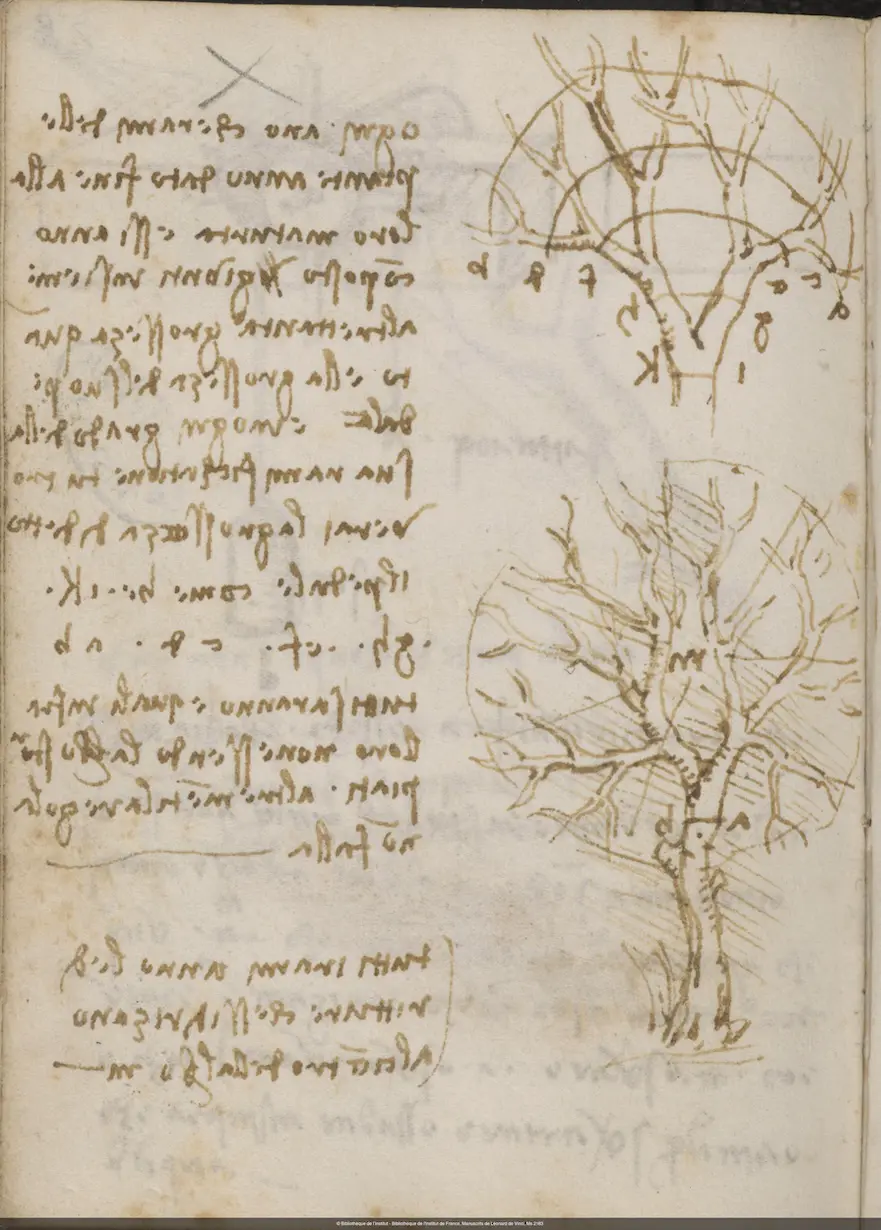
What is Leonardo da Vinci’s Rule of Trees?
Over 500 years ago, Leonardo da Vinci noticed a striking geometric pattern in how trees grow. He recorded it in his notebooks with a simple observation:
“All the branches of a tree at every stage of its height when put together are equal in thickness to the trunk.”
In simpler terms, if you take a tree trunk, slice it horizontally, and measure its cross-sectional area, that area will equal the combined cross-sectional area of all the branches if you sliced them at any height further up the tree.
The Mathematics Behind It
When a “mother” branch splits into smaller “daughter” branches, the total cross-sectional area is conserved. Because the area of a circle is proportional to the square of its diameter (\(A \propto d^2\)), the rule can be expressed mathematically as:
$$D^2 = d_1^2 + d_2^2 + \dots + d_n^2$$Where:
- \(D\) is the diameter of the parent branch or trunk.
- \(d_1, d_2, \dots, d_n\) are the diameters of the resulting branches after the split.
If a trunk splits into exactly two equal branches, each branch won’t be half the thickness of the trunk—instead, their diameters scale down by a factor of roughly \(1/\sqrt{2}\) (about 70% of the trunk’s thickness) to keep the total area the same. This creates a recursive, fractal-like structure that gives trees their organic, balanced look.
Why Do Trees Grow This Way?
While da Vinci originally came up with this rule as a guide to help artists paint more realistic landscapes, modern scientists have spent years trying to figure out why nature adheres to it. Two main schools of thought have emerged:
- The Hydrological (Vascular) Theory: Think of a tree as a massive bundle of microscopic drinking straws running from the roots to the leaves. To keep water flowing efficiently without bottlenecks, the total number of straws (and thus the total cross-sectional area) needs to remain constant from the bottom to the top.
- The Structural (Wind-Resistance) Theory: In 2011, physicist Christophe Eloy used wind-tunnel simulations to show that this exact branching ratio is mathematically perfect for resisting wind. It distributes mechanical stress evenly across the tree, keeping branches from easily snapping during heavy storms.
The Modern Verdict: Is it Absolute?
While da Vinci’s rule has been widely used for centuries by painters and modern 3D CGI artists to generate lifelike digital trees, recent science shows it isn’t completely perfect:
- The Exponent Varies: Real-world measurements show the exponent isn’t always a perfect 2. Depending on the tree species, age, and environment, the exponent typically ranges between 1.8 and 2.3.
- Micro-Level Breakdown: A 2023 study published in PNAS revealed that the rule actually breaks down at the tree’s furthest extremities (the twigs and leaves). At a microscopic level, trees must maintain “hydraulic resistance” to pump water to the very top, meaning the internal vascular structure must contract more than the rule predicts.
So, while it might slightly fail the strict micro-biology test at the very tips of the branches, as a macroscopic rule of thumb for art, physics, and nature-watching, Leonardo’s 500-year-old observation remains incredibly brilliant.