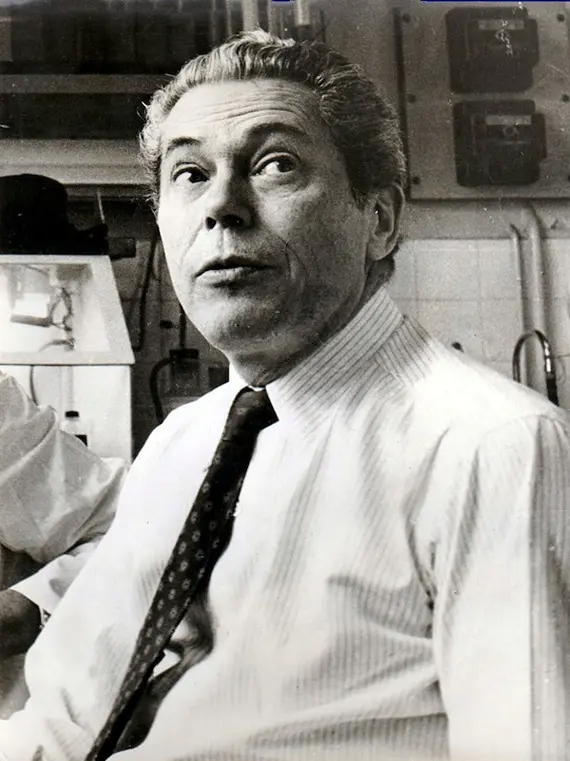
Jacques Monod published his philosophical treatise, Chance and Necessity, in 1970. He had already shared the Nobel Prize in Physiology or Medicine with François Jacob and André Lwoff for elucidating how cells regulate protein synthesis through messenger RNA — work that established molecular biology as one of the defining sciences of the century.
During the Nazi occupation of France, Monod led a double life. By day he designed experiments at the Pasteur Institute; by night he ran clandestine operations as a commander in the Forces Françaises de l’Intérieur. According to Sean B. Carroll, he coordinated acts of sabotage, organized the assassination of collaborators, and in the summer of 1944 helped direct the insurrectional operations that opened Paris to General Patton’s forces.
It was Monod who proposed the concept of allostery — now a cornerstone of biology — which describes how proteins can switch between distinct functional states depending on which regulatory molecules bind to them at sites structurally unrelated to the active site. The effect is something like an electrical control circuit built into the molecule itself. Agnès Ullmann, his colleague at the Pasteur Institute, recalls that late one evening in 1961 Monod walked into her laboratory looking tired and worried. He stood silently at her bench for several minutes before finally looking at her and saying: “I think I have discovered the second secret of life.” He was referring to allostery — the first secret, implicitly, being the double helix.
Chance and Necessity is a brilliant book. It is an essay in which Monod sets forth, with precision and genuine elegance, his conception of life as the product of inorganic mechanics and chemistry. He explores the role of macromolecules — proteins and nucleic acids — in the fundamental processes of all living beings, and explains the cellular cybernetic complexity that makes life possible with a clarity rare in scientific writing. What is striking is not just the scientific exposition but the philosophical honesty: Monod does not soften his conclusions. The fluidity of his analysis, the narrative coherence, the frank acknowledgment of epistemological limits — these attest to a mind unwilling to console itself with comfortable ambiguities.
It is true that Monod writes at times with what might be called philosophical boldness; as a result, Chance and Necessity — particularly in the chapters where he draws implications from biology for ethics and metaphysics — has attracted criticism from philosophers who found him reductionist or overreaching. One suspects that some of that criticism reflects professional resentment at a scientist entering a jealously guarded domain, or perhaps a residual attachment to anthropocentric worldviews that Monod quietly demolishes. What is not in doubt is that this is a classic of scientific literature: a work of profound ideas grounded in a nascent science of which its author was one of the principal architects.
Monod concludes that life is the result of chance — pure and unguided — and that, as the existentialists of his generation also maintained, the human situation is one in which no duty is written in advance. His closing image is stark and clarifying: “The kingdom above or the darkness below: it is for him to choose.”
Excerpts from Chance and Necessity
“It necessarily follows that chance alone is at the source of every innovation, and of all creation in the biosphere. Pure chance, absolutely free but blind, at the very root of the stupendous edifice of evolution: this central concept of modern biology is no longer one among many other possible or even conceivable hypotheses. It is today the sole conceivable hypothesis, the only one that squares with observed and tested fact. And nothing warrants the supposition — or the hope — that on this score our conceptions will, or ever could, be revised.”
“The ancient covenant is in pieces; man knows at last that he is alone in the universe’s unfeeling immensity, out of which he emerged only by chance. His destiny is nowhere spelled out, nor is his duty. The kingdom above or the darkness below: it is for him to choose.”
Author: Jacques Monod
Original title: Le Hasard et la Nécessité (1970) · English translation: Austryn Wainhouse, 1971
Publisher: Alfred A. Knopf · Genre: Scientific philosophy
Nobel Prize in Physiology or Medicine: 1965